Table of Contents
- Why Matching Office Desks Matter for Your Workspace
- Measure Your Space and Plan Your Desk Configuration
- A Practical Framework for Mixing and Matching Desk Styles
- Benefits of Pre-Owned Office Furniture for Desk Matching
- How to Navigate Bulk Office Furniture Procurement
- Sourcing Vintage and Second-Hand Matching Desk Sets
- Where to Buy Matching Office Desks
- Conclusion
- Frequently Asked Questions
Last Updated: September 22, 2026
Why Matching Office Desks Matter for Your Workspace
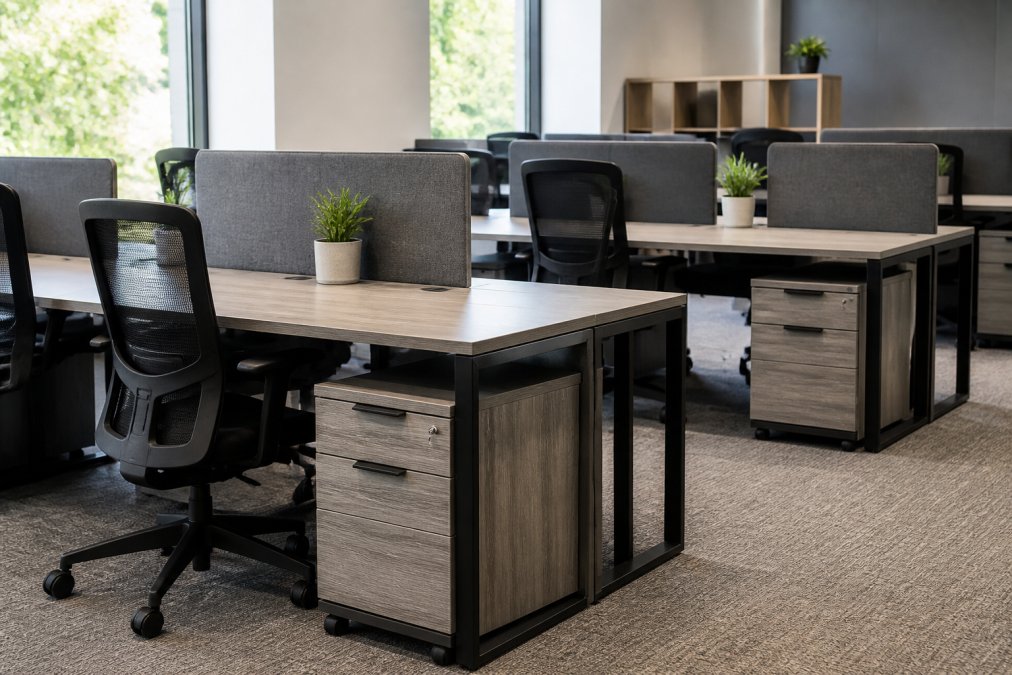
Matching office desks are one of the fastest ways to make a workspace look intentional rather than improvised. When every desk in a row shares the same finish, height, and edge profile, clients read competence before they read your pitch. At Office Furniture Warehouse, we have over 35 years of experience.
The case for consistency is practical, not just visual. Uniform desks simplify cable routing, make replacement easier when a unit wears out, and let you reconfigure a floor plan without hunting for a discontinued model. A mismatched cluster, by contrast, creates a subtle friction: visitors notice it even when they cannot name what feels off.
Below, we break down how to plan, measure, mix, and source matching desks without blowing a budget. The framework works whether you are furnishing 5 workstations or 50.
Measure Your Space and Plan Your Desk Configuration
Good sourcing starts with a tape measure, not a catalog. Before you buy anything, map the room and decide how many workstations it can hold without crowding. This is the step most buyers rush, and it is the one that determines whether your matching desks actually work in the space.
Room Dimensions and Traffic Flow
Walk the space and note door swings, windows, HVAC vents, and electrical outlets. A common mistake is measuring only the wall where desks will sit and ignoring the aisle. Leave at least 36 inches of clear circulation behind seated workers so chairs can push back without blocking a walkway. For primary walkways, aim for 44 to 48 inches.
Sketch the room on graph paper at scale, then block in each desk footprint. This small step prevents the most expensive error in office furnishing: buying desks that physically fit the wall but leave no room to move.
Desk Height and Work Surface Needs
Standard desk height in the United States sits between 28 and 30 inches, but the right number depends on your team and their chairs. A fixed-height desk paired with a non-adjustable chair locks every user into one posture, which is where discomfort starts. If you are mixing brands, measure the actual height of each candidate desk with a tape measure rather than trusting the spec sheet, manufacturing tolerances can vary by a quarter inch or more, and that difference is visible when desks sit side by side.
Work surface depth matters just as much. A 24-inch depth suits a laptop and a coffee cup. Anyone running dual monitors or handling paper files needs 30 to 36 inches. Measure the largest setup on your team, then buy for that, not the average.
The Measurement Checklist for Mixing Brands
When you are sourcing matching desks from more than one manufacturer, measure these five dimensions on every candidate and record them in a spreadsheet:
- Height: floor to top surface. Target a maximum variance of 0.25 inches across the set.
- Depth: front edge to back edge. A 6-inch difference between two desks in the same row reads as a mistake.
- Width: left to right. Standard single workstations run 48 to 60 inches; executive desks run 66 to 72 inches.
- Edge profile: square, beveled, or rounded. Measure the radius if rounded, a 1-inch radius next to a 0.25-inch radius looks mismatched even in the same finish.
- Leg or panel style: measure the thickness of legs or side panels. A 1-inch leg next to a 2-inch panel leg breaks visual continuity.
Buy one desk first, assemble it, and sit at it for a full workday before committing to a bulk order. It costs you a few days and saves you from repeating a bad decision across 20 workstations.
A Practical Framework for Mixing and Matching Desk Styles
Mixing and matching works when you anchor the design in three shared elements: finish, edge profile, and hardware. Match those three and you can vary size and shape freely without the room looking chaotic. But the deeper principle is visual weight distribution, how much of each color, material, and texture occupies the room.
The 60-30-10 Rule for Office Furniture
Interior designers use a simple proportion to keep mixed spaces cohesive: 60% dominant color, 30% secondary color, 10% accent (The Color Rule: 60-30-10). Applied to office desks:
- 60% dominant finish: Your primary desk finish, say, a warm walnut laminate, covers the majority of workstations and sets the visual baseline.
- 30% secondary finish: A complementary finish, perhaps a light oak or white, appears on storage credenzas, meeting tables, or a reception desk.
- 10% accent: A bold element, black metal legs, a colored chair, or a statement piece, adds energy without overwhelming.
Color Palette and Finish Consistency
Finish consistency is where most mixed setups fail. Two desks labeled “walnut” from different manufacturers rarely match, because wood grain, stain depth, and sheen vary by factory and batch.
Matching Wood Grains and Metal Finishes Across Manufacturers
This is the hardest part of mixing brands, and most guides skip it entirely. Here is how to do it:
- Wood grain direction: Check whether the grain runs vertically or horizontally on the desktop. A vertical-grain desk next to a horizontal-grain desk looks mismatched even if the stain is identical.
- Sheen level: Measure or ask for the sheen rating. Matte (10-20% gloss), satin (30-40%), and semi-gloss (50-60%) reflect light differently. Mixing sheens in the same color creates a subtle but noticeable inconsistency.
- Metal tone: “Black” metal can be matte black, satin black, or textured black. “Silver” can be brushed aluminum, chrome, or nickel. Bring a sample of your existing hardware when shopping so you can compare in person.
- Laminate vs. veneer: A wood-look laminate will never perfectly match a real wood veneer. If you are mixing, keep laminate and veneer in separate zones rather than side by side.
The 60-30-10 rule gives you a framework for mixing without chaos. Match grain direction, sheen, and metal tone across brands, and your mixed set will read as intentional rather than improvised.
Benefits of Pre-Owned Office Furniture for Desk Matching
Pre-owned furniture solves the matching problem that new retail often creates. Corporate liquidations release entire floors of identical desks at once, so you can buy 15 or 20 units that were manufactured in the same run and share an exact finish.
The benefits stack up quickly:
- Consistent batches. Decommissioned offices yield full sets, not one-offs.
- Durable materials. Commercial-grade desks from brands like Steelcase and Herman Miller are built for daily use.
- Budget headroom. Buying pre-owned frees money for ergonomic chairs and storage.
- Faster sourcing. A single liquidation can furnish a whole floor in one purchase.
How to Navigate Bulk Office Furniture Procurement
Bulk office furniture procurement rewards planning over speed. The goal is to buy every desk in one order, from one source, so finish and dimensions stay consistent across the whole floor.
Inventory Planning and Scalability
Think about growth before you sign. If you expect to add 5 desks next year, confirm your supplier can still source the same model. Ask directly whether the line is current or being phased out.
Never split a single order across two suppliers to save a few dollars. Even matching model numbers can differ by production year, and the finish mismatch will be visible the moment the desks sit side by side.
Sourcing Vintage and Second-Hand Matching Desk Sets
Vintage and second-hand sets are the best-kept shortcut to matching desks on a tight budget. Older steel tanker desks and mid-century wood models often survive in complete sets, because institutions bought them in bulk and retired them together.
Where to look:
- Corporate liquidations and office closures, which release full floors at once.
- University and government surplus sales, where durable commercial desks are sold in lots.
- Estate and institutional auctions, good for period pieces in matched pairs.
- Reputable pre-owned dealers, who clean, inspect, and guarantee condition.
The single biggest advantage of second-hand sourcing is batch consistency. A single liquidation gives you a matched set that no retail store can replicate at the same price.
Where to Buy Matching Office Desks
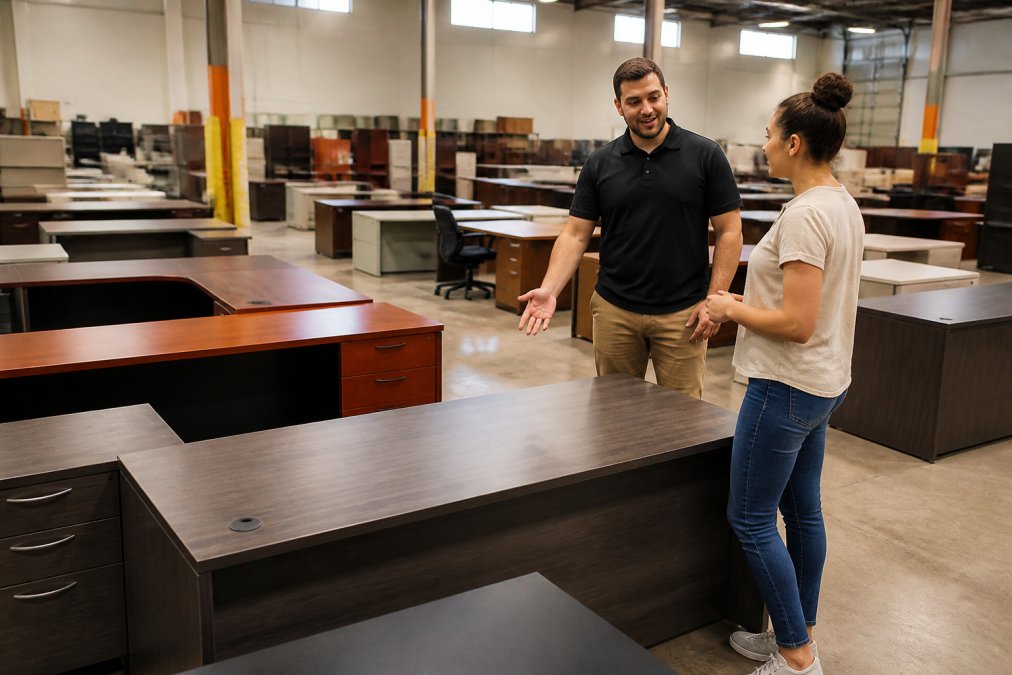
The best place to buy matching office desks is a supplier that holds large, single-batch inventory and lets you inspect it in person. Volume dealers who handle corporate liquidations can supply a full floor in one finish, which retail stores rarely can.
Conclusion
Sourcing matching desks comes down to discipline: measure first, anchor on one finish, and buy the full quantity from one batch. The teams that skip those steps end up with mismatched floors and replacement headaches.
Frequently Asked Questions
How do I ensure desk finishes match when ordering from different batches?
Finish consistency across batches is a real concern with wood grain and laminates. Request a physical sample from each batch before committing to a large order. If you are sourcing matching office desks from a pre-owned dealer, inspect the actual units in person or ask for detailed photos under consistent lighting. Dealers with large inventories, like Office Furniture Warehouse’s 4-acre warehouse, often have enough units from a single decommissioned office to keep finishes uniform.
What are the benefits of buying pre-owned matching office furniture?
Pre-owned office furniture often comes from corporate liquidations where entire floors were furnished at once, meaning you can find many identical desks with the same finish and dimensions. This makes it far easier to source matching office desks than buying new piece by piece. You also get access to premium brands like Steelcase and Herman Miller at a fraction of the cost, and the furniture is already assembled and proven durable.
How many desks should I order to ensure future scalability?
A common rule is to order 10-15% more desks than your current headcount to accommodate growth without scrambling for matching pieces later. If you are working with a pre-owned dealer, ask about their current inventory depth for the model you want. Bulk office furniture procurement from a single liquidation lot is the most reliable way to get identical desks now and have spares on hand for new hires.
Is it better to source desks from a single manufacturer or mix brands?
Single-manufacturer sourcing guarantees exact matches in finish, dimensions, and hardware, which simplifies assembly and replacement parts. However, if you are mixing and matching office furniture across a larger space, you can pair desks from different brands as long as you coordinate color palette and work surface height. Focus on visual consistency rather than brand loyalty, especially when sourcing pre-owned inventory where availability varies.
