Table of Contents
- Why Pre-Owned Office Furniture Makes Financial Sense in 2026
- Used Steelcase Chairs for Sale: Premium Ergonomics at a Fraction of Retail
- How to Inspect Used Office Chairs Before You Buy
- Refurbished Office Furniture vs Used: What’s the Difference?
- Sustainability and the Circular Economy: Reducing Your Environmental Footprint
- Immediate Availability, Quality Durability, and Design Flexibility
- Conclusion
- Frequently Asked Questions
Last Updated: September 23, 2026
Why Pre-Owned Office Furniture Makes Financial Sense in 2026
The benefits of buying pre-owned office furniture start with the balance sheet. Commercial-grade desks, chairs, and storage that once sold new at full retail can be acquired for a fraction of that outlay, and the savings land in the same fiscal year as the purchase. At Office Furniture Warehouse, we have over 35 years of experience helping procurement teams stretch fixed budgets across entire floors instead of single rooms by buying pre-owned first. This guide breaks down the real math, the inspection process, and the sustainability case, so you can decide with evidence rather than guesswork.
Cost Savings and Budget Efficiency for Growing Teams
A dollar spent on pre-owned furniture buys more furniture. That sounds obvious, but the multiplier matters for growing teams: a startup furnishing fifteen workstations can often cover the full floor with pre-owned pieces for what a partial new fit-out would cost. Budget-friendly does not mean compromised when the original build quality was commercial-grade to begin with.
Where teams get this wrong is treating furniture as a one-time line item instead of a budget lever. Every dollar saved on seating and desks is a dollar available for monitors, network infrastructure, or headcount. A common mistake is buying new for the front-of-house and pre-owned everywhere else, when the reverse often delivers a better-looking office for less.
Total Cost of Ownership and Tax Implications
Total Cost of Ownership (TCO) is the full cost of an asset across its life: purchase, delivery, assembly, maintenance, and eventual disposal. Pre-owned furniture frequently wins on TCO because the depreciation hit has already been absorbed by the first owner, while the usable service life remaining is often substantial.
On the tax side, office furniture is generally treated as a depreciable business asset, and many small purchases qualify for immediate expensing under current federal rules. Because thresholds and eligibility change, confirm the specifics with your accountant or the IRS guidance on business asset depreciation before you file.
Used Steelcase Chairs for Sale: Premium Ergonomics at a Fraction of Retail
Ergonomics is where pre-owned buying pays off most. A Steelcase chair built for eight-hour days holds its mechanical integrity far longer than a discount chair built for occasional use, so a pre-owned unit often delivers better ergonomic support than a brand-new budget model at the same price. That is the core case for buying used Steelcase chairs for sale rather than settling for cheap new seating.
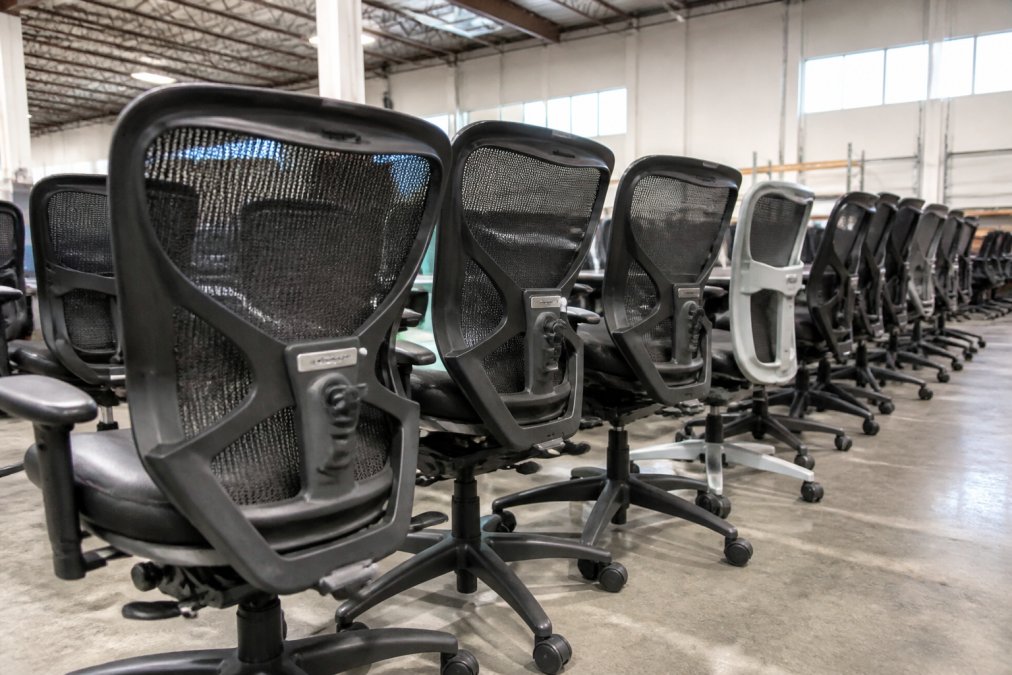
Check the gas cylinder first on any pre-owned task chair. Pump the seat up and down five times and listen for grinding. A failing cylinder is the single most common hidden defect, and it is the cheapest part to replace before it strands a user mid-day.
How to Inspect Used Office Chairs Before You Buy
Learning how to inspect used office chairs takes ten minutes per unit and saves months of replacement headaches. Work through the chair systematically rather than eyeballing it, because the failures that matter are mechanical, not cosmetic.
Mechanical Functionality and Upholstery Condition Checklist
- Gas cylinder: raises and lowers smoothly through full range, no grinding or drift
- Tilt mechanism: locks in every position and returns without a snap
- Armrests: adjust up, down, and in without wobble
- Base and casters: no cracks, all five wheels roll cleanly on carpet and hard floor
- Upholstery: no tears at stress points, foam recovers within a few seconds of compression
- Frame and welds: no rust, no bent supports, no creaking under full weight
- Ergonomic certification label: intact and legible, verifying the model’s original ANSI/BIFMA compliance
That last item is the one most buyers skip. Verifying the original ergonomic certification tells you the chair met recognized performance standards when new, which is a far better durability signal than any sales pitch.
Never buy a chair you cannot sit in and cycle through every adjustment. Online listings with a single photo hide cylinder failure, torn foam, and cracked bases, and those repairs often cost more than the chair did.
Refurbished Office Furniture vs Used: What’s the Difference?
Refurbished office furniture has been inspected, repaired, cleaned, and often reupholstered before resale, while used furniture is sold as-is in whatever condition it arrived. The distinction determines your warranty, your risk, and how much work lands on your team. The problem is that “refurbished” has no single legal definition in the resale market, so two sellers can use the same word to describe very different processes.
What a Real Refurbishment Process Includes
A credible refurbishment is a documented, repeatable process rather than a quick wipe-down. Ask the seller to walk you through each step:
- Inspection. Every unit is examined for structural damage, cracked bases, bent frames, and failed mechanisms before anything else happens.
- Mechanical repair or replacement. Gas cylinders, tilt mechanisms, casters, and armrest adjustments are repaired or replaced, not merely tested.
- Upholstery and foam. Torn fabric is reupholstered, and compressed or collapsed foam is replaced so the seat recovers its shape and support.
- Surface refinishing. Laminate, veneer, and metal surfaces are cleaned, touched up, or refinished to remove scratches and edge damage.
- Cleaning and sanitization. Fabric and hard surfaces are cleaned to remove dust, odors, and residue from prior use.
- Function testing. Every adjustment is cycled through its full range before the piece is released for sale.
Warranty Terms to Verify Before You Buy
- What is covered? Mechanical parts, upholstery, and structural components are often treated differently. Get the coverage list in writing.
- How long does it last? Terms vary widely, from a short parts-only window to multi-year coverage on specific components.
- Who performs the repair? On-site repair, return-to-seller, or parts shipped to you are very different experiences.
- What voids it? Improper assembly, unauthorized repair, or use outside the intended environment can void coverage.
| Factor | Refurbished | Used (As-Is) |
|---|---|---|
| Condition | Repaired, cleaned, tested | Unmodified, variable |
| Warranty | Typically included, terms vary | Often none |
| Price | Higher | Lowest |
| Best for | Client-facing spaces | Back-office, tight budgets |
| Risk | Low | Buyer inspects and assumes |
| Verification | Ask for process documentation | Inspect every unit yourself |
“Refurbished” is not a regulated term. A seller can use it without performing any of the steps above. Always ask for the process in writing and confirm the warranty terms before you commit.
Modular furniture adds design flexibility here. Because most commercial systems share panel and component dimensions across product lines, pre-owned modular pieces can be reconfigured into new office layouts as your team grows, without buying a whole new system.
Sustainability and the Circular Economy: Reducing Your Environmental Footprint
Every pre-owned desk that stays in service is one less desk manufactured and one less sent to landfill. The circular economy framing is not marketing: extending the asset lifecycle of durable goods is one of the most direct ways a facilities team can shrink its environmental footprint without changing how the office functions.
The greenest office chair is the one already built. Extending a commercial-grade asset’s service life avoids the manufacturing footprint entirely, which no recycled-content new product can match.
Immediate Availability, Quality Durability, and Design Flexibility
Supply chain delays have made lead times a real planning risk. Pre-owned inventory is sitting on a showroom floor today, which means you can walk the space, confirm the count, and schedule delivery in days rather than months. That availability advantage is often worth more than the price savings alone.
Lead Times vs. Inventory Availability
New furniture orders routinely run into extended production and shipping windows, and a single backordered component can stall an entire floor. Pre-owned inventory availability removes that variable: what you see is what ships. For teams on a fixed move-in date, that certainty is the deciding factor.
Warranty and Refurbishment Standards to Verify
Ask any pre-owned seller two questions before you commit. First, what refurbishment standard did the piece meet: inspection only, or full mechanical and upholstery reconditioning? Second, what warranty covers it, and for how long? A written warranty and a documented refurbishment process separate a professional operation from a warehouse clearing space.
Conclusion
Furnishing a growing office on a fixed budget forces a choice between less furniture and smarter sourcing. Office Furniture Warehouse has over 35 years of experience helping teams make the second choice, with a massive 4-acre inventory of new and pre-owned seating, desks, and storage from brands like Steelcase and Herman Miller at up to 80% off. Our expert design and layout planning services help you fit premium commercial-grade furniture into your budget, with flexible pickup or delivery options to match your timeline.
Frequently Asked Questions
Is buying used office furniture worth it?
For most businesses, yes. Pre-owned office furniture delivers commercial-grade quality at a fraction of new retail pricing, and because it is already in inventory, you avoid the supply chain delays that stretch new furniture lead times to weeks or months. The key is buying from a supplier that inspects mechanical functionality, verifies ergonomic support, and stands behind the product with a warranty.
What should I look for when buying pre-owned office furniture?
Check mechanical functionality first: chair cylinders, tilt locks, and arm adjustments. Inspect upholstery for tears, stains, or odor. Confirm the piece meets BIFMA standards for durability. For desks, test drawer slides and check for structural wobble. Ask about sanitization procedures and whether the seller offers any warranty or return policy. A reputable dealer will let you test items before purchase.
How much money can you save by buying used office furniture?
Savings depend on the brand, condition, and quantity you need. Pre-owned pieces from top-tier brands like Steelcase and Herman Miller often sell for significantly less than new equivalents, which lets you fit premium ergonomic support into a startup or renovation budget. Request a quote from the seller with your specific workstation count for accurate numbers.
Does pre-owned office furniture come with a warranty?
It depends on the seller. Some dealers offer limited warranties on refurbished items, covering mechanical parts or structural integrity for a set period. Others sell as-is condition with no guarantee. Always ask upfront what the warranty covers, how long it lasts, and what the claims process looks like. A seller with decades in business is more likely to stand behind their inventory.
