Table of Contents
- The Real Math: Cost Savings vs. New Furniture
- Quality and Durability: What You Actually Get with Used Office Furniture
- How to Inspect Used Office Furniture Before You Buy
- Where to Find Reliable Used Steelcase Chairs for Sale
- Ergonomic Features That Survive the Secondhand Market
- Depreciation, Resale Value, and Total Cost of Ownership
- Warranty, Returns, and Sustainability: What Buyers Often Miss
- Frequently Asked Questions
Last Updated: September 14, 2026
The Real Math: Cost Savings vs. New Furniture
Is used office furniture worth it? For most small businesses and facility managers, yes, provided you inspect before you buy. Pre-owned inventory sells for a fraction of new retail, and the gap widens on premium brands built to last decades. This guide from Office Furniture Warehouse covers the numbers, the inspection process, and the hidden costs.
Separate the two costs that matter: acquisition and lifecycle. A new high-end task chair’s retail price reflects manufacturing, freight, dealer margin, and warranty reserve. A secondhand unit from the same production line carries only the resale price, because the original buyer absorbed everything else, which is why pre-owned commercial grade furniture can land at a fraction of new pricing while delivering the same daily function.
Where buyers get burned is ignoring the second number. Cheap furniture that fails in eighteen months costs more than quality furniture bought once.
| Factor | New Furniture | Used Office Furniture |
|---|---|---|
| Upfront cost | Full retail | Fraction of retail |
| Lead time | Weeks to months | Often same-week pickup |
| Warranty coverage | Full manufacturer term | Limited or as-is |
| Depreciation | Immediate and steep | Already absorbed |
| Sustainability | New materials, new packaging | Diverted from landfill |
The savings on used furniture are real, but they only hold if you verify condition before purchase. A cheap chair with a failing pneumatic cylinder is not a bargain, it is a future replacement.
Quality and Durability: What You Actually Get with Used Office Furniture
Commercial grade furniture is built to survive years of daily use, which is why the secondhand market works. Steelcase, Herman Miller, and similar manufacturers engineer task chairs and cubicles for high-cycle environments: eight-hour shifts, repeated adjustments, constant movement. A chair that spent five years in a corporate office has consumed only part of its designed service life.
Foam density is the clearest signal of remaining durability. High-density foam in a quality seat cushion compresses slowly and recovers its shape; low-density foam collapses into a permanent dip within a couple of years. When you sit in a used chair, check whether the cushion rebounds when you stand. If it stays flat, the foam is spent.
Upholstery tells a similar story. Fabric durability is rated in double rubs, and commercial textiles are tested far beyond residential standards (astm.org). Pilling or fading is cosmetic; fraying at seams, tears at stress points, or exposed backing are structural warnings.
The one component that ages fastest is the gas lift. A pneumatic cylinder loses pressure gradually, and a chair that sinks under your weight within seconds of adjustment is near the end of that part’s life. Cylinders are replaceable, but factor the cost and effort into your offer.
How to Inspect Used Office Furniture Before You Buy
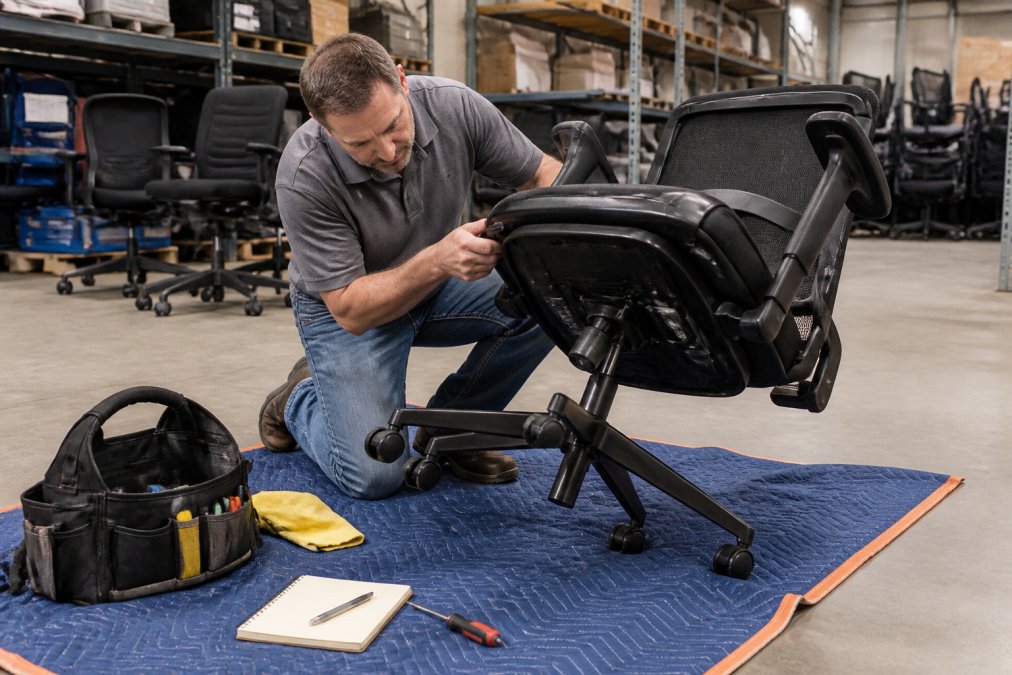
Inspection is where a good deal is confirmed or killed, and it takes about ten minutes per chair once you know what to look for. Work through structure first, then moving parts, then cosmetics, buyers who reverse that order pay for looks and replace mechanics.
Most buying guides tell you what to look at without telling you what passes and what fails. The checklist below adds a pass/fail standard to each item, so the inspection produces a decision rather than a feeling.
The Onsite Inspection Checklist
Use this checklist on every unit before money changes hands.
Structure and frame
- Pneumatic cylinder: raise the chair to full height and sit down firmly. Pass if it holds height with no slow sink. Fail if it sinks within seconds or drops immediately.
- Five-star base and hub: rock the chair side to side while seated. Pass if there is no lateral play at the hub. Fail if the base wobbles, the hub shows cracks, or any leg flexes independently.
- Seat pan and frame: tilt the chair and inspect the underside. Pass if the pan is rigid and the mounting bolts are present and tight. Fail on cracked laminate, bent steel, or missing hardware.
- Backrest attachment: apply gentle pressure to the top of the backrest. Pass if it holds firm through the tilt range. Fail if the bracket flexes or the backrest separates from the frame.
Moving parts and adjustments
- Seat height: cycle through the full range. Pass if it moves smoothly and locks at each position. Fail on grinding, sticking, or a lever that does nothing.
- Arm height and width: adjust each arm independently. Pass if both move and hold. Fail if one arm is seized or drifts under load.
- Seat depth: slide the seat forward and back. Pass if it locks in position. Fail if it slides freely under body weight.
- Tilt tension and tilt lock: adjust tension and engage the lock. Pass if tension changes and the lock holds. Fail if the chair reclines without resistance or will not lock upright.
- Lumbar support: adjust it and press against it. Pass if it moves and holds position under pressure. Fail if it no longer locks, which is worse than a fixed lumbar curve.
- Casters: roll the chair across the floor in both directions. Pass if all five roll freely and swivel. Fail on flat-spotted, seized, or missing casters.
Upholstery, foam, and cosmetics
- Seat foam: press the cushion firmly and release. Pass if it rebounds within a second or two. Fail if it stays compressed or you can feel the seat pan through the foam.
- Upholstery seams: check stress points at the front edge, backrest, and armrests. Pass if seams are intact. Fail on fraying, tears, or exposed backing.
- Surface condition: pass on pilling, fading, or minor scuffs, which are cosmetic. Fail on cracks in plastic shells, delamination of laminate, or rust bleeding through powder coat.
Desks, storage, and casegoods
- Desk underside: inspect for cracked laminate, bent frames, and missing assembly hardware. Pass if the structure is sound. Fail on water damage, swollen particleboard, or a frame that flexes under hand pressure.
- Drawers and doors: open and close every one. Pass if slides and hinges run without grinding and the unit closes flush. Fail on misaligned fronts, broken slides, or doors that will not stay closed.
- Locking systems: test every lock and key. Pass if the lock engages and the key turns smoothly. Fail if keys are missing or the lock is seized, since replacement locks are a recurring hidden cost.
Bring a flashlight and a tape measure. The flashlight reveals hairline cracks in chair bases and desk frames that overhead lighting hides, and the tape measure confirms a used desk will actually fit your floor plan before you commit to delivery. A small level is worth adding for casegoods, because a desk that rocks on a flat floor usually has a bent frame rather than an uneven floor.
How to Score the Inspection and Set Your Offer
A checklist is only useful if it produces a number. Score each unit on the three categories above and assign a tier.
- Tier 1, buy at asking price: all structural and mechanical items pass, foam rebounds, upholstery intact.
- Tier 2, buy with a price adjustment: mechanics pass but foam is compressed, upholstery is frayed, or casters need replacing. Estimate the parts and labor to fix, and deduct that from your offer.
- Tier 3, pass: any structural failure, a dead cylinder combined with compressed foam, or a cracked base. Repair cost approaches the value of the unit.
A common mistake is buying the cheapest matching lot without testing adjustment mechanisms. A set of fifteen chairs with four failing cylinders looks like a bargain until you are sourcing replacement parts and paying for labor within the first year. Score every unit individually, even in a matched lot, because condition varies chair to chair regardless of how uniform the set looks from across the room.
Where to Find Reliable Used Steelcase Chairs for Sale
The most reliable source for used Steelcase chairs for sale is a dealer that handles corporate decommissioning directly, because those units come from single-owner offices rather than mixed auction lots. When a company downsizes or relocates, its entire inventory leaves at once, matching models, consistent condition, known service history.
That matters more than most buyers realize. Auction sites sell chairs one at a time, so furnishing fifteen matching workstations becomes a months-long scavenger hunt. A dealer with large physical inventory can supply a consistent set in a single visit.
Office Furniture Warehouse has operated in this space for over 35 years, with a four-acre inventory of new and pre-owned furniture including Steelcase and Herman Miller models. For procurement teams furnishing multiple workstations, that scale means inspecting an entire matching set in person rather than gambling on individual listings, and sitting in a chair before buying, which online sellers cannot offer.
A common mistake is buying the cheapest matching lot without testing adjustment mechanisms. A set of fifteen chairs with four failing cylinders looks like a bargain until you are sourcing replacement parts and paying for labor within the first year.
Ergonomic Features That Survive the Secondhand Market
Ergonomic value is the strongest argument for buying pre-owned, because the features that prevent injury are mechanical and inspectable. A used chair with working adjustments delivers the same posture support as a new one at a fraction of the cost, provided each mechanism still functions through its full range.
Adjustable Features and Lumbar Support
Seat height, arm height, seat depth, and tilt tension matter most for daily comfort. Test each at the top and bottom of its travel. Stiffness is normal and often improves with use; grinding, sticking, or a dead lever signals a broken mechanism.
Lumbar support should move when adjusted and hold position under pressure. Fixed lumbar curves on older models are still effective, but an adjustable one that no longer locks is worse than a fixed one.
Pneumatic Cylinder and Base Stability
The pneumatic cylinder is the most failure-prone component on any task chair, new or used. Raise the chair to full height and sit down firmly: a healthy cylinder holds, a failing one sinks slowly, a dead one drops immediately.
Base stability comes down to the five-star base and its hub. Commercial grade bases in reinforced nylon or aluminum outlast cheap replacements by years. Rock the chair while seated; lateral play at the hub means the base is compromised, pass on it.
Depreciation, Resale Value, and Total Cost of Ownership
New office furniture depreciates the moment it is delivered, steepest in the first year. That is the core insight behind the secondhand market: the original buyer absorbs the depreciation, and the second buyer captures the remaining utility at a lower price.
Total cost of ownership decides whether used furniture is worth it. Add purchase price, refurbishment, delivery, and expected replacement parts over your ownership period, then divide by expected years of service. A used commercial grade chair needing a new cylinder in year three still usually beats a new budget chair replaced in year two.
Lifecycle Cost Analysis for Secondhand Furniture
Run this comparison before any large purchase:
- Estimate years of service you need from each unit
- Add purchase price plus delivery and any refurbishment cost
- Subtract expected resale value at the end of your ownership
- Divide the total by years of service for an annual cost figure
Refurbishment versus as-is is the main variable. A reupholstered chair with a replaced cylinder costs more upfront but resets much of its service life; an as-is unit is cheaper today and carries more risk.
Warranty, Returns, and Sustainability: What Buyers Often Miss
Warranty coverage is the biggest structural difference between new and used, and the term most buyers fail to pin down before money changes hands. New commercial furniture carries the manufacturer’s full term, commonly 12 years on premium task chairs, and lifetime on some components (Warranty). Pre-owned furniture almost never transfers that coverage, because most manufacturer warranties are written for the original purchaser and void on resale. What you get instead falls into one of three buckets.
| Warranty Type | What It Typically Covers | What It Excludes |
|---|---|---|
| As-is, no warranty | Nothing after pickup | Everything, including defects present at sale |
| Limited dealer warranty | Functional mechanisms for a set window, often 30 to 90 days | Cosmetic wear, upholstery, user damage, normal cylinder decline |
| Refurbished with parts warranty | Replaced components such as cylinders, casters, and gas lifts | Original frame and foam unless reupholstered |
Ask four questions at the point of sale and get the answers in writing on the invoice or quote: What is covered, for how long, who pays return freight, and whether the seller repairs, replaces, or refunds. A verbal “we stand behind it” is not a warranty. A written 60-day mechanism guarantee with a defined remedy is.
Returns work differently on used inventory. New furniture sold through a dealer usually carries a restocking fee, often 15 to 25 percent, plus return freight. Used furniture is frequently final sale. If a seller does accept returns, confirm the window in days, whether original packaging is required, and whether delivery charges are refunded. For multi-unit orders, ask whether returns are handled per unit or only as a full lot.
A limited dealer warranty that covers “mechanisms” but excludes the pneumatic cylinder is close to worthless, because the cylinder is the part most likely to fail. Read the exclusion list before you read the coverage list.
Sustainability and Hygiene: The Numbers Behind the Green Claim
Sustainability is the benefit buyers underrate, and the one they most often state without evidence. The concrete case rests on two measurable effects: avoided manufacturing and avoided landfill. Every pre-owned desk and chair that stays in service is one fewer unit manufactured from virgin steel, plastic, and foam, and one fewer entering the waste stream at end of life. Commercial furniture is bulky and slow to decompose, so diversion has an outsized landfill impact.
For organizations tracking procurement against environmental reporting goals, secondhand furniture is one of the few purchases that cuts cost and embodied carbon at once. Document it: record units diverted, approximate weight kept out of landfill, and purchase price versus new retail. That gives a facilities or sustainability team a defensible line item rather than a vague green claim.
Hygiene kills more used-furniture deals than condition does. Chairs and desks used by multiple people should be cleaned and prepared before resale, and buyers in healthcare, childcare, and food-service settings should treat this as a hard requirement. Ask the seller three things: what cleaning agents are used, whether upholstery is treated or replaced, and whether high-touch surfaces such as armrests, adjustment levers, and drawer pulls are included. A seller who cannot describe the process in specific terms does not have one.
Request the sanitization method in writing alongside the warranty terms. For hygiene-sensitive buyers, the cleaning protocol matters as much as the condition of the foam, and a documented process is easier to defend to a safety officer than a verbal assurance.
Lifecycle Cost Analysis: The Five-Year TCO Comparison
This is the calculation most buying guides skip, and the one that actually answers whether used furniture is worth it. Upfront price is a single number; total cost of ownership decides the purchase. Run it over a five-year horizon, long enough to capture a cylinder replacement, short enough to stay realistic.
Build the model with four inputs for each option:
- Purchase price per unit, including delivery and any assembly
- Refurbishment or repair cost expected during the ownership window
- Residual value at the end of five years, if any
- Annual cost, calculated as (purchase + repairs − residual) ÷ 5
A common pattern: a new budget task chair at entry-level retail may need full replacement within two to three years under daily eight-hour use, buying it twice inside the five-year window. A used commercial grade chair from a premium line may cost a comparable amount upfront, need one cylinder replacement in year three, and still be serviceable in year five. The used chair wins on annual cost even after the repair, because the frame, base, and foam were engineered for a longer service life.
The variables that flip the result are condition and refurbishment scope. An as-is unit with a failing cylinder and compressed foam is not a bargain at any price, because you inherit the repair immediately. A refurbished unit with a replaced cylinder and reupholstered seat resets much of its service life and typically produces the lowest annual cost.
Compare options on annual cost over five years, not on sticker price. The cheapest chair on the floor is frequently the most expensive one to own, because it is the one you buy twice.
U.S. Environmental Protection Agency resources on waste reduction and materials management
Frequently Asked Questions
What should I look for when buying used office furniture?
Inspect structural integrity, foam density, fabric durability, and assembly hardware. Test adjustable features like lumbar support and pneumatic cylinders. Check for cracks in the base and ensure all parts move smoothly. Ask about warranty coverage and the furniture’s previous use. A thorough inspection helps you avoid pieces with hidden mechanical failure or excessive wear and tear.
Is it worth buying a used high-end office chair?
Yes, if you inspect it carefully. High-end brands like Steelcase and Herman Miller are built with commercial-grade materials that last for years. A used Steelcase chair often costs a fraction of the new price while offering the same ergonomic benefits. Check the pneumatic cylinder, base stability, and upholstery condition. Many used chairs still have years of reliable service left.
What are the risks of buying pre-owned office equipment?
Risks include hidden wear and tear, mechanical failure of moving parts, and voided warranties. Some pieces may have been in heavy use and could need refurbishment soon. Without proper sanitization, hygiene can be a concern. Buying from a reputable dealer that offers quality assurance and a return policy reduces these risks significantly.
Does used office furniture hold its value?
Used office furniture depreciates more slowly than new furniture. After the initial drop from retail price, quality pieces from top brands retain a significant portion of their resale value. Commercial-grade items like task chairs and office cubicles often hold value well because demand remains steady. Proper care and maintenance help preserve resale value over time.
