Last Updated: November 6, 2026
Quick Summary
Space saving filing systems for home offices work best when matched to your layout: a compact two-drawer cabinet suits most home offices, under-desk rolling units fit tight floor plans, and wall-mounted files or binders work when you have no floor space to spare. Mixing two formats, such as a desktop sorter plus binders on a shelf, often beats forcing one cabinet into a small room.
- Measure floor width, drawer pull-out clearance, and height under windows or shelves before ordering a cabinet.
- A drawer typically needs its own depth again in clearance to open fully.
- Check that under-desk rolling unit casters lock, or the unit will drift when you open a drawer.
- A standard magazine file is about 4 inches wide and holds one binder’s worth of loose paper.
- Label the tab rather than the folder front, since tabs are what you see in a drawer.
Table of Contents
- Quick Comparison: Space Saving Filing Systems at a Glance
- Home Filing System Ideas That Fit Real Workspaces
- Compact Filing Cabinet with Drawers: What to Measure Before You Buy
- Under-Desk File Storage: Reclaim Floor Space Without Losing Access
- Filing Cabinet Alternatives for Small Spaces
- Paper Organization: Labels, Tabs, and Color-Coded Filing
- Budget Tiers and Total Cost for a Home Filing Setup
- Choosing Your Space Saving Filing System at Office Furniture Warehouse
- Frequently Asked Questions
Quick Comparison: Space Saving Filing Systems at a Glance
If you work from home, you know the struggle: paperwork piles up faster than you can file it, and floor space disappears with every new folder.
Here is the short version. A compact two-drawer cabinet suits most home offices. Under-desk rolling units can be a good option when floor space is tight.
| Option | Footprint | Best For | Access Style |
|---|---|---|---|
| Two-drawer cabinet | Small, roughly 12-20 inches wide | Standard home offices | Pull-out drawers |
| Four-drawer cabinet | Tall but narrow | High paper volume | Stacked drawers |
| Under-desk rolling unit | Fits beneath a desk | Tight floor plans | Mobile, roll-out |
| Wall-mounted file | Zero floor space | Small rooms, apartments | Open or covered racks |
| Desktop sorter | Countertop only | Active daily paperwork | Tiered slots |
| Binders and shelves | Shelf space only | Low-volume, long-term | Spine-out on shelves |
Below, we break down each format so you can match one to your room, your paperwork, and your budget.
Home Filing System Ideas That Fit Real Workspaces
A home filing system is any organized method for storing and retrieving paper documents in a home office, from a single desktop tray to a full cabinet wall. The best system matches your storage format to the space you actually have.
Most home offices fall into one of three layouts, and each points to a different answer:
- A dedicated room with a closed door: a compact filing cabinet with drawers gives you secure, dust-free storage and a clean look.
- A corner of a bedroom or living area: under-desk storage and vertical wall files keep paperwork out of sight without stealing floor.
- A shared or multi-use space: binders on a shelf and a small desktop sorter let you pack everything away when guests arrive.
Start by counting your active files. For a full walkthrough, see our step-by-step guide on how to organize a compact home office.
Compact Filing Cabinet with Drawers: What to Measure Before You Buy
A compact filing cabinet with drawers is the workhorse of home office storage, but only if it fits. Measure three things before you order: the width of your open floor, the depth of the cabinet plus the clearance needed to pull a drawer fully open, and the height of the space under any window or shelf.
A drawer typically needs its own depth again in clearance to open. A drawer also needs clearance to open fully, so measure the room before you buy.
Two-Drawer vs. Four-Drawer Cabinets
Two-drawer cabinets suit most home offices. They sit lower, double as a surface for a printer, and take up less vertical wall space.
For many home offices, a two-drawer unit is a practical choice unless you are storing years of records. If you are short on floor space, a four-drawer cabinet can be the smarter pick because it stacks storage upward instead of spreading it out.
Vertical vs. Lateral Filing
Vertical filing uses drawers that pull toward you, with folders arranged front to back. Lateral filing uses wider drawers where folders hang side to side, which suits long runs of wall space. Vertical cabinets are narrower and fit small rooms better.
Under-Desk File Storage: Reclaim Floor Space Without Losing Access
Under-desk file storage can add filing capacity without adding a piece of furniture to your room. A rolling two-drawer cabinet slides beneath the desk and disappears from view, and you keep the full surface above for actual work.
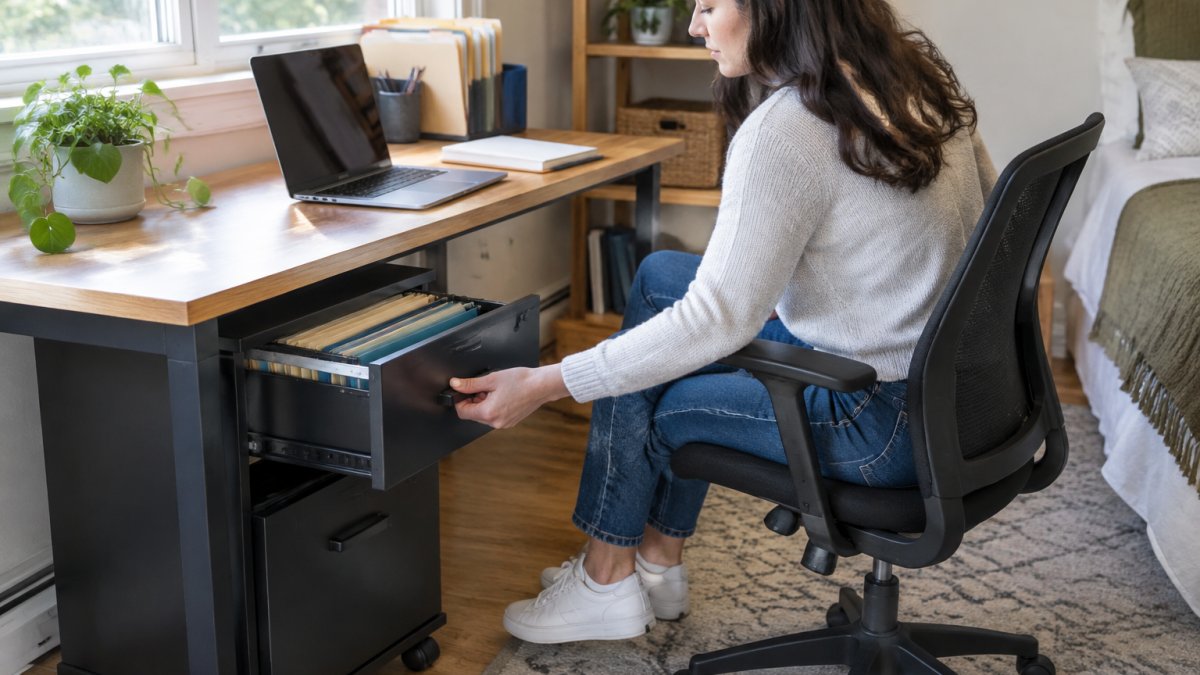
Before you buy a rolling unit, check the clearance under your desk and the height of the unit with its casters. Our guide to managing cables in a home office helps you keep the space tidy once the cabinet is in place.
Best for: tight floor plans where every square foot counts.
Skip if: your desk has a center support or drawer bank that blocks the space.
Filing Cabinet Alternatives for Small Spaces
When there is no floor space for a cabinet, the alternatives carry the load. Below is a format-by-format comparison of common small-space filing options.
Wall-Mounted Files
A wall-mounted file uses vertical wall space you are not using anyway.
Mount them at eye level or slightly below so you can read tabs without stretching.
Best for: apartments, shared rooms, and any layout where the floor is fully committed.
Watch out: wall files are open to dust and casual view, so keep sensitive documents in a closed binder or lockable box instead.
Desktop Sorters
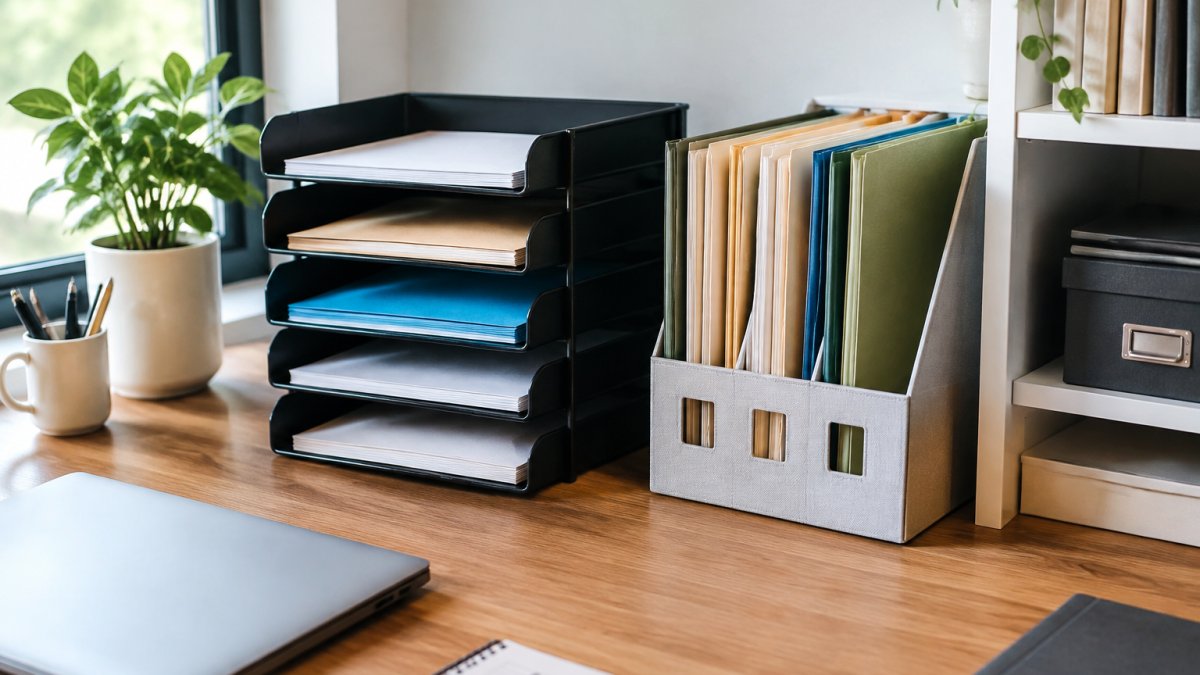
Desktop sorters are tiered trays or multi-pocket organizers that sit on the desk and hold the papers you touch daily.
They are not for archives. Use one tier or pocket for “to file,” one for “to act on,” and clear it weekly.
Best for: daily paperwork you need within arm’s reach.
Skip if: your desk is shallower than about 24 inches or you already use the surface for a printer.
Binders and Shelf Files
Binders remain the most space-efficient option for low-volume, long-term paperwork.
Shelf files and magazine files work similarly: a standard magazine file is about 4 inches wide and holds one binder’s worth of loose paper or a few folders. Binders are slower to update than a drawer, so reserve them for documents you rarely change, such as tax returns, insurance policies, and warranties.
Best for: archival and annual records where retrieval is infrequent.
Watch out: overfilled binders tear at the rings and bow on the shelf, so move to a larger binder rather than cramming a 2-inch ring past its capacity.
Format-by-Format Comparison
| Format | Typical footprint | Usable capacity | Floor space | Best use |
|---|---|---|---|---|
| Wall-mounted multi-pocket rack | 12-14 in. wide, 30-40 in. tall, 3-5 in. deep | 500-1,500 sheets | None | Active files in tight rooms |
| Desktop sorter (3-tier) | 10-13 in. wide, 9-14 in. deep | 450-750 sheets | None (desk only) | Daily paperwork |
| Binders on one shelf | 36 in. of shelf, 12 in. deep | 3,500-5,000 sheets | None (shelf only) | Long-term and archival |
| Under-desk rolling cabinet | 12-15 in. wide, 18-22 in. deep | 1,500-3,000 sheets | About 2 sq. ft. | Secure, frequent access |
Mixing two formats usually beats forcing one cabinet into a room that cannot take it. A common pattern is a desktop sorter for the week’s paperwork plus binders on a shelf for everything older, covering active and archival needs with no floor space at all.
For a broader set of small-space storage ideas beyond filing, our roundup of the best office storage solutions for decluttering small spaces covers shelving, bins, and vertical options that pair well with any of these formats.
Paper Organization: Labels, Tabs, and Color-Coded Filing
Paper organization lives or dies on labeling. A cabinet full of unlabeled folders is just a tidier pile.
Set up your categories first. Common ones include financial, legal, medical, property, and personal. Assign each category a color, then apply color-coded labels to every folder and matching tabs to the hanging files behind them.
A few habits keep the system working:
- Label the tab, not the front. Tabs are what you see when folders sit in a drawer.
- Use pre-printed labels for recurring categories so every folder matches.
- Create a self-purging file for anything with a review date, and clear it on a set schedule.
The goal is document retrieval in seconds, not a perfect archive. If you can find a document without emptying a drawer, your labels are doing their job.
Budget Tiers and Total Cost for a Home Filing Setup
Cost depends on format, not just size, and the supplies that make a system work often cost as much as the storage itself. Pricing depends on format, quantity, and current availability. Check Office Furniture Warehouse’s website or request a quote for current prices.
Entry Tier: Under $100
A desktop sorter, a few wall pockets, and a starter set of binders can set up a functional system for very little.
- Three-tier desktop sorter: $15-$40
- Multi-pocket wall rack: $20-$45
- One-inch binders: $4-$10 each
A realistic entry setup with one sorter, one wall rack, six binders, a box of folders, and labels lands around $90-$150. This tier suits light paperwork and zero floor space.
Mid Tier: $100-$300
A compact two-drawer cabinet or a rolling under-desk unit adds secure, dust-free storage and room to grow.
- Two-drawer letter-size cabinet: $80-$200
- Rolling under-desk cabinet: $70-$180
- Hanging files and folders to fill it: $25-$50
A mid-tier setup with one cabinet and supplies typically runs $120-$270. This is the sweet spot for most home offices: enough capacity for several years of active records without committing a wall.
Full Tier: $300 and Up
A four-drawer cabinet or a matched cabinet-and-shelf setup gives maximum capacity for heavy records.
- Four-drawer letter-size cabinet: $200-$500
- Lateral four-drawer cabinet: $300-$700
- Shelving unit: $80-$250
A full-tier setup with one cabinet, shelving, and supplies generally runs $350-$900. Pre-owned cabinets from brands like Steelcase and Herman Miller can cut the cabinet cost substantially while keeping the same capacity.
The Extras That Quietly Add Up
Budget-conscious shoppers building a whole workspace should read our guide on setting up an ergonomic home office on a budget to keep total spend in check.
Choosing Your Space Saving Filing System at Office Furniture Warehouse
The right system comes down to three questions: how much paper you keep, how much floor you can spare, and how often you need access. Answer those honestly and the format picks itself.
At Office Furniture Warehouse, we help home office users and businesses find quality storage for their workspaces. If you are furnishing a full small office, browse our office furniture sets for small home offices to match your filing setup with a desk and chair that fit the room.
Frequently Asked Questions
What is the best filing system for a small home office?
The right system depends on how much paper you keep and how much floor space you have. A compact two-drawer cabinet works for most home offices, while under-desk rolling cabinets and wall-mounted files suit rooms where floor space is tight. Measure your available footprint first, then match the format to your document volume. Many home offices combine a small cabinet for active files with binders or desktop sorters for reference paperwork.
How can I organize paperwork in a home office with limited space?
Start by sorting paperwork into three groups: active, reference, and archive. Keep only active files within arm’s reach in a compact cabinet or desktop sorter, move reference material to binders or wall-mounted files, and store archive documents out of the workspace. Use pre-printed labels and color-coded tabs so you can retrieve documents without pulling out every folder. A self-purging routine, where you clear one folder per week, keeps the system from overflowing.
What are the best alternatives to a filing cabinet for a home office?
Wall-mounted file pockets, desktop sorters, binders, and under-desk storage trays all replace a traditional cabinet. Binders work well for reference documents you review regularly, while multi-pocket organizers handle mail and pending paperwork. For households that rarely touch paper, a digital and hybrid workflow, where you scan and store documents digitally, can cut filing volume substantially. Compare the storage capacity of each option against your actual paper volume before choosing.
Are vertical filing cabinets better for small spaces?
Vertical filing cabinets have a smaller footprint than lateral models because they use depth rather than width. A two-drawer vertical cabinet fits into narrow gaps beside a desk, while lateral cabinets need more wall width. The tradeoff is that vertical drawers hold fewer files per drawer. For a home office with limited floor space, a compact vertical or mobile cabinet is usually the better fit, especially if you can roll it out of the way when not in use.
What should I look for in a compact filing cabinet?
Check the listed dimensions first, including drawer depth, and confirm the cabinet fits letter-size or legal-size hanging files. Look for adjustable shelves or multiple compartments if you store mixed items, and locking storage if documents are sensitive. Mobility matters in small rooms, so casters help. Finally, compare finish options, since a wood or metal finish affects both durability and how the cabinet fits your home office layout.
Fitting a filing system into a small home office takes more than picking a cabinet. It takes measurements, a labeling plan, and storage that matches how you actually work. Office Furniture Warehouse can help you get there with expert layout planning, a deep inventory of new and pre-owned storage, and delivery or pickup that fits your timeline. Get started with Office Furniture Warehouse and build a home office that stays organized without giving up an inch of usable space.

