Table of Contents
- Why the Right Office Storage Solutions Matter in Small Spaces
- Vertical Office Storage Ideas That Use Every Inch
- Under-Desk Storage Solutions That Keep Floors Clear
- Desk Drawer Organization: Dividers, Trays, and Labels
- Small Office Organization Tips for Hybrid and Shared Workspaces
- Where to Place Storage: The Ergonomics Most People Ignore
- DIY vs. Professional Office Storage: What Makes Sense for Your Space
- Frequently Asked Questions
Last Updated: September 29, 2026
Why the Right Office Storage Solutions Matter in Small Spaces
A cramped workspace costs you more than floor space. According to the U.S. General Services Administration’s workplace research, clutter and poor layout directly reduce how efficiently people work. At Office Furniture Warehouse, we’ve spent over 35 years helping teams squeeze function out of tight rooms, and the pattern is always the same: the best office storage solutions for decluttering small spaces aren’t about buying more containers. They’re about using the space you already have, vertically and underfoot.
Office storage solutions are the systems and furniture that hold supplies, files, and equipment while keeping work surfaces clear. Good ones do three things at once: they move clutter off the desk, they use dead space, and they stay easy to reach.
Below, we break down the specific storage types that work in small offices, from wall-mounted shelving to under-desk trays, plus the ergonomic placement rules most guides skip.
Vertical Office Storage Ideas That Use Every Inch
Vertical storage is the fastest way to reclaim a small office. It moves items off the floor and desk onto walls, where space is free.
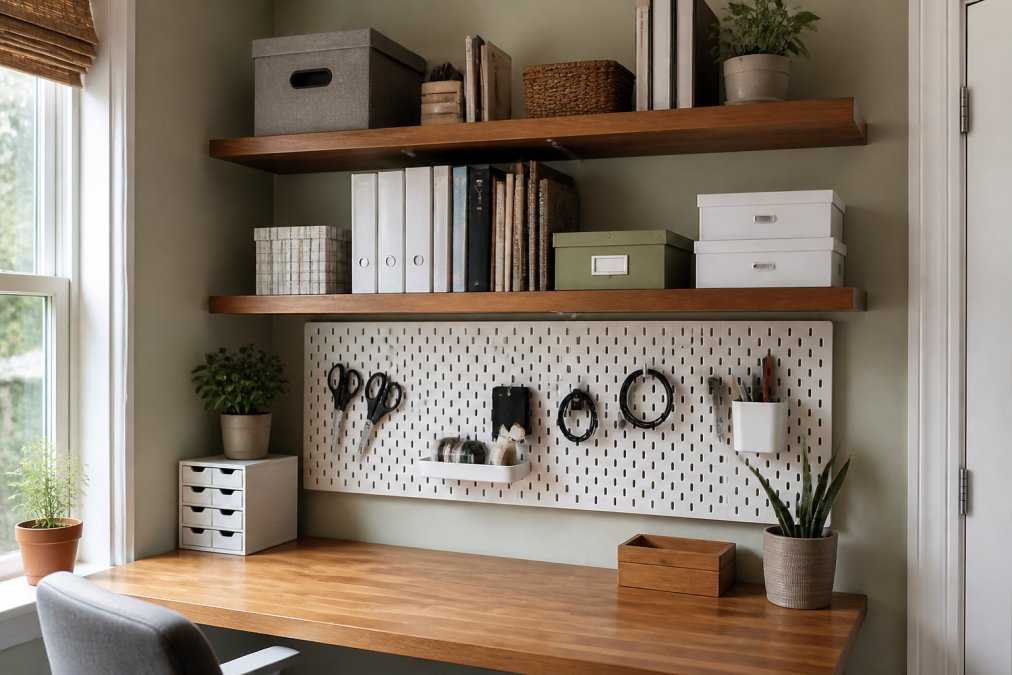
The trick is matching the system to what you store. Open shelving suits boxes and books. Pegboards suit tools and cables you grab daily.
Wall-Mounted and Floating Shelving
Floating shelves are the simplest vertical win. Mount two or three above your desk, and you gain storage without adding a single square foot of floor footprint.
Keep the lowest shelf at least 51 centimeters above the desk so it doesn’t crowd your monitor or your head.
Pegboard Systems for Tools and Supplies
A pegboard turns a blank wall into flexible storage. A pegboard system is a good example: you add hooks, clips, and small shelves, then rearrange them as your needs change.
Mount your pegboard beside the desk, not behind it. Reaching behind a monitor to grab a stapler gets old fast, and side placement keeps everything in your peripheral vision.
Under-Desk Storage Solutions That Keep Floors Clear
Under-desk storage hides clutter where nobody sees it. It also keeps the floor clear, which makes a small room feel bigger.
Rolling Carts and Mobile Drawer Units
A rolling cart is the most flexible under-desk option. A rolling cart fits under standard desk heights and rolls out when you need it.
Cable Trays and Cord Management
Cable clutter is the storage problem people ignore until it’s a tangle. A tray mounts to the desk frame and holds power strips and cords out of sight.
Desk Drawer Organization: Dividers, Trays, and Labels
Drawer dividers stop the junk-drawer spiral before it starts. Drawer dividers fit most standard drawers and keep pens, clips, and notes separated.
A quick setup order:
- Empty the drawer completely
- Group items by how often you use them
- Place daily items at the front
- Add dividers around each group
- Label each zone
Small Office Organization Tips for Hybrid and Shared Workspaces
Hybrid and shared desks need storage that disappears. When a desk rotates between people or sits empty three days a week, anything left out becomes the next person’s problem, and anything bolted down becomes a permanent obstacle.
Dual-Function Furniture for Flexible Rooms
Dual-function pieces earn their footprint by doing two jobs at once. A storage ottoman doubles as guest seating. A desk with built-in drawers replaces a separate filing cabinet. A bench with a lift-up lid hides a printer and a ream of paper.
- Storage ottoman, seating plus blanket, cable, and bag storage; typically 30-45 cm tall, so it tucks under a window
- Desk with integrated drawers, removes the need for a freestanding cabinet entirely
- Wall-mounted fold-down desk, closes flush against the wall when the room is not in use
- Rolling file cabinet used as a side table, holds letter and legal folders, then doubles as a surface for a lamp or printer
Paper Management and Filing Systems
Paper is the hardest clutter to kill, and in a shared space it is also the hardest to attribute. A compact file box holds active letter-sized folders and slides onto a shelf. For archives, stackable totes stack vertically and seal against dust and water, not for daily access, but ideal for long-term document storage in a closet corner.
A Pack-Up Checklist for Shared Desks
A short end-of-day routine keeps a shared desk genuinely neutral:
- Return loose supplies to the rolling cart and lock your drawer
- Move active paper into your portable file box
- Coil and clip cables to the under-desk tray
- Wipe the surface and leave the monitor arm folded back
- Roll the cart to its storage spot
Where to Place Storage: The Ergonomics Most People Ignore
Placement decides whether storage helps or hurts. Store items you use daily between waist and shoulder height, and your body stops compensating. Store them above your head or below your knees, and you spend the day reaching, twisting, and lifting, small movements that add up to real discomfort by mid-afternoon.
The Reach Zones That Matter
Think of the space around a seated worker as three concentric zones:
- Primary zone (about 35-75 cm from the torso), daily items: pen cup, phone, current notebook, the folder you touch every hour
- Secondary zone (about 75-120 cm), weekly items: reference binders, spare supplies, the printer tray
- Tertiary zone (beyond 120 cm or outside the seated arc), monthly or archive items: sealed totes, backup drives, seasonal files
Height Rules for Shelves and Cabinets
- Keep frequently used items within about 75 cm of your seated reach
- Anything heavier than a ream of paper belongs below waist height, so you lift with your legs, not your shoulders
- The lowest floating shelf should sit at least 51 cm above the desk surface so it does not crowd the monitor or your head
- Reserve the top shelf, roughly 180 cm and above, for items you touch monthly, not daily
Hanging heavy boxes above head height is the most common small-office mistake. Overhead lifting from a seated position strains the neck and shoulders, and those boxes are the first thing to fall. If a box needs a step stool to reach, it should not hold anything you need this week.
Matching Storage Type to Body Position
The storage format should follow the zone, not the other way around:
| Zone | Best storage format | Why |
|---|---|---|
| Primary | Drawer dividers, desk trays, monitor-base organizers | Keeps daily items in the seated arc |
| Secondary | Floating shelves, pegboard, rolling cart top | Reachable with a slight lean, no standing |
| Tertiary | Sealed totes, high cabinets, closet shelving | Out of the way, accessed occasionally |
A Quick Ergonomic Audit
Before buying anything, sit at the desk and answer four questions:
- Can I reach my three most-used items without standing or twisting?
- Is anything heavier than a ream of paper stored above shoulder height?
- Does the lowest shelf clear my monitor and my head when I stand up?
- Is there a clear path from chair to cart to door?
DIY vs. Professional Office Storage: What Makes Sense for Your Space
Go DIY for simple, reversible fixes. Go professional when you need load-bearing shelving, custom closets, or a layout that has to fit a whole team.
DIY wins when:
- You rent and can’t drill into walls
- You need storage this week
- Your needs will change in a year
Professional systems win when:
- You’re converting a closet into a storage hub
- You need shelving rated for heavy loads
- You’re furnishing multiple workstations that must match
| Situation | Best Approach | Why |
|---|---|---|
| Renting, no drilling | Adhesive hooks, rolling carts | Reversible, no wall damage |
| Converting a closet | Adjustable shelving kit | Uses full vertical height |
| Shared or hybrid desks | Mobile drawer units | Rolls away when unused |
| Heavy archives | Stackable sealed totes | Protects documents, stacks high |
| Team-wide rollout | Professional design service | Matching, load-rated systems |
Frequently Asked Questions
What are the four C’s of decluttering in an office?
The four C’s are Clear, Categorize, Contain, and Clean. Start by clearing everything off surfaces, then group items by type (paper, supplies, cables). Contain each category in a dedicated bin, drawer, or shelf, and clean the space weekly to prevent buildup. This method works for any small office storage solutions plan because it forces you to assign a home to every item rather than just shifting piles around.
How do I organize a small home office without a closet?
Use vertical office storage ideas instead of floor space. Mount floating shelves above your desk, install a pegboard for tools and cables, and add a rolling cart that tucks under the desk when not in use. A file box on a shelf handles paper. These under-desk storage solutions and wall-mounted options keep the floor clear and make the room feel larger without a closet.
What is the best way to manage cables in a small office?
Mount an under-desk cable management tray to hold power strips and adapters, then use adhesive hooks on the wall or desk edge to route cords. Label each cable near the plug so you can identify it later. This approach clears floor clutter and makes cleaning easier. Cable management is one of the small office organization tips that has the biggest visual impact for the least effort.
Should I buy new or pre-owned office storage furniture?
Pre-owned storage furniture from a reputable dealer often costs significantly less than new while still offering brands like Steelcase and Herman Miller. Inspect drawers, shelves, and casters for damage before buying. A dealer with a showroom lets you check condition in person. For tight budgets, pre-owned is a practical way to get durable storage without sacrificing quality or professional appearance.
Small spaces punish guesswork. The right mix of vertical shelving, under-desk units, and thoughtful placement turns a cramped room into a workspace that actually functions. Office Furniture Warehouse helps you get there with over 4 acres of new and pre-owned furniture, premium brands like Steelcase and Herman Miller at up to 80% off, and expert design and layout planning to fit storage to your exact floor plan. Visit our showroom and let our team map out storage that works for your space.
