Table of Contents
- Why Buying Used Office Furniture Is a Smart Move
- The 7-Point Inspection Checklist for Used Office Furniture Quality
- 1. Check Structural Integrity and Frame Stability
- 2. Test Chairs for Ergonomic Adjustment and Gas Cylinder Function
- 3. Examine Drawers, Slides, and Hardware
- 4. Look for Surface Wear, Rust, and Moisture Damage
- 5. Evaluate Upholstery, Foam Density, and Edge Banding
- 6. Assess Casters, Wheels, and Base Durability
- 7. Confirm Weight Capacity and Load-Bearing Specs
- How to Inspect Used Office Chairs: A Step-by-Step Guide
- Refurbished vs Used Office Furniture: What’s the Difference?
- What to Look For When Buying Used Steelcase Chairs for Sale
- Red Flags, Sanitization, and Repairability Concerns
- Conclusion: Buy With Confidence
- Frequently Asked Questions
Last Updated: September 5, 2026
Why Buying Used Office Furniture Is a Smart Move
Verifying used office furniture quality is the difference between a smart investment and a costly mistake, and it is a skill any facility manager or business owner can learn quickly. At Office Furniture Warehouse, we have spent over 35 years helping buyers evaluate pre-owned pieces. The core idea is simple: you are checking for structural integrity, functional mechanics, and cosmetic wear that affects longevity.
The financial argument for buying pre-owned is compelling, and the practical benefits extend well beyond the initial purchase price. Many businesses find that allocating budget toward premium brands like Steelcase or Herman Miller is only feasible when buying second-hand. However, the market does carry risk, which is why knowing how to verify used office furniture quality protects your investment.
The 7-Point Inspection Checklist for Used Office Furniture Quality
A systematic approach is the only reliable way to assess used office furniture quality, and this checklist covers the seven areas where pre-owned pieces most often fail. Work through these points in order, and you will catch the majority of problems that lead to premature failure.
1. Check Structural Integrity and Frame Stability
Structural integrity is the non-negotiable foundation of any used furniture purchase. Begin by sitting in the chair or applying firm pressure to the desk surface, then rock side-to-side and front-to-back to detect any wobble or instability. A solid frame should feel rigid with no creaking, flexing, or visible movement at the joints.
2. Test Chairs for Ergonomic Adjustment and Gas Cylinder Function
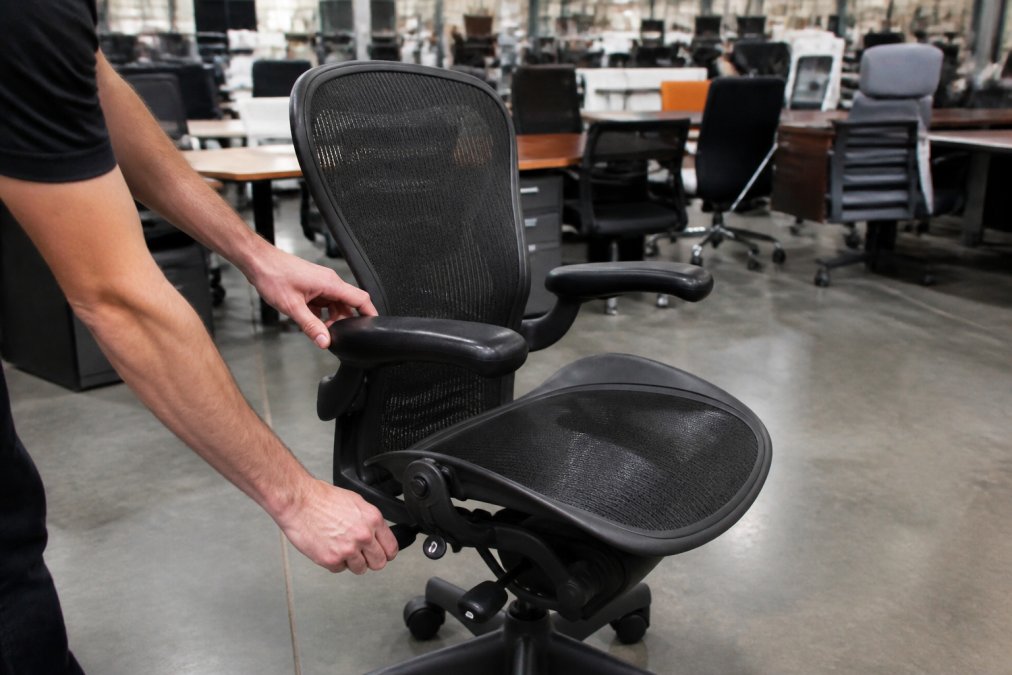
The gas cylinder is the most common mechanical failure point on used office chairs. Raise the seat to its highest position, sit on it, and then use the lever to lower it; the chair should descend smoothly without dropping suddenly or sticking. Ergonomic adjustment mechanisms, including lumbar support, armrest height, and tilt tension, should all move through their full range without resistance or grinding noises.
3. Examine Drawers, Slides, and Hardware
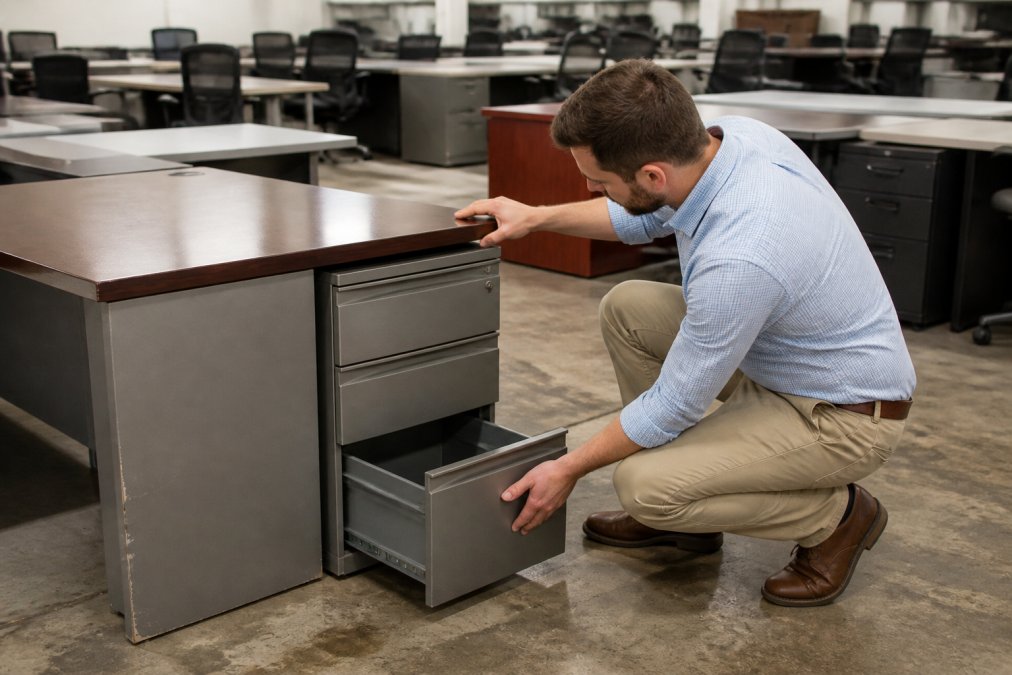
Drawers and filing cabinets see heavy daily use, so their slides and hardware reveal a lot about how well a piece was maintained. Pull each drawer fully open and check that it glides smoothly without catching, and inspect the slides for bent tracks or missing ball bearings. Look for stripped screws, broken handles, or misaligned doors, as these indicate either heavy use or poor maintenance.
4. Look for Surface Wear, Rust, and Moisture Damage
Surface wear is the most visible indicator of a piece’s history, and it helps you distinguish between normal cosmetic aging and damage that shortens lifespan. Scratches and scuffs on desks are common and often acceptable, but deep gouges or dents in particle board can expose the core to moisture damage. Check underneath desks and inside drawers for rust, water stains, or swollen edges.
5. Evaluate Upholstery, Foam Density, and Edge Banding
The condition of upholstery tells you how much life remains in a chair’s seat and backrest, and foam density is the key metric to assess. Press firmly into the seat cushion; quality high-density foam should spring back quickly, while foam that stays compressed or feels flat indicates it is nearing the end of its useful life. On desks and shelving, check the edge banding for peeling or delamination.
6. Assess Casters, Wheels, and Base Durability
Casters take constant abuse on office floors, and worn wheels can damage flooring or make a chair difficult to move. Roll the chair across a hard surface and listen for grinding, check that each wheel spins freely, and inspect for hair or debris wrapped around the caster stems. The base itself, typically aluminum or nylon, should have no cracks.
7. Confirm Weight Capacity and Load-Bearing Specs
Every piece of office furniture has a rated weight capacity, and matching it to your team’s needs is essential for safety and longevity. Look for a manufacturer label on the underside of the seat or desk frame that lists the load rating, and be cautious if the label is missing or damaged. For task chairs, a higher weight capacity generally indicates a more durable frame and gas cylinder.
How to Inspect Used Office Chairs: A Step-by-Step Guide
Knowing how to inspect used office chairs properly requires a consistent sequence that covers mechanics, structure, and comfort in a logical order. Start with the chair on a flat, hard surface and complete these six steps:
- Test the gas cylinder: Raise and lower the seat three times to confirm smooth operation.
- Check the base and casters: Tilt the chair and spin each wheel, checking for cracks in the base.
- Evaluate the seat mechanism: Operate the tilt, lock, and tension controls while seated.
- Adjust the armrests: Move them through all positions to test the locking mechanisms.
- Compress the seat cushion: Press firmly and watch for slow or incomplete recovery.
- Inspect the backrest: Check the lumbar support and mesh or upholstery for tears or sagging.
The entire process takes about five minutes and covers the most common failure points on pre-owned chairs.
Refurbished vs Used Office Furniture: What’s the Difference?
The distinction between refurbished and used office furniture comes down to the level of reconditioning the piece has received, and it directly affects price and expected longevity. Used furniture is sold in its existing condition, meaning you are responsible for assessing wear and accepting cosmetic imperfections. Refurbished pieces have been professionally inspected, repaired, and cleaned, with worn parts like gas cylinders or casters replaced as needed.
The Three Tiers of Refurbishment
Not all ‘refurbished’ furniture is created equal. Most professional dealers sort their inventory into three tiers, and knowing which tier you are looking at will help you evaluate the price:
- Grade A (Certified Pre-Owned): This is the highest tier. The piece has been fully disassembled, cleaned, and inspected. All moving parts, gas cylinders, tilt mechanisms, casters, are replaced with new OEM parts if they show any wear. Upholstery is either replaced or professionally deep-cleaned, and the frame is touched up to near-new condition. These pieces typically come with a 1- to 5-year warranty. Expect to pay 50-70% of the original list price.
- Grade B (Refurbished): This is the most common tier. The piece has been cleaned, and any safety-critical parts (gas cylinders, brakes on casters) have been replaced. Cosmetic wear like scratches and scuffs is left as-is or minimally touched up. Upholstery is cleaned but may show visible wear. These pieces are functional and reliable but not cosmetically perfect. Expect to pay 30-50% of the original list price.
- Grade C (As-Is/Used): This is the ‘as-is’ tier. The piece has been inspected for safety but is sold without repairs or deep cleaning. You are buying the piece as it currently sits, with all its wear and tear. This is where you find the deepest discounts (often 10-30% of list price), but you are also taking on the risk of hidden mechanical failures.
The Cost-Benefit Analysis: When to Pay for Refurbished
The price gap between used and refurbished is not arbitrary, it reflects the cost of labor and parts. A full refurbishment of a commercial task chair typically involves $40-$80 in parts (cylinder, casters, new foam) and 1-2 hours of labor.
Here is a practical framework for deciding which tier is right for you:
- Choose Grade A or B for primary workstations. If an employee will sit in the chair for 8 hours a day, the cost of a new gas cylinder and proper foam is worth the investment. A chair that fails in 6 months will cost you more in lost productivity than the $100 you saved.
- Choose Grade C for low-use areas. Conference rooms, guest seating, and breakout spaces see far less wear. A used chair with cosmetic scuffs is perfectly fine for these areas, and the savings can be significant.
- Always calculate the ‘total cost of ownership.’ A used chair at $200 that needs a $60 cylinder and $40 in casters is actually a $300 chair. If a refurbished version of the same chair is $350, the refurbished option is the better value because it includes the labor and a warranty.
What to Ask the Seller About Their Refurbishment Process
To avoid paying a ‘refurbished’ premium for a piece that has only been wiped down with a damp cloth, ask these three specific questions:
- What parts did you replace? A reputable dealer will have a list. If they say ‘we replace everything that’s broken,’ that is a red flag, they likely did not inspect it thoroughly.
- What is your grading scale? If the dealer cannot define what ‘Grade A’ or ‘Grade B’ means in their inventory, you are not comparing apples to apples.
- What does your warranty cover? A warranty that covers parts and labor for 1 year is a strong signal. A warranty that only covers the frame is nearly worthless, since frames rarely fail, gas cylinders and mechanisms do.
| Feature | Used Furniture | Refurbished Furniture (Grade B) | Certified Pre-Owned (Grade A) |
|---|---|---|---|
| Inspection | Buyer’s responsibility | Professional grading | Professional grading + full disassembly |
| Repairs | None performed | Safety-critical parts replaced | All worn parts replaced with OEM |
| Cleaning | As-is condition | Sanitized and detailed | Sanitized, detailed, and deodorized |
| Cosmetic wear | Visible scratches and dents | Some wear visible | Near-new appearance |
| Price point (vs. new list) | 10-30% | 30-50% | 50-70% |
| Warranty | Rarely offered | 90 days – 1 year | 1-5 years |
For buyers who lack the time or expertise to conduct a full inspection, refurbished pieces offer greater peace of mind. The trade-off is price, but the added reliability often justifies the premium, especially for chairs that will see eight hours of daily use.
What to Look For When Buying Used Steelcase Chairs for Sale
Steelcase chairs are among the most popular pre-owned options because of their build quality and parts availability, but they still require careful inspection. The same seven-point checklist applies, though you should pay extra attention to the gas cylinder and the seat mechanism, as these are the components that wear out first on high-use models.
Serial number verification is a smart step when looking at used Steelcase chairs for sale, as it confirms the model and manufacturing date. Look for a label on the underside of the seat base, and use the model number to research the chair’s original specifications and weight capacity.
Red Flags, Sanitization, and Repairability Concerns
Beyond the mechanical inspection, several hidden concerns can turn a good deal into a bad one, and they often go unnoticed by first-time buyers. This section covers the ‘ick factor’ of hygiene and the long-term economics of repairability.
Common Damage That Signals a Short Remaining Lifespan
Certain types of damage indicate that a piece has reached the end of its practical life. Delamination on desk edges, where the laminate separates from the particle board, allows moisture to penetrate and causes the core to swell and crumble. Bent chair bases, cracked welds on frames, and gas cylinders that fail to hold pressure are all signs of structural compromise that cannot be economically repaired.
Hygiene and Pest Protocols: The Inspection You Can’t See
The visual inspection only covers what you can see. The real risk in used fabric furniture is what you can’t see: allergens, bacteria, and pests. Reputable dealers treat all incoming upholstered pieces with a multi-step process, but you should never assume it. Here is the protocol to ask about or verify before you commit:
- Ask for the sanitization log. Professional operations use industrial-grade steam cleaners that reach 212°F to kill bacteria and dust mites, followed by a disinfectant spray rated for upholstery (the CDC). Ask the seller if they use a commercial-grade process or just a home carpet cleaner.
- Check for pest evidence yourself. Look for tiny black specks (fecal matter) along seams, under seat cushions, and in the crevices of the backrest. Also check the underside of the chair base and inside desk grommets for signs of insect activity. Bedbugs are a real barrier for buyers, and a used chair from an unknown source is a primary vector.
- Inquire about the ozone or heat treatment. Many professional refurbishers run upholstered pieces through an ozone chamber or a heat tent to eliminate pests and odors at the source. If the seller cannot confirm this step, factor the cost of professional cleaning ($75-$150 per chair) into your offer.
- For non-upholstered pieces, check for mold. Look for a musty smell and inspect the underside of desk tops and the inside of pedestal drawers for dark spots or a powdery residue. Mold on particle board is a deal-breaker because it compromises the structural core and is a health hazard.
Repairability and Parts Availability: The Long-Term Cost Question
The second hidden concern is whether you can fix the piece when it breaks. A used chair is only a good deal if replacement parts are available and affordable. The market for commercial-grade furniture is built on repairability, but this varies wildly by brand and model. Here is how to assess the long-term viability of a piece before you buy:
- Check the manufacturer’s parts catalog. Brands like Steelcase, Herman Miller, and Haworth publish detailed parts diagrams online. Before you buy, look up the model number (usually on a sticker under the seat or on the desk frame) and confirm that the gas cylinder, armrest pads, and casters are still listed as orderable parts. If a part is discontinued, the piece becomes a liability the moment it fails.
- Know the cost of common replacements. A replacement gas cylinder for a commercial chair typically runs $30-$60, and a set of replacement casters is $15-$40. If the seller is asking near-new prices but the chair needs a cylinder and new casters, your ‘deal’ quickly evaporates. Use these numbers to negotiate a fair price.
- Beware of proprietary parts. Some lower-end or older models use non-standard components that are impossible to source. If the chair has a unique tilt mechanism or an odd-sized armrest, walk away unless the seller can provide a spare. The safest bet is to stick to models from major manufacturers that have a long production history and a robust aftermarket.
- Ask the seller directly. A simple question, ‘Can I get a replacement gas cylinder for this model?’, will often reveal the seller’s expertise. A knowledgeable dealer will have the part in stock or can order it. A seller who hesitates or says ‘you can find anything online’ is a red flag.
BIFMA safety and performance standards for office furniture provide a useful baseline for understanding the durability expectations of commercial-grade pieces, and they are a helpful reference when assessing pre-owned items. Additionally, the OSHA guidelines on workstation ergonomics explain why proper chair adjustability matters for worker comfort and safety, reinforcing the importance of testing ergonomic mechanisms during your inspection.
The 24-Hour Rule: If you are buying from a private seller, ask if you can take the piece home for a 24-hour trial. This is the only way to test for odor issues that only appear after the piece has been in a closed environment. A reputable private seller will often agree; a dealer should offer a return window.
Conclusion: Buy With Confidence
The process of verifying used office furniture quality comes down to a systematic inspection of structure, mechanics, and materials, and it is a skill that pays for itself on the first purchase. Use the seven-point checklist on every piece you evaluate, and you will avoid the common pitfalls that lead to premature failure and wasted budget. For buyers who want professional assurance without the legwork, Office Furniture Warehouse applies these same standards across its 4-acre inventory of pre-owned and refurbished pieces, with premium brands like Steelcase and Herman Miller available at significant savings. Get started with Office Furniture Warehouse and outfit your office with quality furniture that fits your budget.
Frequently Asked Questions
What are the most common signs of poor quality in used office furniture?
Look for soft or cracked casters, a wobbly base, a gas cylinder that drops under load, and deep scratches or dents in the frame. Check for edge banding that is lifting or peeling, which signals delamination. Test every drawer and sliding mechanism for smooth alignment. Rust or a musty smell indicates moisture damage that compromises structural integrity. These signs point to heavy wear and a shorter remaining lifespan.
How can I tell if a used office chair is still ergonomically sound?
Sit in the chair and test every adjustment. The seat height should raise and lower smoothly without sudden drops. Tilt tension and lock mechanisms must engage firmly. Armrests should adjust without excessive force. The lumbar support should hold its position under pressure. A chair that wobbles at the base or has a gas cylinder that sinks slowly has likely failed and will need replacement parts soon.
What is the difference between refurbished and used office furniture?
Used furniture is sold in its as-received condition, which means it will show visible wear and tear. Refurbished pieces have been professionally inspected, cleaned, and repaired. Worn casters, damaged gas cylinders, and torn upholstery are typically replaced with new parts. Refurbished furniture is more thoroughly tested for mechanical function and often comes with a warranty, making it a safer choice for long-term reliability.
What is the average lifespan of a high-quality used office chair?
Premium brands like Steelcase and Herman Miller are designed for 10 to 15 years of heavy daily use. A well-maintained used chair from these brands often has several good years left. The lifespan depends on the condition of the gas cylinder, casters, and foam. If those components are sound and the frame shows no cracks, the chair can easily serve another 5 to 10 years in a typical office.
This article was written using GrandRanker
