Table of Contents
- Why Look Beyond AG Office Furniture?
- Quick Comparison: New vs. Pre-Owned vs. Refurbished
- The Refurbished Office Furniture Benefits You Can’t Ignore
- Best Ergonomic Chairs for Remote Workers on Any Budget
- How to Choose Office Furniture for Startups: A Framework
- Sustainable and Eco-Friendly Furniture Options
- Maintenance, Repairability, and Lifecycle Planning
- Your Next Steps for a Workspace Makeover
- Frequently Asked Questions
Last Updated: September 6, 2026
Office furniture alternatives are no longer a compromise. At Office Furniture Warehouse, we have spent over 35 years watching businesses discover that the best route to a polished, high-functioning workspace rarely runs through a standard retail catalog.
The old binary of buying brand-new or settling for mismatched hand-me-downs is outdated; the real decision framework involves sourcing channels, condition grades, ergonomic standards, and lifecycle planning.
Premium brands hold their value and function far longer than budget imports, which is why the secondary market has matured into a professional, reliable channel.
Why Look Beyond AG Office Furniture?
Purchasing decisions should follow the furniture’s engineering, not the nameplate. Established manufacturers like Steelcase, Herman Miller, Humanscale, and Haworth have spent decades refining ergonomic research into their seating and desking systems, but their retail prices reflect that investment.
When a budget cannot absorb those retail prices, a smarter approach evaluates the piece itself: its mechanism, its adjustability range, its material quality, and its remaining service life.
Ergonomic seating and height-adjustable desks are the two categories where skimping hurts most. A poor chair leads to discomfort and lost productivity, while a desk without proper adjustment range forces awkward postures.
Quick Comparison: New vs. Pre-Owned vs. Refurbished
Choosing between these three routes depends on your timeline, your tolerance for wear, and your budget flexibility.
| Option | Best For | Key Trade-Off | Typical Lead Time |
|---|---|---|---|
| New (Direct from Manufacturer) | Enterprises with specific customization needs | Highest cost, full warranty, long wait for build | 8-12 weeks |
| Pre-Owned (As-Is) | Budget-conscious buyers with flexible timelines | Lowest cost, visible wear, immediate availability | 1-2 weeks |
| Refurbished (Certified) | Professionals wanting quality without full price | Moderate cost, like-new condition, inspected | 1-3 weeks |
New furniture offers the widest customization, but the downside is the price and the wait. Pre-owned inventory provides immediate availability and significant savings, but condition varies piece by piece.
Refurbished furniture sits between the two, inspected, cleaned, and repaired to a certified standard. For a facility manager needing matching workstations without the 12-week lead time, refurbished stock often represents the best balance and supports sustainability goals.
The Refurbished Office Furniture Benefits You Can’t Ignore
Refurbished office furniture benefits extend far beyond the sticker price, allowing you to fit high-quality ergonomic chairs and sit-to-stand desks into a budget that would otherwise only cover entry-level imports.
What most guides miss is the inspection process. Reputable dealers often test gas cylinders, replace worn casters, reupholster damaged fabric, and verify that all adjustment mechanisms function correctly, delivering a piece that performs like new at a fraction of the cost.
There is also a practical advantage for procurement officers: availability. When you need to furnish 15 workstations with matching ergonomic chairs and desks, waiting months for a factory order stalls your entire project. Refurbished inventory is typically in stock, compressing your timeline from quarters to weeks.
The real value of refurbished furniture is not just the lower price. It is access to premium ergonomics and durability that would otherwise be out of reach, delivered on a timeline that keeps your project moving.
Best Ergonomic Chairs for Remote Workers on Any Budget
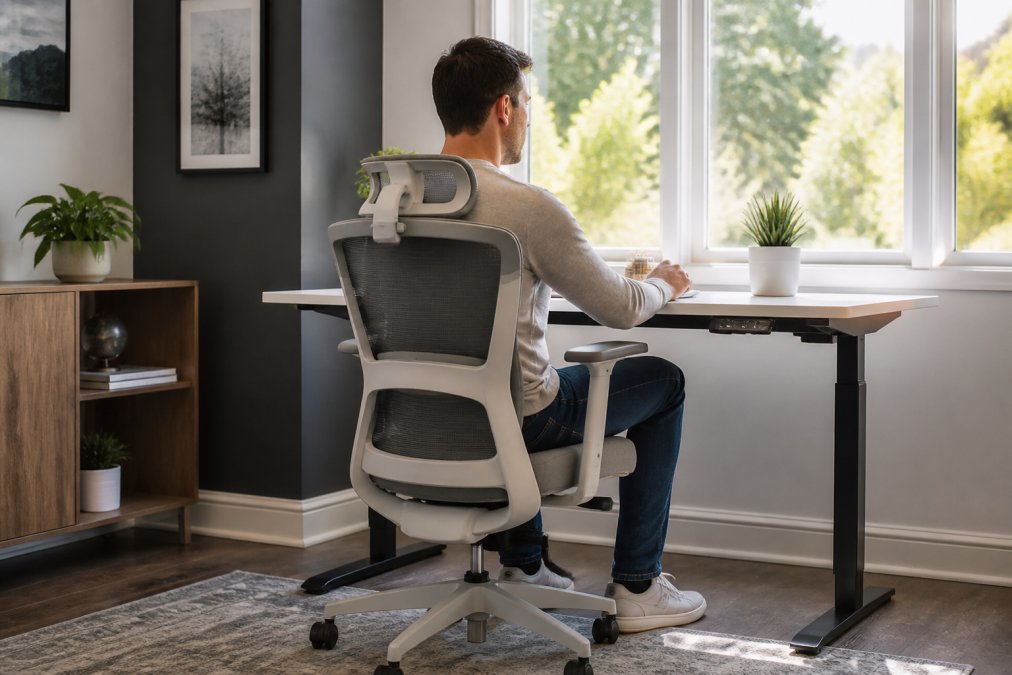
Remote workers face a challenge that corporate buyers do not: there is no facilities team to measure your space, adjust your chair, or enforce a replacement schedule. You are the entire ergonomics department. Before you compare models, run a quick self-assessment using these four measurements.
1. Seat height range. Measure the distance from the floor to the underside of your desk. Your chair’s seat height range must allow your feet to rest flat with your thighs parallel to the floor. For most desks at 29 inches, that means a seat range starting at 16 to 18 inches. If you are under 5’4″ or over 6’2″, standard ranges often fail, check the spec sheet, not the marketing photos.
2. Seat depth. Sit with your back against the chair’s backrest. You should have two to three finger widths of space between the back of your knee and the front edge of the seat pan. If the pan is too long, it compresses the back of your legs; if too short, it fails to support your thighs. Look for a sliding seat pan with at least 2 inches of travel.
3. Armrest adjustability. Your forearms should rest at desk height without raising your shoulders or slouching. That requires armrests that adjust in height and width at minimum. Chairs with only fixed or 2D armrests force you to adapt to the chair, which is backwards.
4. Room clearance. A chair with a synchro-tilt mechanism needs roughly 30 inches of clearance behind it to recline fully. If your home office is a corner nook, a chair with a weight-activated recline (like Humanscale’s Freedom) may be a better fit than one requiring a manual tilt lock.
Once you have those numbers, the market splits into three practical tiers.
Tier 1: Premium new (budget $1,000+). Herman Miller’s Aeron and Steelcase’s Leap and Gesture remain the engineering benchmarks. The Aeron’s mesh back promotes airflow, and its PostureFit SL support addresses the lower spine directly. The Leap’s seat edge adjusts to relieve thigh pressure, and the Gesture’s armrests mimic natural arm movement. These chairs carry 12-year warranties and are built for 24/7 use. If your budget absorbs the price, they are the safest long-term purchase.
Tier 2: Refurbished premium (budget $400-$800). This is the value sweet spot that most guides ignore. A certified refurbished Aeron, Leap, or Freedom has had its gas cylinder tested, casters replaced, and upholstery sanitized or replaced. The mechanism is identical to a new unit. The savings come from the dealer’s ability to buy in volume and recondition, not from inferior parts. For a remote worker, this tier delivers the same ergonomic support as Tier 1 at roughly half the cost.
Tier 3: Budget new (under $400). If you must buy new at this price, focus on chairs with the four adjustments above, not on brand names. Many import chairs offer a 3-year warranty and acceptable support for part-time work. The trade-off is durability: a budget chair’s foam and gas cylinder typically degrade within two to three years of daily 8-hour use, while a premium chair’s components are designed for a decade or more.
Before buying any ergonomic chair, verify the seat depth adjustment. Many chairs force a one-size-fits-all seat pan, which fails for taller or shorter users. A proper seat depth range of several inches is the difference between comfort and chronic pressure points.
How to Choose Office Furniture for Startups: A Framework
How to choose office furniture for startups comes down to a single word: flexibility. A modular workstation with bolt-on components allows you to expand from 10 desks to 30 without discarding your original purchase.
Startups should also weigh the impression their space makes. Clients and investors judge competence partly on the environment. A cohesive design plan, consistent color palette, and quality seating in the reception area signal professionalism regardless of whether the desks are new or refurbished.
A practical framework for startup procurement:
- Define the budget per workstation, including seating and desk.
- Prioritize ergonomic seating and height-adjustable desks for employee health.
- Choose modular desking that supports future expansion.
- Select a consistent finish and color scheme for a unified look.
- Allocate remaining budget to shared spaces like conference rooms.
For startups, the decision often comes down to buying fewer, higher-quality pieces versus more, lower-quality ones. Choosing the former positions the company for better long-term outcomes.
Sustainable and Eco-Friendly Furniture Options
Sustainability in office furniture is no longer a niche concern. Procurement officers and facility managers increasingly face mandates to reduce their environmental footprint. The most effective strategy is also the simplest: buy furniture that already exists. The Environmental Protection Agency’s guidelines on sustainable materials management highlight the significant environmental impact of manufacturing new goods versus extending the life of existing ones.
But sustainability does not end at the purchase. The full lifecycle, how you acquire, maintain, and eventually dispose of furniture, determines your actual environmental impact. Here is the lifecycle framework that top results skip.
Phase 1: Acquisition. Choosing refurbished premium furniture avoids the raw material extraction, energy consumption, and manufacturing emissions of a new purchase. Every piece kept in service is one less piece in a landfill. When new purchases are unavoidable, specify materials with recycled content or low-VOC finishes. Herman Miller has incorporated recycled ocean plastics into some product lines, and Steelcase publishes environmental product declarations for its major lines.
Phase 2: Maintenance. A chair that lasts 15 years has a fraction of the environmental impact of three chairs lasting 5 years each. Premium brands are designed for repairability: replacement gas cylinders, casters, armrest pads, and seat foams are available through dealer networks. Budget furniture rarely offers this parts ecosystem, which is why it ends up in landfills. The Occupational Safety and Health Administration’s guidance on workstation ergonomics underscores that well-maintained, adjustable furniture is a component of a safe work environment. Maintenance is both an ergonomic and an environmental strategy.
Phase 3: Disposal and donation. When you decommission an office, you have three responsible options beyond the dumpster. First, sell usable pieces to a used-furniture dealer; even a modest per-piece price offsets moving costs. Second, donate to qualified nonprofits. Many organizations, including Goodwill and local workforce development centers, accept office furniture and provide a donation receipt for tax purposes. Third, use a certified e-waste and furniture recycler for pieces beyond repair. The IRS allows deductions for qualified charitable donations of furniture in good condition, so document the fair market value and the receiving organization’s tax-exempt status.
A circular approach to office furniture is not just about buying used. It is a three-phase strategy: acquire refurbished or sustainable new pieces, maintain them for maximum service life, and route decommissioned furniture to resale, donation, or recycling rather than landfill.
For most projects, a mixed strategy works best: refurbished for the bulk of workstations, new sustainable pieces for high-visibility areas, and a documented disposal plan for what you retire.
Maintenance, Repairability, and Lifecycle Planning
The conversation about office furniture alternatives rarely extends to what happens after the purchase. Maintenance and repairability determine the true cost of ownership. Premium brands like Steelcase and Herman Miller are designed to be repaired, with replacement parts readily available, meaning a chair can serve for 15 years or more with basic upkeep.
Budget furniture, by contrast, is often disposable. When a component fails, there is no parts network, and the entire chair ends up in a landfill. The Occupational Safety and Health Administration’s guidance on workstation ergonomics underscores that well-maintained, adjustable furniture is a component of a safe work environment. A sagging seat or a broken recline mechanism is not just an inconvenience; it is a safety hazard.
Lifecycle planning should also address disposal. Responsible removal and disposal services can ensure that usable furniture is resold or donated rather than dumped, benefiting the environment and potentially offsetting moving costs.
Do not assume a cheap chair is a bargain. When a non-repairable budget chair fails within two years, the replacement cost often exceeds what a refurbished premium chair would have cost, and the broken chair adds to landfill waste. Factor repairability into your initial purchase decision.
Your Next Steps for a Workspace Makeover
A workspace makeover does not require a blank check. Start by auditing your current space: measure your footprint, count your workstations, and identify which pieces genuinely need replacing versus which can be refurbished or reupholstered.
Then, set your priorities. Ergonomic seating for employees who spend eight hours a day at a desk should top the list, followed by height-adjustable desks for their well-documented benefits to posture and energy.
For facility managers and business owners in the Midwest, the most efficient path is often a single source that handles everything from space planning to delivery. A partner with a large, physically available inventory allows you to see and test pieces before committing. This is where the advantage of a showroom becomes clear, especially when you need 15 matching workstations on a deadline. The Small Business Administration’s resources on workplace planning offer useful baseline guidance, but nothing replaces seeing the furniture in person.
Outfitting a workspace is a balancing act between quality, budget, and timeline. The best office furniture alternatives resolve that tension by giving you access to premium brands without the premium wait or the premium price. At Office Furniture Warehouse, our 4-acre inventory of new and pre-owned Steelcase and Herman Miller pieces, combined with expert design and layout planning, helps you achieve a professional look that fits your budget. Visit our Cleveland showroom today and see how far your furniture budget can go.
Frequently Asked Questions
What are the best alternatives to traditional office chairs?
Beyond standard task chairs, consider ergonomic seating like the Steelcase Gesture or Herman Miller Aeron. For a more active option, try a saddle chair or a stability ball chair. Height-adjustable standing desks also reduce the time you spend seated. Buying these premium brands refurbished is a practical way to get ergonomic support without the full retail price.
Is Steelcase better than Herman Miller?
Both are top-tier manufacturers, but they excel in different ways. Steelcase chairs like the Leap are known for their highly adjustable lumbar support and durable build. Herman Miller’s Aeron is famous for its breathable mesh and iconic design. The right choice depends on your body type and work habits. Testing both, or buying from a warehouse with a good return policy, is the best way to decide.
What are the benefits of buying refurbished office furniture from established warehouses?
The primary benefit is cost savings, often 30-70% off new prices. This lets you afford premium, durable brands like Steelcase and Herman Miller that fit your budget. Established warehouses also inspect, clean, and repair items, so you get quality without the risk. It is also a sustainable choice, keeping furniture out of landfills and reducing the demand for new materials.
How can I maximize my office furniture budget without sacrificing ergonomics?
Prioritize your investment in chairs, as they impact your health the most. Look for pre-owned or refurbished high-end chairs from a reputable dealer. For desks, a height-adjustable model is a solid investment. You can save on ancillary items like file cabinets and bookcases by buying used, allowing you to allocate more funds to seating.
