Table of Contents
- Used vs New Office Furniture Pros: The Quick Comparison Table
- Cost Savings and Capital Expenditure: What the Numbers Actually Show
- Used Steelcase Chairs for Sale: What to Look For and What to Expect
- How to Inspect Used Office Chairs Before You Buy
- Warranty Coverage, Durability, and Asset Lifecycle: New vs Pre-Owned
- Environmental Footprint and the Circular Economy Case for Pre-Owned
- Sanitization, Hybrid Office Layouts, and Customization: What Competitors Skip
- Conclusion
- Frequently Asked Questions
Last Updated: September 19, 2026
Used vs New Office Furniture Pros: The Quick Comparison Table
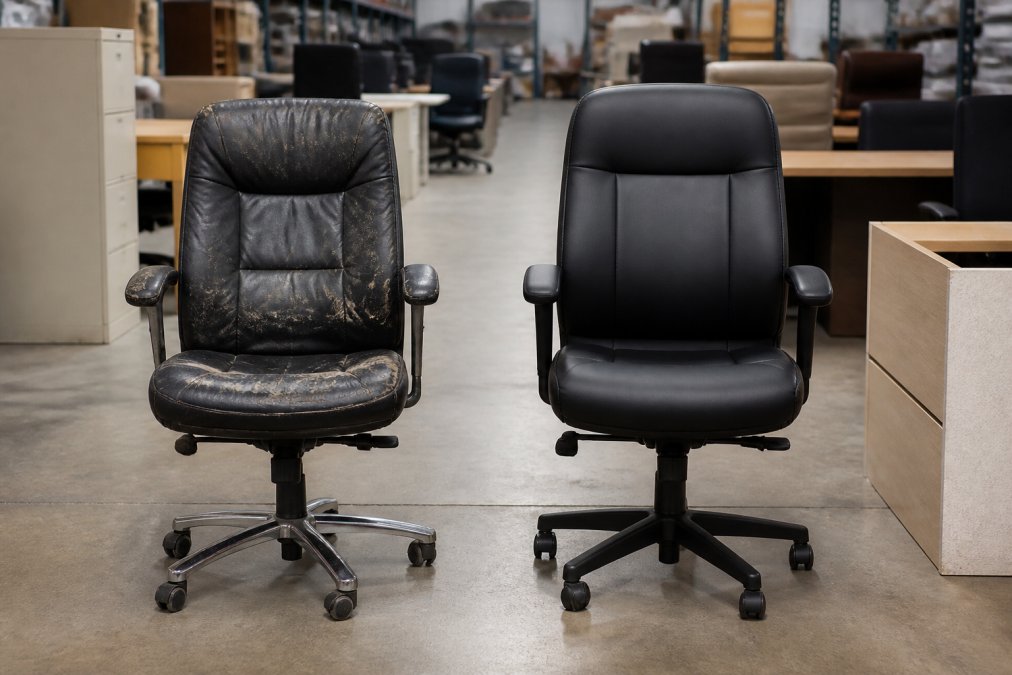
The used vs new office furniture pros debate comes down to one question: how much capital expenditure should go toward furniture that starts depreciating the moment it arrives? At Office Furniture Warehouse, we’ve spent over 35 years helping facility managers and business owners answer that. This guide breaks down the real trade-offs, including a total cost of ownership framework and an inspection checklist.
| Factor | New Furniture | Pre-Owned Furniture |
|---|---|---|
| Upfront cost | Highest | Significantly lower |
| Lead time | Weeks to months for custom orders | Often immediate from stock |
| Warranty coverage | Full manufacturer warranty | Usually limited or none |
| Customization | Full fabric and finish selection | Limited to available inventory |
| Depreciation | Steepest in year one | Already absorbed by first buyer |
| Environmental footprint | New materials and manufacturing | Avoided manufacturing impact |
| Best for | Branded flagship spaces, long-term builds | Fast rollouts, budget-driven projects |
Cost Savings and Capital Expenditure: What the Numbers Actually Show
Cost savings are the loudest argument for pre-owned, but the real story is capital allocation. New office furniture loses value fastest in its first year; buy pre-owned and someone else has already absorbed that depreciation hit.
Total Cost of Ownership (TCO) Calculator for Office Furniture
Use this framework to compare any two options:
TCO = Purchase Price + Delivery & Setup + (Annual Maintenance × Years Owned) + Replacement Cost − Resale Value
| Cost Component | New Chair | Pre-Owned Chair |
|---|---|---|
| Purchase price | Higher | Lower |
| Delivery and setup | Often included | Varies by dealer |
| Annual maintenance | Minimal in early years | Depends on condition grade |
| Expected service life | Full lifecycle ahead | Partial lifecycle remaining |
| Resale value | Low after years of use | Already at floor value |
Ask any pre-owned dealer how they grade condition and whether they replace worn gas cylinders, casters, and arm pads before resale. A dealer that refurbishes mechanical components is selling you usable life, not just a chair.
Used Steelcase Chairs for Sale: What to Look For and What to Expect
Shopping for used Steelcase chairs for sale is where most buyers either save smartly or get burned. Steelcase builds commercial-grade seating designed for years of daily use, so a well-maintained chair often has plenty of service life left.
Expect three tiers of pre-owned Steelcase inventory:
- Decommissioned corporate stock: Office furniture from a company that relocated or downsized. Usually uniform, lightly used, and the best value.
- Dealer-refurbished units: Worn components replaced, fabric cleaned, function tested. Higher price, lower risk.
- As-is secondary market: No testing, no guarantee. Cheapest, highest risk.
How to Inspect Used Office Chairs Before You Buy
Learning how to inspect used office chairs takes about ten minutes and saves you from buying someone else’s problem. The goal is to separate cosmetic wear, which is fine, from structural and mechanical wear, which is not.
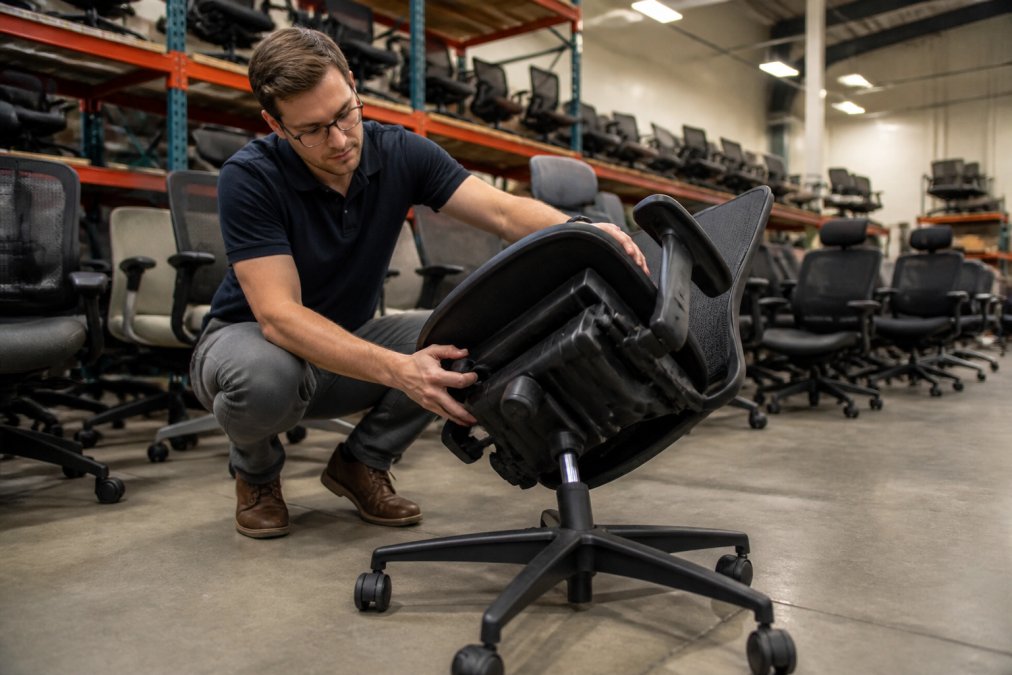
Work through this checklist on every chair:
- Gas cylinder: Sit down and raise the height fully, then lower it. It should hold position without sinking. A cylinder that drifts is failing.
- Tilt mechanism: Engage and release the tilt lock several times. It should catch firmly and release cleanly.
- Casters: Roll the chair across a hard floor. Wheels should spin freely without flat spots or grinding.
- Arm pads: Press and wiggle each arm. Loose arms usually mean a cracked mounting point, not just a loose bolt.
- Seat foam: Press the front edge of the seat. If you feel the frame through the foam, the cushion is compressed and won’t recover.
- Frame and base: Look for cracks at the base spokes and where the seat meets the back. Cracks here are a dealbreaker.
- Upholstery: Check seams and high-wear edges. Fraying seams will spread; surface scuffs won’t.
- Structural integrity: Rock the chair side to side while seated. Excessive flex signals a compromised frame.
Never buy a chair with a cracked base or a frame that flexes under load, no matter how good the price looks. These failures can’t be repaired economically, and a collapsing chair is a workplace injury risk.
Warranty Coverage, Durability, and Asset Lifecycle: New vs Pre-Owned
Warranty coverage is the clearest structural difference between new and pre-owned, and where new furniture earns its premium. But the useful question isn’t whether a warranty exists, it’s what it covers, how long it runs, and whether it survives a change of owner.
What Manufacturer Warranties Actually Cover
Commercial furniture warranties are not uniform; most manufacturers split coverage into categories with different terms per component:
- Structural frame and base: Often the longest coverage, frequently measured in years rather than months. Frames rarely fail, so this is the least valuable part of the warranty in practice.
- Mechanical components (gas cylinders, tilt mechanisms, casters): Usually shorter coverage than the frame. These are the parts that actually wear out, so this is the coverage that matters most.
- Upholstery, foam, and arm pads: Typically the shortest coverage, and often excluded for normal wear. Foam compression and fabric fraying are usually classified as wear items, not defects.
- Labor and shipping: Frequently excluded or limited. A warranty that replaces a part but not the labor to install it can still leave you paying.
Warranty Transferability: The Question Most Buyers Forget
Warranty transferability varies by manufacturer and product line. Some allow a warranty to transfer to a second owner under specific conditions; many don’t. If a dealer claims a warranty transfers, get it in writing before you buy, including any registration or proof-of-purchase requirements.
Durability Is About Grade, Not Age
Durability is less about new versus used and more about furniture grade. Commercial-grade construction is built for daily, multi-shift use, and it’s the same whether the chair is new or five years old. What changes is how much of that built-in lifespan remains.
Reading Condition Grades Like a Buyer, Not a Browser
Condition grades are only useful if you know what they map to. A common industry pattern is a three-tier system; here’s what each tier usually means for remaining life:
- Grade A / decommissioned corporate stock: Light use, uniform finish, all components functional. Expect the majority of service life remaining. Best value for matching sets.
- Grade B / dealer-refurbished: Worn components replaced (gas cylinder, casters, arm pads), fabric cleaned, function tested. Higher price than as-is, lower risk. Ask specifically which components were replaced.
- Grade C / as-is secondary market: No testing, no guarantee. Cheapest, highest risk. Only worth it if you can inspect in person and you’re comfortable with the possibility of near-term replacement.
The Asset Lifecycle Math
Think in terms of asset lifecycle, not purchase date: compare cost per year of remaining service, not sticker price. A pre-owned commercial-grade chair at roughly half the price of new with several years left usually wins; one near end-of-life doesn’t, no matter how low the price.
Ask the dealer two questions before you buy: which mechanical components were replaced during refurbishment, and what the condition grade means in terms of expected remaining service life. A dealer who can answer both is selling you usable life, not just a chair.
A warranty that covers only the frame is close to worthless in practice, because frames rarely fail. The components that fail, gas cylinders, tilt mechanisms, casters, are usually the ones with the shortest coverage. Read the schedule, not the headline.
Environmental Footprint and the Circular Economy Case for Pre-Owned
The environmental case for pre-owned is straightforward: every reused piece avoids the materials, manufacturing, and shipping footprint of a new one. That’s the circular economy in practice, keeping durable goods in service instead of sending them to landfill when an office closes or renovates.
Sanitization, Hybrid Office Layouts, and Customization: What Competitors Skip
Most buying guides stop at price and warranty. Three factors they skip, hygiene, hybrid occupancy math, and the real limits of customization, often decide whether a pre-owned purchase works out.
Sanitization and Hygiene: The Question Buyers Ask Quietly
Hygiene is the question buyers ask quietly and dealers rarely answer well. Sanitization standards for pre-owned furniture should cover upholstery cleaning, hard-surface disinfection, and replacement of high-contact wear items where feasible.
A reasonable process to ask any dealer about:
- Upholstery: Fabric should be cleaned with a method appropriate to the material, extraction for woven fabric, appropriate cleaners for vinyl or coated textiles. Ask whether cleaning happens before or after refurbishment.
- Hard surfaces: Frames, bases, arm supports, and casters should be wiped with a disinfectant rated for the surface. Metal and plastic tolerate most commercial disinfectants; some finishes don’t.
- High-contact wear items: Arm pads are the highest-contact soft surface on a chair and are often the cheapest component to replace. A dealer that replaces arm pads during refurbishment is removing both wear and the hygiene concern in one step.
- Foam and seams: Foam can’t be effectively disinfected once contaminated. If a cushion is compressed or the seams are failing, replacement, not cleaning, is the answer.
Hybrid Office Requirements: Furnish for Peak Occupancy, Not Headcount
Hybrid office requirements add a wrinkle most buying guides ignore. With people in fewer days per week, you may need fewer desks but more flexible, shared seating, a change that favors pre-owned.
A practical way to size it:
- Start with peak concurrent occupancy, not total headcount. Ask department leads what the busiest day looks like.
- Add a buffer for growth and for days when attendance runs higher than expected.
- Separate assigned from shared seating. Assigned desks for people who are in most days; shared, bookable seating for everyone else.
- Weight the mix toward flexible pieces. Height-adjustable desks and task chairs that suit multiple users beat fixed configurations in a hybrid floor plan.
Customization: Where New Clearly Wins
Customization is where new furniture clearly wins. New orders let you specify fabrics, finishes, and configurations to match your aesthetics and branding; pre-owned inventory is limited to what’s available, so matching a specific color across a large floor plan can be difficult.
Three practical trade-offs to weigh:
- Matching a large floor plan: If you need 50 identical chairs in a specific fabric, new is the safer path. Pre-owned inventory rarely has that depth in a single colorway.
- Branded or client-facing spaces: Reception, boardrooms, and customer-facing areas benefit from new furniture where the finish and configuration are controlled.
- Back-of-house and shared work areas: Pre-owned commercial-grade pieces deliver the function without the aesthetic premium, and mismatched colorways matter far less in a workspace than in a lobby.
For most hybrid and budget-driven projects, the winning move is a mix: new furniture where branding and matching matter, pre-owned commercial-grade pieces where function and cost matter more. Size the buy to peak occupancy, not headcount, and ask the dealer to describe their sanitization and refurbishment process in specific terms.
Conclusion
The hardest part of this decision isn’t the price tag, it’s matching your timeline, volume, and aesthetic needs to the right source. Get that wrong and you either overspend on new furniture you didn’t need or gamble on pre-owned pieces with no support behind them.
Frequently Asked Questions
What are the benefits of buying used office furniture?
The main benefits are lower upfront cost and faster availability. Pre-owned commercial-grade pieces from brands like Steelcase and Herman Miller often sell for a fraction of new retail, and they are ready to ship instead of facing weeks of lead time for custom orders. Used furniture also keeps usable product out of landfills, supporting a circular economy. The trade-off is limited color and configuration choices, so plan your office layout around what is in stock.
Are used office chairs worth it compared to new ones?
For most buyers, yes. A used Steelcase or Herman Miller chair that has been inspected for structural integrity, cylinder function, and upholstery wear can deliver years of ergonomic support at a much lower capital expenditure. New chairs come with full warranty coverage and exact customization, which matters if you need specific fabrics or finishes. If your priority is budget and immediate availability, pre-owned is the stronger buy.
How does the lifespan of used office furniture compare to new?
Commercial-grade office furniture is built for long service, so a pre-owned piece that is five to seven years old can still have many productive years left. The key variables are wear and tear on mechanical components, upholstery condition, and whether the frame retains structural integrity. New furniture starts its lifecycle at zero, but it also carries a higher acquisition cost and longer lead time. Inspect before you buy to confirm remaining life.
What should I look for when inspecting pre-owned office furniture?
Check the frame for cracks or bends, test the gas cylinder and tilt mechanism on chairs, and look at upholstery for tears or heavy staining. On desks, verify that the surface is level and that any height-adjustment motors run smoothly. Ask about warranty coverage and whether any warranty transferability applies. A verification checklist covering these points will help you avoid surprises after delivery.
Does buying used office furniture impact office aesthetics and branding?
It can if you buy mismatched pieces without a plan. The workaround is to source pre-owned furniture in coordinated color families and pair it with a professional office layout design. Many pre-owned inventories include multiple matching workstations from a single decommissioned office, which makes it easier to keep a polished look. Customization is more limited than new orders, but the savings often outweigh that constraint.
