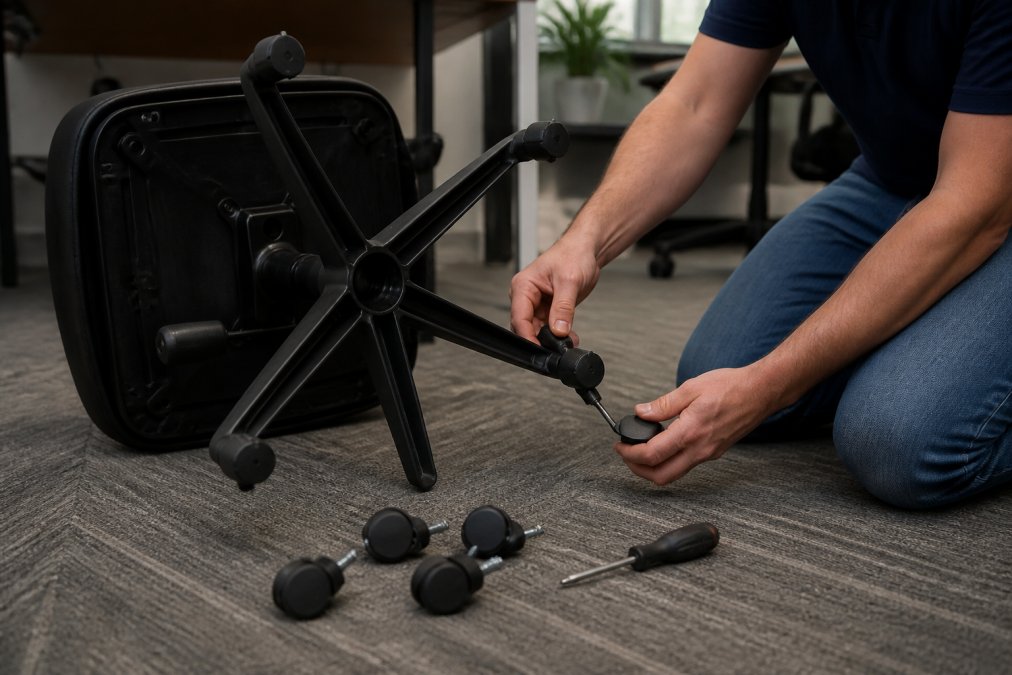
Table of Contents
- Why Replacing Casters on Used Office Chairs Beats Buying New
- Tools and Materials You Need Before You Start
- How to Remove Stuck Office Chair Wheels Without Damaging the Base
- Office Chair Caster Stem Sizes: How to Measure and Match
- Rollerblade Wheels for Office Chairs: Are They Worth the Upgrade?
- Choosing the Right Caster Material for Your Flooring
- Installing New Casters and Maintaining Them Long-Term
- Frequently Asked Questions
Last Updated: September 17, 2026
Why Replacing Casters on Used Office Chairs Beats Buying New
Replacing casters on used office chairs is the cheapest way to fix a wobbly, noisy, or stuck chair. A new set of wheels costs far less than a new chair, and the swap takes most people under 30 minutes with basic hand tools.
The chair is almost never the problem. The caster is. Fix the caster and you’ve saved a $400+ chair for the price of a set of wheels.
Tools and Materials You Need Before You Start
Gather everything first. A mid-job trip to the hardware store kills your momentum, and you’ll be tempted to force a stuck stem with the wrong tool.
What you’ll need:
- Flathead screwdriver
- Pry bar or stiff putty knife
- Needle-nose pliers
- Penetrating oil for rusted stems
- Tape measure or calipers
- Replacement casters (matched to your stem size)
- Clean rag
- Optional: rubber mallet
How to Remove Stuck Office Chair Wheels Without Damaging the Base
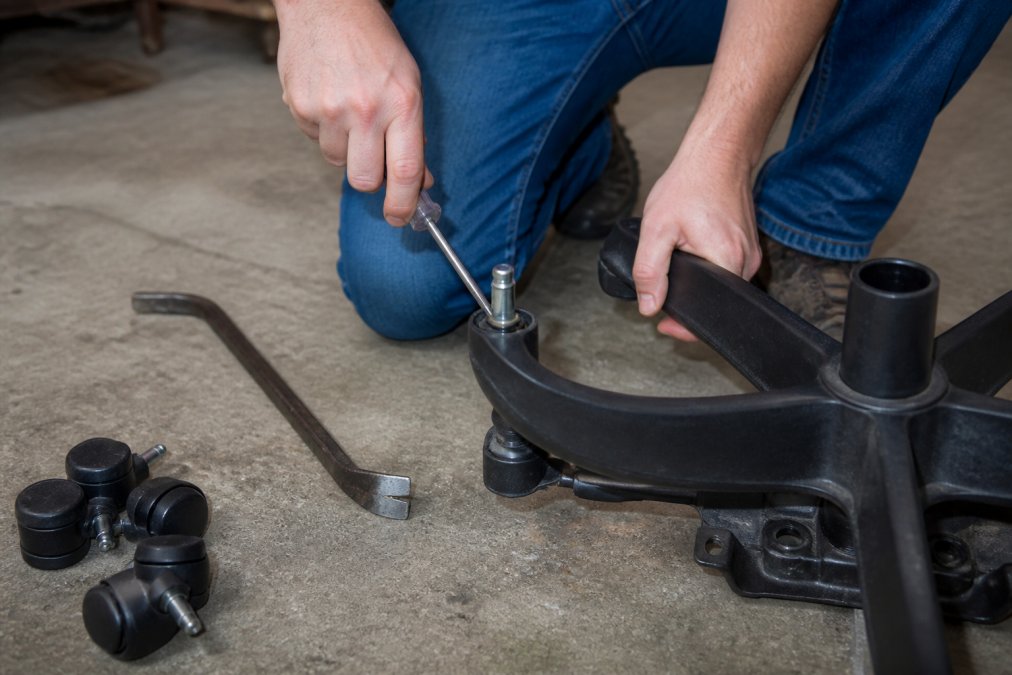
Removing a stuck caster means prying the stem straight up and out of the socket. The trick is use and patience, not force. Most chair bases are nylon or reinforced plastic, and they crack under sideways pressure.
Step-by-Step Removal Process
- Flip the chair upside down on a hard, stable surface.
- Locate the stem where it enters the base socket.
- Spray penetrating oil around the stem if it looks rusted. Wait 10 minutes.
- Slide a flathead screwdriver under the caster housing, not the stem.
- Apply steady upward pressure. Do not twist sideways.
- Work around the housing in small increments if it resists.
- Pull the caster free once it loosens, using pliers if needed.
Expected result: The stem pops out with a firm tug, and the socket stays intact.
Troubleshooting Rusted or Seized Casters
A caster that won’t budge after oil and steady pressure needs more time, not more force. Soak it again and wait another 20 minutes.
Prying sideways against a plastic base is the fastest way to crack it. A cracked base means the caster won’t seat properly, and you’ll be shopping for a whole new chair base.
Office Chair Caster Stem Sizes: How to Measure and Match
This is the section that decides whether your replacement casters work or go back in the box. Stem size is the number one reason replacement wheels fall out, wobble, or won’t seat, and it’s the detail most guides skip.
The Two Stem Types You’ll Actually Encounter
| Stem Type | How It Holds | Typical Diameter | Best For | Removal Difficulty |
|---|---|---|---|---|
| Friction ring | A rubber or plastic ring compresses against the socket wall | 7/16″ or 3/8″ | Most standard office chairs | Easy |
| Grip ring | A metal C-ring snaps into a groove inside the socket | 7/16″ or 3/8″ | Heavier chairs, higher load ratings | Moderate |
| Proprietary | Brand-specific stem geometry | Varies | Some premium lines | Varies |
Friction ring stems rely on outward pressure. Grip ring stems rely on a mechanical lock. If you pull a grip ring stem and the metal ring stays in the socket, the new caster won’t seat until you fish that ring out with needle-nose pliers.
How to Measure Your Stem Without Calipers
You don’t need machinist tools. A ruler with millimeter markings and a piece of paper will do:
- Pull one old caster using the removal steps above.
- Wrap a strip of paper snugly around the stem, mark where it overlaps, and lay it flat against a ruler. That’s the circumference.
- Divide the circumference by 3.14 to get the diameter. A 7/16-inch stem measures about 35 mm around; a 3/8-inch stem measures about 30 mm.
- Measure stem length from the base of the housing to the tip. Common lengths run about 7/8 inch to 1-1/8 inch.
- Write both numbers down, diameter and length, before you open a product listing.
Universal Fit vs. Proprietary Stems
Universal fit casters are built for the standard 7/16-inch socket found on most generic office chairs.
Order one caster first, test-fit it, then order the full set. A single test caster costs less than return shipping on four wrong wheels.
Measuring Caster Diameter and Load Capacity
Stem size is half the spec. Wheel diameter is the other half.
- Wheel diameter affects roll-over ability. A 2-inch wheel handles carpet and thresholds; a 2-1/2 inch or 3-inch wheel handles them noticeably better. Smaller wheels suit tight desk clearances.
- Load capacity is rated per caster, not per set. Multiply the per-caster rating by the number of casters (usually five) and compare that to the combined weight of the chair and the person using it. A 250 lb user on a 50 lb chair needs a set rated well above 300 lb total, with margin for dynamic load when sitting down.
Rollerblade Wheels for Office Chairs: Are They Worth the Upgrade?
Rollerblade wheels for office chairs are worth it if you roll across carpet, thresholds, or uneven floors. They use larger polyurethane wheels on ball bearings, which glide instead of drag.
If you’re swapping to rollerblade wheels, check the stem length first. Some larger wheels sit higher and need a slightly shorter stem to keep the chair at the same height.
Choosing the Right Caster Material for Your Flooring
Caster material decides whether you protect your floors or scratch them. It also decides how much effort it takes to roll. Most buyers pick a wheel by color or price and never think about the material, then wonder why the chair drags on carpet or leaves marks on hardwood.
The Three Materials and How They Behave
Hard nylon is the cheapest and the most common on budget chairs. It’s hard, durable, and rolls easily on carpet because it doesn’t deform. On hardwood, laminate, or vinyl, hard nylon transmits every bump and grit particle straight into the floor surface, that’s what causes scratches and that characteristic clacking sound.
Matching Material to Floor Type
| Floor Type | Best Material | Avoid | Why |
|---|---|---|---|
| Hardwood | Soft polyurethane | Hard nylon | Nylon grit scratches the finish |
| Laminate | Soft polyurethane | Hard nylon, rubber | Nylon scratches; rubber can mark |
| Vinyl / LVP | Soft polyurethane | Rubber | Rubber leaves scuff marks |
| Low-pile carpet | Nylon or hard polyurethane | Soft rubber | Soft wheels drag and sink |
| Plush carpet | Nylon or large-diameter polyurethane | Small soft wheels | Small soft wheels bog down |
| Concrete / tile | Any hard material | , | Surface is harder than the wheel |
The Durometer Number Nobody Mentions
Polyurethane wheels are rated by durometer on the Shore A scale. A lower number is softer. Wheels in the Shore 85A to 95A range are the sweet spot for office use, soft enough to protect hard floors, firm enough to roll on low-pile carpet. Wheels rated below 80A feel gummy and flat-spot under a seated user. Wheels above 95A behave like nylon and defeat the purpose of upgrading.
Rollerblade Wheels and Flooring
Rollerblade-style wheels are almost always polyurethane on ball bearings, which is why they roll quietly and smoothly. On hardwood and laminate, they’re the best combination of protection and glide. On plush carpet, the larger diameter helps, but a soft polyurethane rollerblade wheel can still feel slower than a hard nylon caster of the same size.
Hard nylon wheels on hardwood are a scratch waiting to happen. If your chair came with nylon casters and you have hardwood, swapping to polyurethane is the single highest-value change you can make, often more impactful than switching to rollerblade wheels.
A Note on Floor Protection
The U.S. Environmental Protection Agency’s guidance on indoor air quality and flooring notes that floor surfaces affect indoor environments. Matching wheel material to your floor isn’t just about scratches, it’s about how the chair interacts with the space you actually use it in. A chair that rolls smoothly and quietly gets used more; one that scratches and clacks gets pushed to the corner.
Installing New Casters and Maintaining Them Long-Term
Installing new casters takes seconds per wheel. Push the stem straight into the socket until it seats. You should feel it click or grip.
Maintenance keeps them rolling:
- Clean hair and debris from the wheel housing monthly
- Wipe stems with a dry rag before reinstalling
- Add a drop of light lubricant to the swivel point twice a year
- Check for loose stems every few months
Frequently Asked Questions
Are all office chair casters universal?
No. Most office chairs use one of two common stem types: grip ring (friction ring) stems that snap into a socket, and threaded stems that screw in. Within grip ring stems, the standard size is 7/16 inch diameter by 7/8 inch length, but some chairs use 3/8 inch or metric stems. Brands like Steelcase and Herman Miller occasionally use proprietary stem designs. Always measure your existing stem before ordering replacements, or check the chair’s model number against the manufacturer’s spec sheet.
How do I know what size caster stem I need for my office chair?
Pull one caster out and measure the stem’s diameter and length with calipers or a ruler. Grip ring stems are typically 7/16 inch in diameter and 7/8 inch long. Also measure the wheel diameter, usually 2 inches or 2.5 inches, and check the load capacity rating on the old caster. If the stem is unmarked, take it to a furniture supply store or match it against a sizing chart online.
Do I need tools to replace office chair wheels?
For grip ring casters, you often need only your hands, though a flathead screwdriver or pry bar helps with stubborn stems. Threaded casters require a wrench or pliers to unscrew. Keep a rag and lubricant like WD-40 on hand for rusted or seized stems, and a rubber mallet can help seat new casters firmly into their sockets. No power tools are necessary for most office chair caster swaps.
Can I upgrade to rollerblade-style wheels on a used office chair?
Yes, as long as the stem size matches your chair’s socket. Rollerblade wheels use polyurethane tires and ball bearings, which roll more smoothly and quietly than standard hard plastic casters, and they are gentler on hardwood floors. Most rollerblade caster sets come in the standard 7/16 inch grip ring size, so they fit a wide range of used chairs. Check the load capacity per wheel before buying, especially for heavier users or chairs with wide bases.
A wobbly chair shouldn’t cost you a new one. Replacing casters on used office chairs is a small job with a big payoff, and it keeps quality furniture out of the landfill. Office Furniture Warehouse stocks new and pre-owned seating from brands like Steelcase and Herman Miller, all backed by over 35 years of experience and expert design guidance. Visit our showroom today to find replacement casters or a chair that’s ready to roll.
