
Knowing what to look for when buying used cubicles can save you from paying for damaged panels, missing connectors, or a layout that will not fit your office. The best purchase is not simply the lowest-priced workstation. It is a complete, structurally sound system that matches your room, your team, and the way you expect to use the space.
Call Office Furniture Warehouse at 216-431-2700 to discuss your used cubicle project.
Office Furniture Warehouse has served Northeast Ohio for more than 35 years from its Cleveland showroom and warehouse at 4100 Payne Avenue. If you need help beyond product selection, the office furniture services guide for Cleveland explains how space planning, delivery, installation, and related services can fit into the project.
What should you look for when buying used cubicles?
When buying used cubicles, check the system brand and model, panel and worksurface condition, connector hardware, measurements, storage, electrical components, configuration options, and the supplier’s inventory details. Confirm that the complete system will fit your floor plan and that delivery, installation, repairs, and missing parts will not create unexpected project costs.
Use this guide as a practical inspection checklist. You do not need to reject a workstation because of every scratch. You do need to separate normal cosmetic wear from damage that affects safety, stability, compatibility, or the finished appearance.
1. Measure the room before you shop
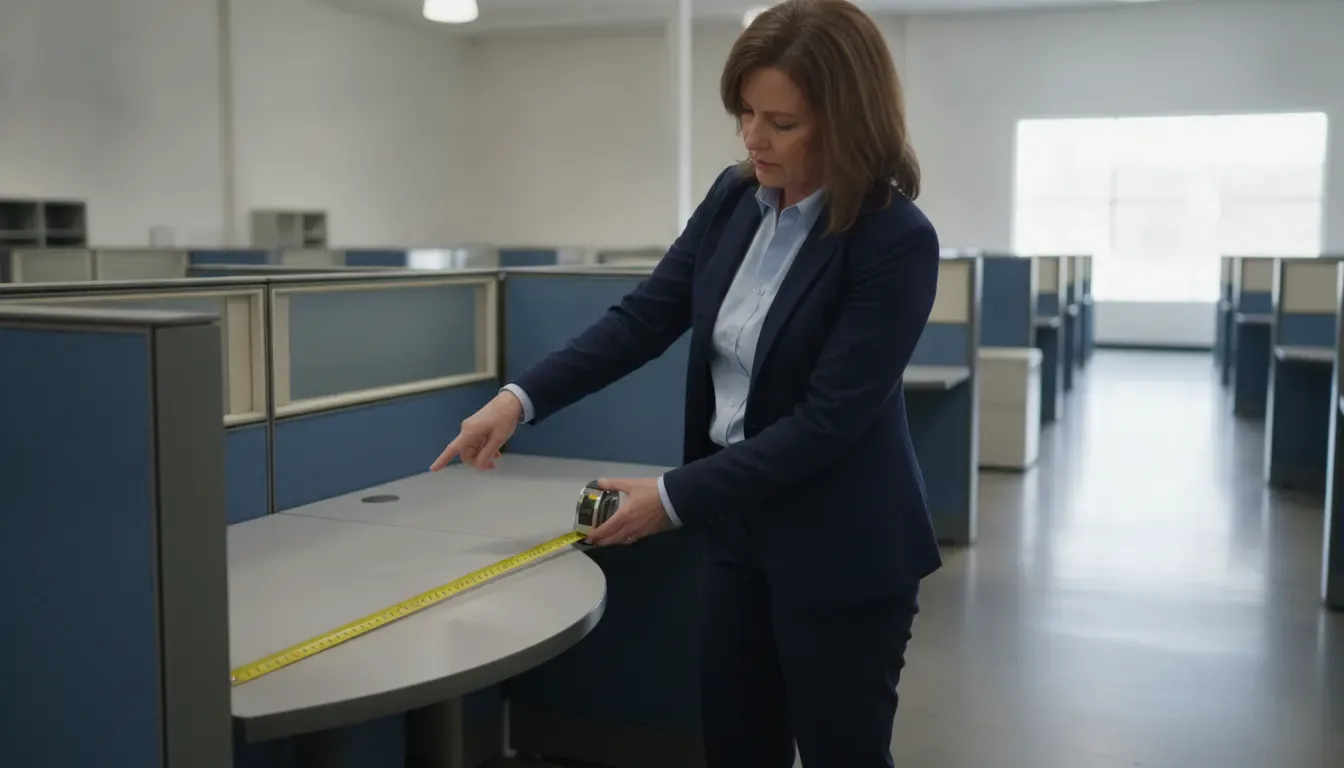
Measure the room, doors, windows, columns, ceiling height, outlets, and circulation paths before choosing used cubicles. Then compare those measurements with the complete footprint of each proposed workstation, including chairs, storage, and access space. A cubicle that looks like a bargain is not a bargain if it cannot be installed or used comfortably.
Start with a simple floor plan and mark the items that cannot move:
- Permanent walls, columns, doors, windows, and stairways
- Power outlets, data connections, lighting, HVAC vents, and sprinkler heads
- Fire exits, primary walkways, reception areas, and shared equipment
- Ceiling height and any low beams or obstructions
- Delivery access, elevator dimensions, and the route from the loading area to the office
Record both the outside dimensions of the room and the usable space inside it. A 6-foot by 6-foot workstation needs more room than its desk footprint once you account for the chair, walkways, storage doors, and the space needed to assemble it. If you are furnishing several stations, sketch the full configuration rather than evaluating one cubicle in isolation.
Panel height also matters. Lower panels can keep a room visually open, while taller panels create more visual separation. Choose based on privacy, natural light, communication, and the needs of the people using the space, not on height alone.
2. Identify the manufacturer and system
Identify the manufacturer, product line, panel height, and approximate generation before evaluating used cubicles. Steelcase, Haworth, Herman Miller, Knoll, and Allsteel systems may have different connectors, trim, worksurfaces, and power components. The exact system determines whether the pieces can be expanded, rearranged, or matched to furniture you already own.
Ask to see the label, model information, or other identifying details on the panels and components. Product names such as Steelcase Answer, Haworth Compose, Herman Miller Canvas, and Knoll Dividends are more useful than a general description such as “gray office panels.” The system identity helps you evaluate:
- Which connectors and trim pieces are required
- Whether replacement parts are likely to be available
- Which work surfaces, pedestals, overhead bins, and accessories fit
- Whether the system can support the layout and panel height you need
- Whether additional stations can be sourced later if your team grows
Do not assume that components from different manufacturers will connect just because they look similar. Even two versions of the same product line may use different hardware. If you are adding to an existing installation, provide photos and the original system information to the dealer and ask for compatibility confirmation before you buy.
3. Inspect the panels, frames, and surfaces
Inspect every visible part of the workstation, starting with the frame and panel edges. Look for bent frames, bowed panels, loose trim, water damage, delamination, torn fabric, deep stains, and unstable bases. Minor scratches may be acceptable, but structural deformation or missing hardware can affect the entire installation.
| Component | What to check | Why it matters |
|---|---|---|
| Panel frames | Edges are straight, frames are not bent, and panels stand securely. | Deformed panels can create gaps and make the system difficult to assemble. |
| Fabric or finish | Stains, tears, fraying, fading, peeling, and signs of moisture. | Visible wear affects appearance and may add cleaning or re-covering work. |
| Work surfaces | Deep scratches, swollen edges, delamination, damaged grommets, and loose fasteners. | Surface damage can affect durability and day-to-day usability. |
| Trim and connectors | Complete, undamaged pieces that match the system. | Small missing parts can prevent a complete configuration. |
| Storage | Drawers, doors, hinges, locks, shelves, and mounting points operate correctly. | Replacement or mismatched storage can change the cost and layout. |
Run your hand along panel edges and look at the workstation from different angles. A panel may appear fine from the front but show bowing or a damaged frame from the side. Check the bottom edges for moisture exposure and the areas around connectors for cracks or pulled hardware. Ask whether the pieces were stored indoors and whether they were cleaned or repaired before being offered for sale.
4. Confirm the system is complete and compatible
A used cubicle system is only useful when the necessary parts are present and compatible. Request a component-level inventory that lists panels, connectors, worksurfaces, support legs, pedestals, overhead storage, trim, electrical parts, and task accessories. Compare that list with your intended configuration before making a purchase.
Ask for a configuration plan
A dealer should be able to explain how the specific inventory will be arranged in your room. For a multi-station project, ask for a layout that shows panel lengths, workstation footprints, aisle positions, storage locations, and any components that are optional or unavailable. This gives you a way to catch missing corners, mismatched heights, or a configuration that blocks a door before delivery.
Check expansion and reconfiguration options
If your team may grow, ask how the system can be expanded. Some used cubicles are best suited to one fixed arrangement. Others are modular and can be rearranged with compatible parts. Confirm which parts are included and which would need to be sourced later. Flexibility is valuable only when the components and connectors are actually obtainable.
Match existing furniture carefully
If you are combining used cubicles with existing desks, chairs, filing cabinets, or panels, compare more than color. Check work-surface height, depth, panel thickness, connector type, trim profile, and the location of power and data pathways. A close color match cannot compensate for parts that cannot connect or work surfaces that sit at different heights.
5. Test electrical and technology components
Inspect built-in power and data components separately from the furniture itself. Look for cracked outlet covers, damaged raceways, loose parts, frayed wiring, or missing covers. Ask what is included, what has been tested, and what must be reviewed or connected by a qualified electrician before the workstations are used.
Older panel systems may include in-panel electrical or data pathways that do not match your building or technology plan. Do not assume that a power module is ready to connect simply because it is physically present. Confirm the electrical configuration, the condition of the covers and receptacles, and any required site work. If the system does not need in-panel power, ask whether the panels can be configured cleanly without it.
Also consider how your team will manage monitors, phones, laptops, printers, and other equipment. Grommets, cable paths, under-surface trays, and accessible outlets can make a major difference in a finished workstation. Include those needs in the configuration discussion rather than treating them as an afterthought.
6. Compare the total project cost, not just the sticker price
The total cost of used cubicles includes more than the furniture. Compare the condition, included components, delivery, installation, reconfiguration, repairs, electrical work, and future parts needs. A clear inventory and written scope make it easier to compare options and avoid choosing a system that requires expensive work after it arrives.
| Cost area | Question to ask |
|---|---|
| Furniture | Which panels, worksurfaces, storage units, connectors, and accessories are included? |
| Condition work | What cleaning, repairs, refinishing, or re-covering has already been completed? |
| Layout | Is the quoted configuration the one that fits the measured room? |
| Delivery | How will the furniture be transported to the building and moved to the installation area? |
| Installation | Who will assemble, level, connect, and test the workstations? |
| Future changes | Which parts may be needed if the office expands or the layout changes? |
Used furniture can provide strong value, but the cheapest individual panel is not always the lowest-cost project. A complete system with a practical layout and professional installation may be a better fit than a mixed collection of inexpensive pieces that require additional parts and rework.
What is the difference between used, refurbished, and remanufactured cubicles?
Used cubicles are pre-owned systems sold in their existing condition after the seller’s inspection and cleaning process. Refurbished cubicles have received selected repairs or cosmetic improvements. Remanufactured systems have been rebuilt more extensively, which may include new fabric, laminate, trim, or other components. Ask what work was done to the exact inventory you are considering.
These labels are not enough by themselves. One dealer’s refurbished workstation may have new fabric and repaired surfaces, while another seller may use the same word for a basic cleaning. Ask for a plain-language description of the work, the remaining wear, and the parts that were not replaced. Focus on the condition of the actual panels and components, not only the category name.
Questions to ask a used cubicle supplier
Before buying, ask the supplier to identify the system, provide a complete component list, explain the condition, confirm the layout, describe delivery and installation, and identify any electrical or site requirements. A supplier who can answer these questions clearly gives you a better basis for comparing used cubicles than a listing with only a few photos.
- What manufacturer and product line is this system?
- What panel heights, work-surface sizes, and storage pieces are included?
- Are all connectors, trim, support legs, and mounting parts present?
- Which components show cosmetic wear, repairs, or replacement fabric?
- Can the exact inventory be arranged in my floor plan?
- Will the system match my existing cubicles or furniture?
- Are power, data, raceway, and cable-management components included and tested?
- What delivery, installation, and reconfiguration services are available?
- Which parts can be sourced later if I add stations?
Use this final walkthrough checklist
Before you commit to a purchase, walk through the system in person when possible or request detailed photos and a written inventory. Confirm each point below:
- The room and delivery route have been measured.
- The manufacturer, product line, panel height, and configuration are identified.
- Frames, panels, trim, connectors, and work surfaces are structurally sound.
- Fabric, laminate, drawers, doors, shelves, and locks meet your condition expectations.
- The component list matches the number and type of workstations you need.
- The proposed layout leaves room for chairs, walkways, doors, equipment, and storage access.
- Existing furniture and future expansion needs have been checked for compatibility.
- Electrical and data requirements have been identified and routed for qualified review where needed.
- Delivery, installation, repairs, and other project scope are clear.
- The supplier has answered your questions about condition and missing parts in writing.
FAQs about buying used cubicles
What is the most important thing to check when buying used cubicles?
Start with the system’s structural condition and compatibility. Confirm the manufacturer, product line, panel condition, connectors, dimensions, and complete component list before focusing on finish or price.
How do I know if used cubicles will fit my office?
Measure the room, doors, windows, columns, ceiling height, outlets, and walkways. Compare those measurements with a layout for the exact cubicle footprint, panel height, chair clearance, storage access, and installation route.
Can I mix used cubicles from different manufacturers?
Do not assume different systems will connect. Manufacturers use different connectors, trim, work surfaces, and power components. Ask a supplier to confirm compatibility for the exact products and generations before combining them.
Should I buy used, refurbished, or remanufactured cubicles?
The right choice depends on your condition, appearance, configuration, and budget requirements. Ask exactly what cleaning, repairs, replacement fabric, laminate work, or rebuilding was done to the inventory rather than relying on the label alone.
What should be included with a used cubicle system?
A complete system may include panels, connectors, trim, worksurfaces, support legs, pedestals, overhead storage, task accessories, and electrical or data components. Request a component-level inventory and compare it with your layout.
Where can I inspect used cubicles in Cleveland?
Office Furniture Warehouse has a Cleveland showroom and warehouse at 4100 Payne Avenue. Call 216-431-2700 to ask about current cubicle inventory, compatible configurations, space planning, delivery, and installation options.
Make the purchase fit the project
Buying used cubicles works best when you evaluate the complete system instead of one panel or one low price. Measure first, identify the system, inspect the structure and surfaces, confirm every component, and ask how the furniture will be delivered and installed. For businesses in Cleveland, Akron, Canton, and across Northeast Ohio, Office Furniture Warehouse can help you compare current inventory with the needs of your space.
