
Table of Contents
- What Office Furniture Delivery Logistics Actually Includes
- How to Plan an Office Furniture Move: A Step-by-Step Process
- White Glove Service vs. Standard Delivery: What’s the Difference?
- Your Office Furniture Delivery Checklist for Move Day
- Finding Office Furniture Installation Services Near Me
- Managing Office Furniture Logistics: Scheduling, Tracking, and Handling
- Common Mistakes to Avoid When Coordinating a Furniture Delivery
- Make Your Office Furniture Move a Success
- Frequently Asked Questions
Last Updated: September 8, 2026
What Office Furniture Delivery Logistics Actually Includes
Office furniture delivery logistics is the coordinated process of transporting, scheduling, and installing commercial furniture from a warehouse to its final workspace position. It covers everything beyond simply dropping a box at the curb: route planning, inside delivery, on-site assembly, packaging removal, and debris disposal.
A common misconception is that logistics only concerns the truck and the driver. In practice, the discipline spans inventory verification, site accessibility checks, and precise installation coordination.
Below, we’ll walk through the exact steps to plan an office furniture move, compare white glove service against standard delivery, and give you the checklist that prevents move-day surprises.
How to Plan an Office Furniture Move: A Step-by-Step Process
A successful office furniture move starts with a written plan, not a phone call to a moving company. The process breaks into five phases:
- Audit your inventory. List every piece moving, note its dimensions, and flag items needing disassembly. This drives every later decision about truck size and crew count.
- Measure all access points. Doorways, elevators, hallways, and stairwells must accommodate your largest pieces. A desk that fits the showroom may not fit your freight elevator.
- Confirm the site is ready. The receiving area should be clear, the elevator reserved, and any floor protection laid down before the crew arrives.
- Schedule the delivery window. Coordinate with building management for loading dock access and with your IT team for workstation setup timing.
- Assign a point of contact. One person on site should have authority to make decisions and sign delivery paperwork.
The most overlooked step is the site accessibility check. Professional movers can handle heavy lifting, but they cannot widen a doorway or book an elevator that is already reserved. The Occupational Safety and Health Administration’s guidelines on materials handling emphasize that proper planning prevents most workplace injuries during moves, which is why measuring access points matters as much as the transport itself.
White Glove Service vs. Standard Delivery: What’s the Difference?
White glove service is a premium delivery option where the crew handles every stage of the process: transport, inside delivery to the exact room, assembly, placement, and packaging removal. Standard delivery typically means the driver brings the items to your loading dock or lobby, and your team handles everything from there.
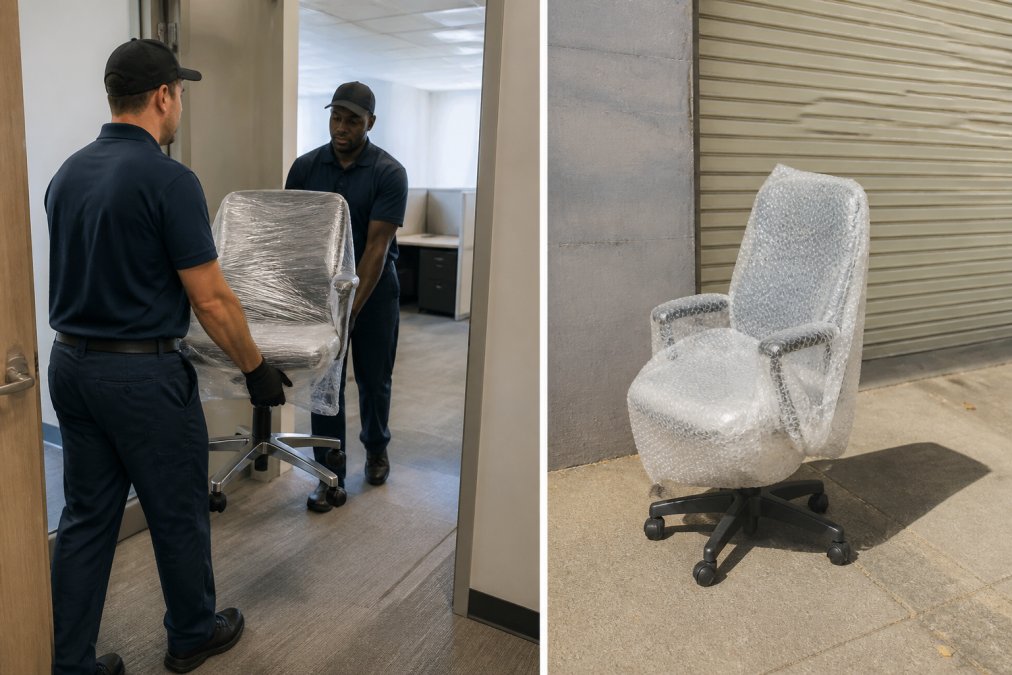
For commercial furniture, the choice is rarely about preference. It is about capacity. If you have an in-house facilities team with the tools and time to assemble workstations, standard delivery keeps costs down. If you are outfitting 15 workstations with ergonomic chairs and sit-stand desks, white glove service prevents your own staff from spending days on assembly.
| Delivery Type | What’s Included | Best For |
|---|---|---|
| Standard Delivery | Curbside or dock drop-off | Teams with in-house assembly capacity |
| White Glove Service | Inside delivery, assembly, placement, packaging removal | Full office fit-outs and multi-piece orders |
| Scheduled Delivery | Time-specific window with route planning | Buildings with restricted dock access |
Your Office Furniture Delivery Checklist for Move Day
We recommend printing this checklist and posting it at your receiving area before the crew arrives:
- Confirm the delivery window with your point of contact
- Reserve the freight elevator and loading dock for the full window
- Clear the path from the dock to each installation room
- Lay down floor protection in hallways and doorways
- Verify the inventory list matches the packing manifest
- Inspect each piece for damage before the crew leaves
- Confirm assembly locations match your floor plan
- Designate a staging area for packaging and debris
- Walk the space with the crew lead before signing off
The most expensive mistake on move day is discovering damage after the crew departs. Inspect every surface, edge, and mechanism while the delivery team is still present.
Finding Office Furniture Installation Services Near Me
Searching for “office furniture installation services near me” returns dozens of local movers, but few specialize in commercial-grade furniture. Steelcase and Herman Miller workstations require specific assembly knowledge, torque specifications, and cable management experience that general movers lack.
The Insurance Question: What “Covered” Actually Means
Most providers will say they are “fully insured.” That phrase is nearly meaningless without documentation. Before you book a crew, request a certificate of insurance (COI) and verify three specific line items:
- General liability limit. Commercial office moves typically require at least $1 million per occurrence. A provider with only a $300,000 policy may be underinsured for a floor of workstations.
- Cargo or transit coverage. This protects the furniture while it is on the truck. Without it, damage that happens between the warehouse and your dock may fall back on your own property policy.
- Workers’ compensation. If a crew member is injured in your building and the provider lacks this coverage, the claim can become your liability.
Ask the provider to name your company as an additional insured on the COI. This is standard practice for commercial projects and costs the provider nothing, but it gives you direct recourse if a claim arises. A provider that cannot produce a COI within 48 hours is a red flag.
Why the Cheapest Bid Is Usually the Most Expensive Option
A low hourly rate rarely survives contact with a real office move. A bare-bones quote typically excludes:
- Assembly labor. General movers often charge extra for any assembly beyond “drop in place.” A sit-stand desk with a cable tray can add 30 to 45 minutes of labor per unit.
- Debris removal. Hauling away cardboard, pallets, and shrink wrap is frequently billed as an add-on, or the crew simply leaves it for your janitorial staff.
- Inside delivery beyond the first floor. Stair carries or long walks from the dock can trigger per-piece surcharges.
- Tools and hardware. Brand-specific fasteners and torque tools may not be in a general mover’s kit.
A provider that specializes in commercial furniture typically bundles these into a flat project quote. That quote will look higher on paper, but it is the number you will actually pay.
The Accountability Advantage of a Single Provider
For facility managers in the Midwest, working with a provider that stocks the furniture and manages the installation creates a single point of accountability. When one company handles both the product and the logistics, there is no finger-pointing between a furniture retailer and a third-party mover when something arrives damaged. The provider that sold you the desk is the same team that assembles it, so they own the condition of the product from the warehouse rack to your workstation. The American Moving and Storage Association’s guidance on selecting movers recommends verifying licensing and insurance before any move, which applies equally to office furniture installation.
Do not rely on a verbal assurance of insurance. Request the COI before the delivery date and confirm the policy period covers your installation window. Policies lapse, and an expired certificate is as useful as none.
Three Questions to Ask Before You Book
When evaluating installation services, ask three questions beyond the price quote:
- Do your crews assemble this specific brand regularly? Ask for the brand names they handle most. A crew that works primarily with one manufacturer will know the torque specs and cable routing without consulting a manual.
- Can you provide a site survey before quoting? A provider willing to walk your space and measure access points is planning for success. A phone-only quote is a guess.
- What is your damage claim process? The answer should include a written procedure, a timeline for inspection, and the name of a claims contact. A vague answer means you will be navigating the process alone.
Managing Office Furniture Logistics: Scheduling, Tracking, and Handling
Furniture delivery logistics management is the behind-the-scenes work that keeps a move on schedule: route planning, GPS-enabled tracking, and load optimization.
Route planning matters more than most buyers realize. A delivery truck navigating city streets, restricted zones, and building dock schedules requires the same precision as a time-sensitive logistics operation.
GPS-enabled tracking has transformed how facility managers experience deliveries. Instead of waiting all day for an unspecified window, you receive updates when the truck is an hour out, then 30 minutes, then on site.
Load optimization is the quiet efficiency driver. A well-packed truck protects furniture during transit and reduces the number of trips required. Each piece should be braced, padded, and stacked according to weight and fragility.
Common Mistakes to Avoid When Coordinating a Furniture Delivery
The most frequent error is treating the delivery as an afterthought. Teams spend weeks selecting furniture, then expect the logistics to handle itself.
Mistake one: ignoring the building’s delivery rules
Many commercial buildings restrict freight elevator use, dock access, or after-hours deliveries. Discovering these restrictions on move day derails the entire schedule. Confirm the rules before you commit to a delivery date by calling the building manager, not just reading the tenant handbook. Ask specifically about:
- Freight elevator reservations. Most high-rise buildings require a booking, and the elevator may need to be padded or put on exclusive use, which can carry a fee.
- Loading dock time limits. Some docks allow only 30 minutes of unloading before a vehicle must move. A full truck of workstations cannot be unloaded in that window without a staging plan.
- After-hours or weekend delivery. If your move must happen outside business hours, confirm that the building’s HVAC and lighting will be available, and that a building representative will be on site to grant access.
A written confirmation from the building manager, including any associated fees, prevents the most common move-day surprise.
Mistake two: skipping the pre-delivery site preparation
A delivery crew can handle the furniture, but they cannot clear your path. Before the truck arrives, walk the route from the loading dock to every installation point:
- Clear the path from the dock to each installation room
- Reserve the freight elevator and loading dock for the full window
- Lay down floor protection in hallways and doorways
- Confirm doorways and hallways measure at least 2 inches wider than your largest piece
- Identify a staging area for packaging and debris, away from walkways
- Verify the elevator cab depth accommodates your longest desk or panel
- Arrange for a second person to hold doors and direct the crew
A 15-minute walkthrough the day before the move eliminates the majority of on-site delays.
Mistake three: underestimating debris volume and disposal requirements
A full office delivery generates an enormous volume of cardboard, plastic wrap, and wooden pallets. A single workstation delivery can produce 20 to 30 pounds of packaging material. Without a disposal plan, this debris overwhelms your loading dock and violates building waste policies. Sustainable disposal is not just environmentally responsible; it is often a building requirement. The Environmental Protection Agency’s Sustainable Materials Management program highlights how commercial waste reduction starts with proper recycling and disposal planning.
Before the move, confirm who removes the debris. White glove service typically includes packaging removal, but standard delivery does not. Some municipalities charge overage fees for excess commercial waste.
Ask the delivery provider whether they can return pallets and shrink wrap to their warehouse for reuse. Many commercial movers recycle these materials, which keeps them out of your dumpster and reduces your disposal cost.
Mistake four: failing to protect floors and walls
Professional crews bring floor runners and corner guards. Confirm this before the move, because scratched hardwood or dented drywall becomes your repair bill, not the mover’s. If you are using a standard delivery service, plan to supply your own protection. A roll of rosin paper and a few rolls of blue tape cost under $50 and cover the highest-traffic paths.
Make Your Office Furniture Move a Success
A smooth office furniture move comes down to preparation, the right service level, and a partner who owns the process from warehouse to workstation. Start planning weeks ahead, measure everything, and choose white glove service when your team lacks assembly capacity.
At Office Furniture Warehouse, we handle the entire journey. With over 35 years of experience, a massive 4-acre inventory of new and pre-owned furniture from brands like Steelcase and Herman Miller, and expert design and layout planning services, we manage delivery logistics so your team can focus on the work ahead.
Visit our showroom today to see how we can plan your office furniture delivery logistics from start to finish.
Frequently Asked Questions
What is included in professional office furniture delivery services?
Professional services cover more than basic transport. Look for inside delivery, where items are brought to the correct floor and room, not just dropped at the curb. White glove service adds precision installation, assembly, and placement of furniture exactly where you need it. Many providers also handle packaging removal and debris disposal, leaving your space ready for work. Confirm what the quoted service includes before you book, since options like same-day delivery or specialized handling for commercial furniture can change the scope.
How do I prepare for a large-scale office furniture delivery?
Start by measuring all doorways, hallways, and elevators to confirm your new pieces will fit. Clear the path from the loading dock to the final location, and protect floors with temporary coverings. Assign a single point of contact to direct the crew, and confirm the delivery window with your logistics provider a day in advance. Have a plan for the old furniture, whether that means scheduling removal or moving it to another zone. This prep work prevents delays and keeps the installation on schedule.
How does office furniture installation differ from standard delivery?
Standard delivery brings items to your location, but installation is a separate service that includes assembly and setup. Professional installers handle tasks like attaching desk legs, connecting modular workstations, and mounting monitor arms. They also manage the precision placement of your pieces according to your floor plan, which is critical for commercial furniture. This service saves your team hours of work and prevents damage from incorrect assembly. Always confirm that installation is included or available when you schedule your delivery.
What should be included in an office furniture delivery checklist?
A complete checklist covers pre-delivery site preparation and the day itself. Before arrival, measure access points, clear pathways, and confirm the delivery window. On delivery day, verify the furniture inventory against your order before the crew leaves. Note any damage on the paperwork immediately. Ensure packaging removal and debris disposal are handled, and confirm the installation team has access to power for assembling electric desks. Finish by walking the space to confirm every piece is placed and assembled correctly.
