Table of Contents
- Why Authenticity Matters When Buying Steelcase Chairs
- Where to Find the Steelcase Chair Identification Label
- How to Identify a Steelcase Chair Model
- Steelcase Leap V1 vs V2 Identification
- How to Spot a Counterfeit or Modified Steelcase Chair
- Buying a Used Steelcase Office Chair: Inspection Checklist
- Conclusion
- Frequently Asked Questions
Last Updated: October 14, 2026
Why Authenticity Matters When Buying Steelcase Chairs
Steelcase chairs are among the most counterfeited and misrepresented office chairs on the used market.
We’ve spent over 35 years buying and reselling Steelcase and Herman Miller furniture. Knowing what to look for saves you money and headaches.
Below, we’ll show you exactly how to verify a chair before you buy, whether you’re standing in a showroom or looking at listing photos online.
Where to Find the Steelcase Chair Identification Label
The fastest way to confirm a Steelcase chair is genuine is to find its identification label. That label sits on the underside of the seat or frame and lists the model, serial number, and manufacturing information.
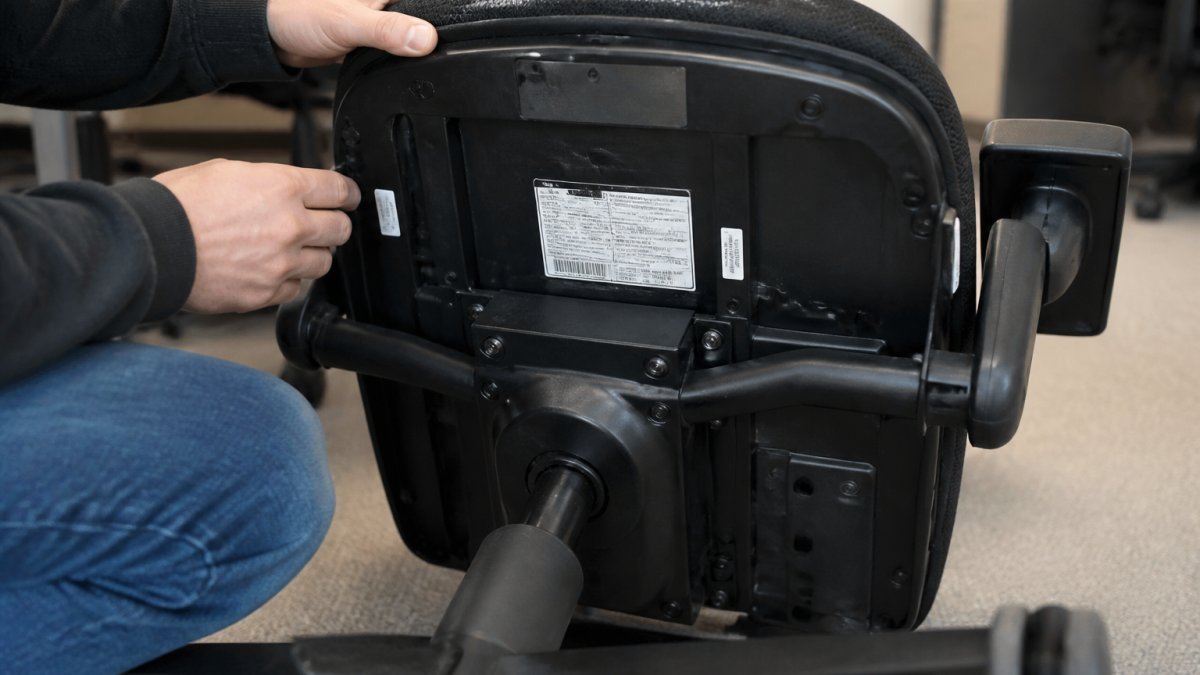
Tilt the chair onto its side or flip it over. You’re looking for a white or silver sticker, usually a few inches wide, often near the seat mechanism or under the seat pan.
Labels on the Underside of the Seat and Frame
Steelcase places labels in a few consistent spots:
- Under the seat pan, near the front edge
- On the metal frame between the seat and backrest
- On the underside of the seat mechanism housing
Some older models use a metal stamp instead of a sticker. If the label is missing, peeled, or scratched off, that’s a red flag. It doesn’t automatically mean the chair is fake, but it removes your easiest proof of authenticity.
Reading the Serial Number and Manufacturing Information
Every genuine Steelcase label includes a model number, a serial number, and a manufacture date. The serial number is your best verification tool.
Here’s how to check it:
- Photograph the label clearly, including all numbers.
- Note the model name printed on the label (for example, “Leap” or “Gesture”).
- Compare the model number against Steelcase’s official product listings.
- Contact Steelcase customer service or an authorized dealer to confirm the serial number matches the model.
A serial number that doesn’t match the model name, or a label with fuzzy printing and odd fonts, points to a counterfeit or a relabeled chair.
Take a photo of the label before you buy, even in person. If the seller won’t let you photograph it, walk away. Legitimate sellers have nothing to hide.
How to Identify a Steelcase Chair Model
Matching a chair to its correct model takes more than reading a label. You need to compare logos, stamps, and design details against known Steelcase features, and then confirm the model against the specific cues that distinguish one chair from another. This is the step most buyers skip, and it is where misidentified listings survive.
Genuine Steelcase chairs carry consistent branding. Counterfeits often get the logo size, placement, or font wrong.
Logos, Stamps, and Embossed Marks to Check
Look for these branding marks:
- A Steelcase logo on the backrest, base, or armrest
- An embossed mark on the metal base or frame
- A stamp on the seat mechanism or tilt mechanism
- A brand mark on the plastic cover over the base
The logo should be crisp and correctly proportioned. Blurry, oversized, or off-center logos are common on knockoffs. On older chairs, a stamped or embossed mark may replace a printed logo entirely, so absence of a sticker is not proof of a fake.
Model-Specific Authenticity Cues
Generic logo checks only get you so far. Each Steelcase model has identifying details that are hard to fake and easy to compare. Use the cues below as a starting checklist, then verify against the label.
| Model | Distinguishing cues to look for |
|---|---|
| Leap V1 | Straighter backrest profile, basic height/width armrests, fewer adjustment levers, firmer seat front |
| Leap V2 | Curved backrest with added lumbar support, 3D armrests, waterfall seat edge, more accessible controls |
| Gesture | Distinctive “C”-shaped armrests that pivot and rotate, four-point back support, integrated device holder |
| Series 1 / Series 2 | Slimmer back, simpler mechanism, plastic base cover on many builds |
| Think | Flexible back with a visible frame, weight-activated recline, lighter overall build |
| Amia | “LiveBack” flexing back, four adjustment levers, rounded seat edge |
If the design details don’t match any known Steelcase model, the chair is likely counterfeit, misidentified, or a modified build using mixed parts. A chair that matches one model’s backrest but another model’s arms is a strong signal of a swapped-parts build.
A Repeatable Model-Verification Workflow
Rather than eyeballing a chair, run this sequence every time:
- Photograph the identification label, including the model number, serial number, and manufacture date.
- Note the model name printed on the label (for example, “Leap” or “Gesture”).
- Compare the visible design cues against the model-specific table above.
- Compare the model number against Steelcase’s official product listings.
- Contact Steelcase customer service or an authorized dealer to confirm the serial number matches the model.
A serial number that doesn’t match the model name, or a label with fuzzy printing and odd fonts, points to a counterfeit or a relabeled chair. Recording the serial number, model number, and manufacture date in one place, a note on your phone is fine, gives you a paper trail if you later need to dispute a seller’s claim.
Model identification is a two-part test: the label tells you what the chair claims to be, and the model-specific cues tell you what it actually is. When those two disagree, trust the physical cues.
Steelcase Leap V1 vs V2 Identification
The Leap is Steelcase’s most popular chair, which makes it the most commonly faked and mislabeled. Telling a V1 from a V2 comes down to a few clear physical differences.
Here’s how to compare them:
| Feature | Leap V1 | Leap V2 |
|---|---|---|
| Armrests | Basic height and width adjustment | 3D arms with more range |
| Backrest shape | Straighter profile | Curved with added lumbar support |
| Seat edge | Firmer, flatter front | Waterfall edge for leg comfort |
| Adjustment controls | Fewer levers | More controls, easier to reach |
| Label placement | Often under seat pan | Under seat pan or on frame |
The V2 also tends to have smoother adjustment features and a more refined seat mechanism. If a seller claims a V2 but the chair has V1 armrests and a straight backrest, you’re looking at a V1 with a new label or new upholstery.
A common mistake is trusting the seller’s model name alone. Sellers sometimes list a V1 as a V2 to get a higher price. Always confirm with the label and the physical features above.
How to Spot a Counterfeit or Modified Steelcase Chair
Counterfeit and modified chairs share warning signs, but they are not the same problem, and treating them as one leads buyers to reject perfectly good chairs, or to trust a bad one. A counterfeit copies the look without the build quality. A modified chair mixes genuine and replacement parts, sometimes hiding damage. A misidentified chair may be entirely genuine and simply listed under the wrong model name.
Separating these three cases is the single most useful skill in used-chair buying, because each one calls for a different response.
Counterfeit Versus Misidentified Versus Modified
| Situation | What it looks like | How to respond |
|---|---|---|
| Counterfeit | Wrong logo font or placement, cheap materials, controls that stick or slip, price far below market | Walk away |
| Misidentified | Genuine Steelcase sold under the wrong model name, often a V1 listed as a V2 | Correct the model, renegotiate the price |
| Modified | Genuine frame with non-Steelcase or mismatched replacement parts | Ask what was replaced, inspect the swapped parts, price accordingly |
| Refurbished | Reupholstered seat or back, replacement casters, new gas cylinder | Normal and often desirable, confirm the parts used |
A counterfeit is built to deceive. A misidentified chair is usually a seller error. A modified or refurbished chair can be a legitimate, well-maintained product, as long as the seller is upfront about what changed.
Warning Signs of an Outright Fake
Watch for these signals:
- Mismatched parts, like a genuine seat on a knockoff base
- A missing or altered identification label with no explanation
- Cheap materials in the upholstery or frame
- Adjustment controls that stick, slip, or feel loose
- A price that seems far below the market for that model
- Logo proportions, fonts, or placement that don’t match known Steelcase branding
How Refurbished, Repaired, and Replacement Parts Affect Identification
A genuine Steelcase chair can carry replacement components and still be authentic. Common legitimate replacements include:
- Gas cylinders (a wear item on any chair)
- Casters and glides
- Armrest pads
- Seat foam and upholstery
- Tilt mechanism components
None of these automatically make a chair a fake. What matters is whether the seller discloses them and whether the replacement parts are appropriate for the model. A Leap V2 with a replaced gas cylinder is still a Leap V2.
Ask directly: “What has been replaced, and were the parts Steelcase or aftermarket?” A seller who can answer that question clearly is usually selling an honest chair. A seller who deflects is not.
The label, the serial number, and the design details together give you the strongest proof. No single check is enough on its own, and a replaced part is not the same thing as a fake.
Buying a Used Steelcase Office Chair: Inspection Checklist
A used Steelcase can be an excellent value if you inspect it properly. Run through this checklist before you commit.
- Confirm the identification label is present and legible
- Verify the serial number matches the model
- Check the logo, stamp, and embossed mark for consistency
- Test every adjustment control: height, tilt, arms, lumbar
- Inspect the frame and base for cracks or bends
- Look at the upholstery for tears, stains, or heavy wear
- Check the seat mechanism for smooth operation
- Ask about replacement parts and any repairs
- Confirm warranty terms if any are offered
For refurbished chairs, ask what was replaced. Genuine replacement parts matter more than a fresh coat of fabric.
Photo Checklist for Remote Purchases
Buying online means you can’t touch the chair. Request these photos from the seller:
- A clear shot of the identification label and serial number
- The underside of the seat and frame
- Close-ups of the logo and any stamps
- All four adjustment controls in use
- The base, including the metal base and plastic cover
- Any wear, tears, or damage
If the seller can’t or won’t provide these, treat it as a dealbreaker.
Conclusion
Spotting a fake or mislabeled Steelcase takes a few minutes of careful checking, but it protects your budget and your back. Start with the label, verify the serial number, and compare the design details against known models.
If you’d rather skip the guesswork, Office Furniture Warehouse has you covered. We carry a 4-acre inventory of new and pre-owned Steelcase and Herman Miller chairs.
Visit our showroom today and see the difference for yourself.
Frequently Asked Questions
How can you tell if a Steelcase chair is authentic?
Check the identification label on the underside of the seat for a serial number, model number, and manufacturing information. Genuine chairs also carry a logo, brand mark, or embossed mark on the frame, base, or mechanism. Compare visible design details like armrest shape and tilt controls against known Steelcase models. If the label is missing and the construction quality feels flimsy, treat it as a knockoff until proven otherwise.
Where can you find the model or identification label on a Steelcase chair?
Look on the underside of the seat, where most Steelcase chairs carry a white label with the model number and serial number. On some models, the label sits on the frame, under a plastic cover on the base, or near the seat mechanism. Tilt the chair onto its side in good light and check the full underside before concluding the label is gone.
How can you tell a Steelcase Leap V1 from a V2?
The Leap V2 has a thinner, more sculpted backrest and a LiveBack system that flexes with your spine. The V1 backrest is taller and flatter, with a bulkier frame. Check the adjustment controls too: the V2 armrests move in more directions and the seat edge has a distinct waterfall shape. The identification label under the seat will list the exact model and serial number, which settles the question fastest.
What should you inspect when buying a used Steelcase office chair?
Test the tilt mechanism, seat height adjustment, and armrests through their full range of motion. Check the upholstery for tears, stains, and compressed foam, and inspect the base and casters for cracks or wobble. Ask the seller for photos of the identification label and any replacement parts. A chair with a verified serial number and smooth adjustment controls is a safer buy than one with a missing label.
