Last Updated: November 22, 2026
Quick Summary
Choose eco friendly materials for office renovations by matching each product to the room’s traffic, moisture, and acoustic needs while keeping recycled content high and emissions low. Specify low-VOC paints, adhesives, and sealants, and verify every sustainability claim with a named certification, recycled content percentage, and product data sheet.
- Reception areas suit recycled-content countertops, low-VOC paint, and reclaimed wood accents.
- Specify strand-woven bamboo rather than horizontal or vertical grain for high-traffic commercial floors.
- Cork absorbs sound and suits meeting rooms but dents under chair legs and point loads.
- Ask suppliers for certificate numbers, recycled content percentages, and VOC product data sheets.
- Request an environmental product declaration to compare lifecycle impacts between functionally equivalent products.
Table of Contents
- Best Eco Friendly Materials for Office Renovations: A Room-by-Room Guide
- Eco Friendly Building Materials That Hold Up in Commercial Offices
- Low VOC Materials for Office Renovations: Protecting Indoor Air Quality
- Eco Friendly Flooring for Offices: Comparing Bamboo, Cork, and Recycled Content
- How to Verify Certifications and Avoid Greenwashing
- Lifecycle Assessment, Embodied Carbon, and Total Cost of Ownership
- Furnishing Your Renovated Office with Pre-Owned and Sustainable Pieces
- Frequently Asked Questions
Best Eco Friendly Materials for Office Renovations: A Room-by-Room Guide
Choosing eco friendly materials for office renovations starts with matching the right product to the right room. Sustainable choices work best when they are planned space by space. A reception area needs durable, low-maintenance finishes. Workstations need quiet, breathable surfaces. Break rooms need moisture-resistant products that still meet indoor air quality goals.
The stakes are higher than most buyers expect. The U.S. Environmental Protection Agency’s indoor air quality guidance notes that indoor pollutant levels can run higher than outdoor levels, and offices are no exception. Materials, finishes, and furniture all contribute. Because furnishings and finishes shape indoor air as well as the room’s character, sustainable art for offices can extend a renovation’s material choices into the spaces employees use every day.
Here is how to think about each zone:
- Reception and lobby: recycled-content countertops, low-VOC wall paint, reclaimed wood accents
- Open work areas: bamboo or cork flooring, acoustic ceiling tiles, low-emission partitions
- Private offices: FSC-certified wood doors, natural fiber wall coverings, recycled metal fixtures
- Break rooms: recycled plastic countertops, durable recycled-content tile, low-VOC sealants
- Meeting rooms: cork wall panels, natural jute rugs, energy-efficient windows
Best eco friendly materials for office renovations are the ones that fit the room’s traffic, moisture, and acoustic needs while keeping recycled content high and emissions low. Get that match right, and the sustainability case makes itself.
Eco Friendly Building Materials That Hold Up in Commercial Offices
Durability matters when choosing eco friendly building materials. An office floor takes rolling chairs, foot traffic, and cleaning chemicals every working day.
Start with these workhorses:
- Recycled steel for framing, shelving, and desk bases. Steel recycles repeatedly without losing strength.
- Recycled metals for fixtures and hardware, which cuts demand for virgin resources.
- Reclaimed wood for accent walls and reception desks. It brings natural texture and a story.
- FSC-certified wood for millwork and doors, sourced from responsibly managed forests.
- Recycled plastic for outdoor benches, storage bins, and partition components.
A common mistake is buying on recycled content alone. Ask about durability ratings and commercial warranties instead. Offices need commercial-grade, not residential-grade.
Low VOC Materials for Office Renovations: Protecting Indoor Air Quality
Low VOC materials for office renovations are paints, sealants, adhesives, and finishes that release fewer volatile organic compounds into the air. Volatile organic compounds are chemicals that vaporize at room temperature and can irritate eyes, noses, and throats. The EPA’s indoor air quality program tracks these emissions closely.
Where do they hide in a renovation? In more places than most facility managers expect:
- Interior paint and primer
- Carpet adhesive and flooring glue
- Caulk and sealants
- Composite wood panels and their binders
- Upholstery treatments on chairs and panels
The fix is straightforward. Specify low-VOC or zero-VOC paint, and ask suppliers for product data sheets before ordering. Schedule painting and adhesive work with ventilation and a buffer period before staff return.
Eco Friendly Flooring for Offices: Comparing Bamboo, Cork, and Recycled Content
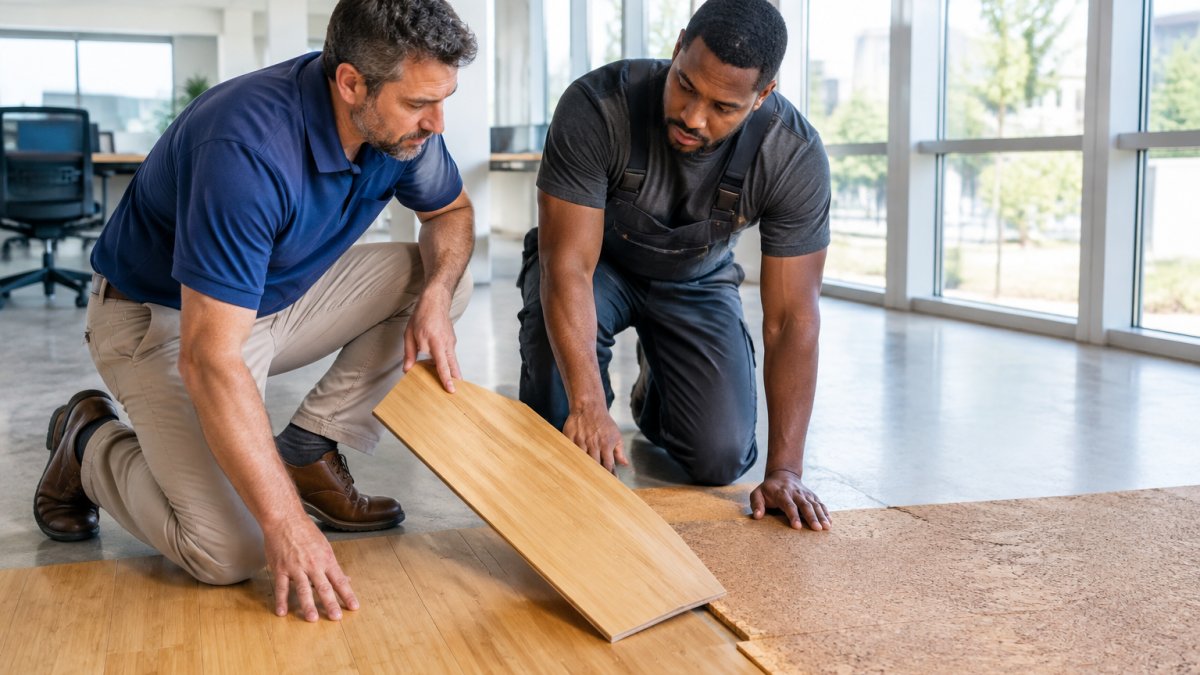
Eco friendly flooring for offices generally falls into three families: bamboo, cork, and recycled content. Each suits different rooms and fails differently when specified for the wrong one.
| Flooring | Best For | Typical Construction | Watch Out For |
|---|---|---|---|
| Strand-woven bamboo | High-traffic work areas, corridors | Click-lock or glue-down planks over a flat subfloor | Moisture sensitivity, especially at entryways |
| Cork | Meeting rooms, quiet zones, wellness rooms | Glue-down tiles or floating planks with a wear layer | Lower scratch and point-load resistance |
| Recycled carpet tile | Open offices, fast swaps, raised-access floors | Peel-and-stick or adhesive-free backing | Adhesive emissions and off-gassing |
| Recycled resilient plank | Break rooms, corridors, copy rooms | Glue-down or loose-lay over level subfloor | Limited color range and lower recycled content in wear layers |
Bamboo is a rapidly renewable grass that regrows quickly after harvest. For commercial use, specify strand-woven bamboo rather than horizontal or vertical grain; strand-woven products are denser and hold up better under rolling chairs.
Cork brings warmth and quiet. It absorbs sound, feels soft underfoot, and comes from bark that regenerates every several years without cutting the tree.
Recycled content flooring splits into two practical categories. Carpet tiles made with recycled content are the workhorse of office renovations because you replace one square, not the whole floor, and because they work over raised-access floors where cable runs change. The catch is the adhesive: many tile systems still use a wet adhesive that off-gasses, so specify adhesive-free backing or a low-VOC adhesive and confirm the emissions data sheet.
Subfloor prep is where most flooring budgets go sideways. Bamboo and resilient plank need a flat, dry substrate, and most manufacturers publish a moisture limit for concrete slabs that must be tested before installation.
Maintenance differs more than buyers expect. Bamboo and resilient plank want damp mopping with a pH-neutral cleaner and no standing water. Cork wants dry dust mopping plus occasional finish renewal.
For a deeper look at how flooring choices fit a broader fit-out plan, see our article on choosing sustainable materials for office fitouts.
How to Verify Certifications and Avoid Greenwashing
Certifications are the fastest way to verify a sustainability claim, and greenwashing is the fastest way to waste a budget. Vague terms like “natural” or “eco” carry no legal weight on their own. The U.S. Federal Trade Commission’s Green Guides set the rules for environmental marketing claims, and they are worth reading before you sign a purchase order.
Use this checklist before you buy:
- Is the certification named, and can the supplier show a certificate number?
- Does the certification cover the whole product or just one component?
- Is the recycled content stated as a percentage, not as a word?
- Are VOC emissions backed by a product data sheet?
- Does the vendor answer questions in writing?
What most buyers miss is that a certificate can cover a single ingredient. Ask what was tested.
Lifecycle Assessment, Embodied Carbon, and Total Cost of Ownership
Lifecycle assessment is the practice of measuring a product’s environmental impact from raw material extraction through manufacturing, transport, installation, use, and disposal.
Products are often compared across four lifecycle stages:
- Extraction and manufacturing. Recycled content lowers demand for virgin material, but the recycling process itself uses energy. Post-industrial content usually carries lower embodied carbon than post-consumer content because it needs less reprocessing.
- Transport. Heavy materials moved long distances carry a transport penalty. Sourcing regionally manufactured products is one of the few levers a tenant controls directly.
- Durability and maintenance. A floor or panel that lasts fifteen years amortizes its embodied carbon over a longer service life. This is where commercial-grade products beat residential-grade products even when the residential product has a better recycled-content label.
- End of life. Carpet tile, resilient plank, and metal components have established take-back or recycling paths. Composite panels and glued assemblies usually do not, which means they go to landfill.
Ask vendors for an environmental product declaration, usually shortened to EPD, which reports lifecycle impacts in a standardized format. Not every product has one, and a supplier who cannot produce one is not necessarily hiding anything, but a supplier who can is giving you a comparable number. Pair the EPD with a health product declaration if you need to document emissions for indoor air quality review.
Total cost of ownership is the budget-side version of the same thinking. Sticker price is only the first line. Add installation labor, subfloor prep, adhesives and sealants, maintenance supplies, finish renewal, and disposal. A cheaper panel that needs replacing in three years costs more than a durable one that lasts a decade, and the gap widens once labor is included.
Two practical moves for a renovation budget:
- Ask vendors for lifecycle or embodied carbon data and prefer suppliers who provide it. Where no EPD exists, ask for recycled content by percentage and for the distance from the manufacturing site.
- Factor disposal into the budget at purchase, not at demolition. End-of-life planning starts when the purchase order is signed, because take-back programs usually require the original buyer to register the product.
Watch out: embodied carbon comparisons only work when the products are functionally equivalent. A lightweight partition and a structural wall are not substitutes, and comparing their carbon numbers produces a decision that looks rigorous and is not.
For a deeper look at how reuse and circular thinking reshape office design, see our article on circular economy principles in office design. If you are weighing pre-owned equipment, our breakdown of tax rules for used office equipment helps with the cost side of that decision.
Furnishing Your Renovated Office with Pre-Owned and Sustainable Pieces
Furniture is where sustainability and budget meet most directly. Pre-owned pieces from quality brands keep working furniture out of landfills and put it back into service. We stock Steelcase and Herman Miller across our 4-acre inventory of new and pre-owned furniture. For current prices, visit our website or request a quote.
Hygiene is the question we hear most. Pairing reused desks with new finishes can help achieve a polished, professional look within a budget.
For a full buying guide, see our piece on sustainable office furniture. If you are sourcing second-hand pieces, our guide to sanitizing second-hand office furniture safely covers the practical steps. And for renovation planning, our article on choosing sustainable materials for office fitouts goes deeper room by room.
A sustainable renovation takes planning, patience, and a supplier who answers hard questions. We help facility managers, startup founders, and procurement teams match eco friendly materials with furniture that fits the budget and the space. Our team offers design and layout planning, a huge selection of new and pre-owned pieces, and flexible pickup or delivery. Get started with Office Furniture Warehouse and furnish a workspace you can feel good about.
Frequently Asked Questions
What is the most eco-friendly building material for an office renovation?
There is no single winner, but reclaimed and FSC-certified wood, bamboo, cork, and recycled-content materials typically score best on lifecycle impact. The right pick depends on the application: bamboo and cork work well for flooring, recycled steel and insulation for structure, and low-VOC paints and finishes for walls. Compare embodied carbon, durability, and maintenance needs for each surface before deciding, and verify certifications rather than relying on marketing claims.
How can I tell whether a building material is sustainably sourced?
Ask for third-party certification documentation, not just a logo on a brochure. Look for FSC certification on wood products, recycled-content verification on metals and plastics, and low-VOC or low-emission testing on paints, adhesives, and finishes. Request the manufacturer’s safety data sheets and certification numbers, then confirm them with the issuing body. A supplier that cannot produce paperwork on request is a red flag, even if the product is marketed as green.
Are recycled materials durable enough for commercial office renovations?
Yes, when specified correctly. Recycled steel performs the same as virgin steel in structural and furniture applications, and recycled-content drywall, insulation, and ceiling tiles meet the same commercial standards as new products. The key is matching the material to the traffic and load it will face. High-traffic corridors need commercial-grade wear layers, while recycled-content options work well in conference rooms and private offices. Ask your supplier for the wear rating and warranty before committing.
Which eco friendly flooring options work best for a busy office?
Bamboo and cork are popular renewable choices, but commercial offices with heavy foot traffic often do better with recycled-content carpet tiles, linoleum made from natural materials, or polished concrete. These handle wear well and many are recyclable at end of life. For a quieter, warmer feel in private offices, cork and bamboo work fine. Match the flooring to the room’s traffic level, and confirm the wear layer and warranty meet commercial standards before you buy.

