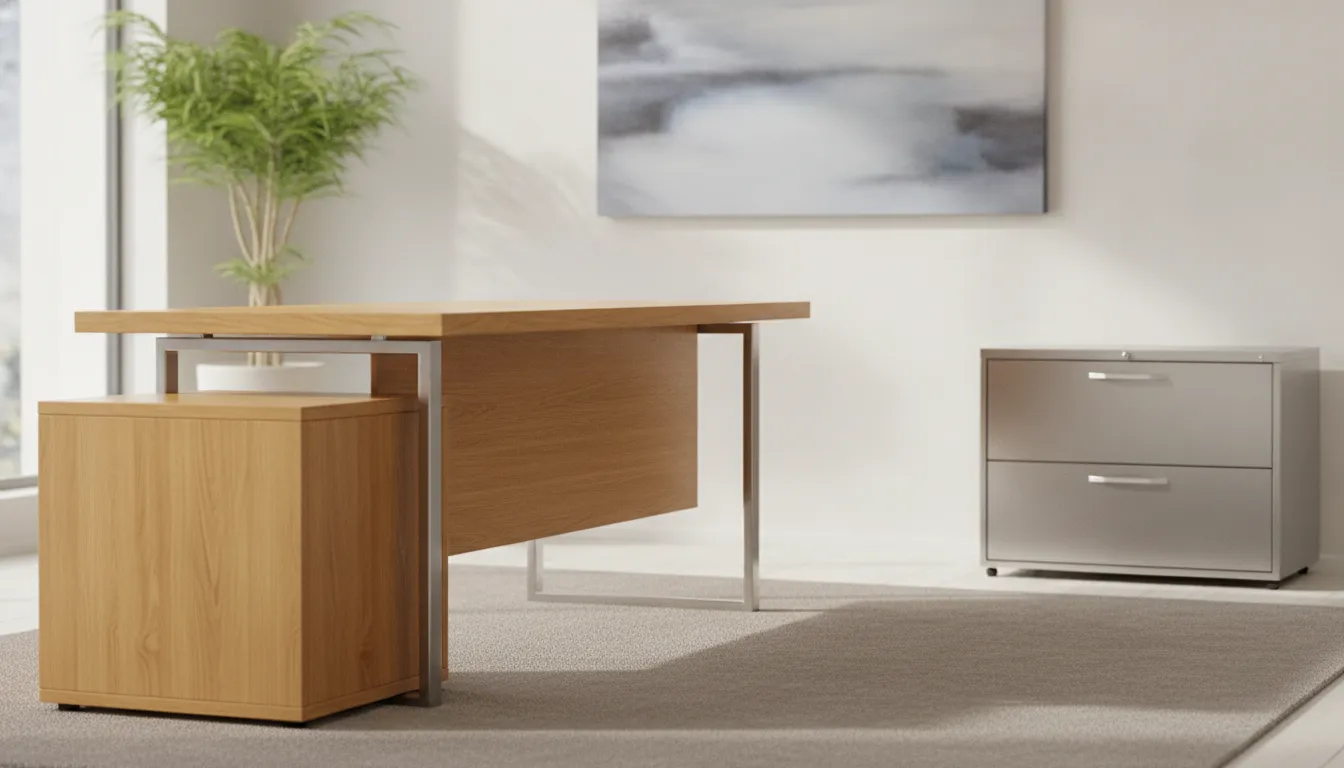
A credenza vs filing cabinet choice is really a choice about the job. A credenza is the low cabinet behind a desk or along a conference wall, with a work top and mixed storage below. A filing cabinet is built to hold hanging files, and little else. If the pile is mostly letter or legal folders, start with a file. If the pile mixes folders, supplies, a printer, and a surface you still need to use, start with a credenza.
Call (216) 431-2700 or visit the Cleveland showroom
Office Furniture Warehouse stocks both pieces at 4100 Payne Avenue in Cleveland, with new and pre-owned options and delivery, setup, and space planning across Northeast Ohio. If you only need the short definition of a credenza, our guide to what a credenza is covers that. This page is the side-by-side decision.
Start With the Job, Not the Name
Name the job before you name the furniture. A private office, a conference room, and a shared file wall do not want the same box. The wrong piece wastes floor space and still leaves the mess.
Use a filing cabinet when the work is records. Letter and legal folders, hanging rails, and a drawer that opens in a straight pull are the whole point. Vertical files take a small footprint and stack drawers high. Lateral files turn the drawers sideways, so a person can read labels without pulling a long drawer into the aisle. Our lateral file cabinets are the usual match for a file wall or a workstation return.
Use a credenza when the work is mixed and the top still has to work. Closed doors hide supplies. A drawer or two can hold active files. The top holds a printer, a sample tray, or the papers that do not belong on the main desk. In a conference room, that same low cabinet becomes a service surface for handouts and a coffee setup, not a file bank.
A third case is worth naming. If the room stores coats, bulk supplies, or tall boxes, neither piece is right. A full-height storage cabinet or a bookcase does that job. Forcing those items into a credenza or a file drawer is how doors stop closing.
Walk the room with one question: what has to be reached every day, and what only has to be out of sight? Daily files want a drawer at standing height. Daily supplies and a working surface want a credenza. Occasional archive boxes want a cabinet, not a piece parked behind the desk.
What Each Piece Actually Holds
Capacity is where buyers get surprised. A filing cabinet is honest about files and poor at everything else. A credenza is the reverse. It looks generous and then disappoints if you expected four drawers of hanging folders.
Inside a typical vertical file, each drawer is a file bay. Letter width is the common stock. Legal width is wider and worth asking for before you assume the drawer will take your folders. A lateral file is wider than it is deep, so two rows of letter files can sit side by side in one drawer. That is more file capacity per drawer, and it is also a wider object against the wall.
A credenza splits the interior. One OFW example, the laminate 4-door storage credenza, is 72 inches wide, 24 inches deep, and 29.5 inches high, with doors rather than a stack of file drawers. Another example, a refinished Kimball traditional lateral credenza, is 72 by 24 inches and is built more like a lateral file in a wood case. Same family name, different interior. Ask what is behind the doors before you count drawers.
Credenza shells are the empty case you finish with the storage you need. OFW lists shells at 71, 66, and 60 inches wide, all 24 inches deep, plus corner shells. A shell is not a finished file cabinet. It becomes one only if the pedestals and file drawers you add are sized for hanging folders. If you need a plain closed cabinet for binders and supplies, doors and shelves are the better fill.
Binders are the usual miss. A standard binder is taller than a hanging folder and wants a shelf, not a file rail. If the “files” are actually binders, catalogs, and sample books, a credenza with shelves or a bookcase will serve you better than a four-drawer vertical. Our used bookcases guide covers that neighboring choice without repeating this one.
Height, Depth, and the Space Around the Piece
Measure the furniture, then measure the person using it. A credenza that matches desk height, about 29 to 30 inches, can sit behind a chair and still leave the top usable. A filing cabinet is often taller. A four-drawer vertical can land near chest or shoulder height. That is fine against a file wall and awkward directly behind a seated person.
Depth matters as much as height. Many office credenzas and lateral files land around 18 to 24 inches deep. A vertical file is often closer to 28 inches deep once you include the drawer front and the pull. Add the drawer travel. A vertical drawer needs a clear lane in front of it, often as long as the drawer itself. A lateral drawer is shallower in travel but wider, so two people cannot share the aisle while it is open.
Leave a walking path that stays open after the drawer is out. OSHA requires exit routes to stay free of materials and equipment, and the exit access cannot run through a room that locks or into a dead-end corridor, under 29 CFR 1910.37. A file bank that blocks the only door is not a layout problem you can fix with a nicer finish. Put the tall files on a wall that is not the exit path. Keep the credenza off the swing of the office door.
Also check what is above the piece. A hutch on a credenza adds closed storage but raises the visual line and can crowd a window or a wall screen. A hutch does not turn a credenza into a filing cabinet. It turns it into a taller storage wall. If the room is already tight, skip the hutch and use a separate cabinet somewhere else.
Desk sets are the clean way to get the heights to match. A shell desk, a return, and a credenza from the same laminate line share a finish and a top height. Mixing a random metal file with a wood desk works, but only if you planned the gap between the chair and the cabinet. If the chair hits the credenza every time someone stands up, the piece is too close, not too small.
| Question | Credenza | Filing cabinet |
|---|---|---|
| Main job. | Work top plus mixed closed storage. | Hanging letter or legal files. |
| Typical height. | Near desk height, about 29 to 30 inches. | Taller as drawers stack, often chest height. |
| Best room. | Private office or conference wall. | File wall, return, or records corner. |
| Weak fit. | High-volume hanging files. | Printers, binders, and a usable top. |
Where a Credenza vs Filing Cabinet Should Sit
Placement is the part people skip, and it decides whether the piece gets used. A credenza behind the desk should clear the chair. Sit down, push back, and stand up. If your calves hit the cabinet, slide the desk forward or pick a shallower credenza. The top should hold only what you reach while standing, not a second junk drawer.
A credenza on a conference wall should stay low enough that people across the table can still see each other. That is why the 29.5-inch laminate example works in a meeting room and a 50-inch storage cabinet usually does not. Use the credenza for handouts, a speaker phone, and a closed bay for extra chairs’ accessories. Do not park archive boxes on it.
Filing cabinets belong where the files are retrieved, not where the furniture looks balanced. A lateral file under a return keeps active client folders next to the person who uses them. A run of vertical files belongs in a records corner or along a wall that is not the path to the door. If several people share the same drawers, a lateral file with a label the width of the drawer is easier to scan than a vertical stack.
Shared filing is a different project from a private-office credenza. If the whole firm needs one place for records, look at a file room plan instead of buying one more cabinet for each desk. Our notes on used filing cabinets and office storage stay on that buying question. This comparison stops at which object you need.
Reception is another special case. A low credenza can sit behind a reception station as closed storage that still looks like furniture. A raw vertical file next to the greeting desk reads as back-office storage. If the public sees it, pick the piece that can take a finish, not only a lock.
New, Pre-Owned, and What to Check in Person
Both pieces show up new and pre-owned in the Cleveland showroom. Pre-owned is often the smarter buy when the case is solid and the interior still matches the files you have. It is a poor buy when the slides are tired or the file rails are the wrong width.
On a filing cabinet, pull every drawer. It should open full length and close without a lift at the end. Look at the rails. Letter rails will not hold legal folders, and a missing rail is not a small part you should assume is in a bin somewhere. Locks should turn, and the key should work every drawer the lock claims to control. Check the case for racking: a twisted cabinet makes the top drawer bind.
On a credenza, open every door and drawer and look past the pretty front. Confirm whether the interior is shelves, file drawers, or both. Measure one real folder or binder against the opening, not against the outside width. A 72-inch case with thick side panels and a center post has less usable width than the tag suggests. Look at hinges, levelers, and the top for lift at the seams.
Finish is a separate decision. Wood and laminate credenzas can be refinished. Metal files and metal credenza cases can be electrostatically painted when the case is sound and the color no longer matches the room. That is a service call, not a reason to ignore a bent slide. Our Cleveland office furniture services include delivery, setup, space planning, refinishing, and electrostatic painting when the piece is worth keeping.
Do not guess a price from a single product page. The site shows a sample of a much larger floor, and pre-owned stock changes. The Kimball lateral credenza example has been listed at $695, which is a snapshot, not a promise that the next one matches. Call or come in for what is on the floor today.
A Simple Way to Choose
You can make the call in one pass if you write down four facts before you shop.
- List what goes inside: hanging folders, binders, supplies, a printer, or a mix.
- Mark where it sits: behind the desk, on a conference wall, under a return, or in a file corner.
- Measure the open space, including drawer travel and the path to the door.
- Decide who sees it. A public room wants a finished credenza. A records corner can take a plain file.
If step one is almost all hanging folders, buy the filing cabinet and size it letter or legal on purpose. If step one is mixed and step two is behind a desk or along a meeting wall, buy the credenza and confirm the interior before you pay. If you need both jobs, buy both, and do not ask one piece to fake the other.
Bring the measurements and one sample folder to the showroom. A sales person can match a shell, a lateral file, or a finished credenza to those numbers faster than a photo can. Space planning is available if the room has more than one workstation to solve.
Call (216) 431-2700 or plan a visit
Frequently Asked Questions
Can a credenza replace a filing cabinet?
Only if the interior has real file drawers sized for your folders. A door credenza with shelves will not hold a run of hanging files. Many offices need one of each: a credenza for the surface and mixed storage, and a file for the records.
Is a lateral file the same thing as a credenza?
No. A lateral file is a wide filing cabinet. A credenza is a low case, often with a work top, and it may or may not include file drawers. Some wood lateral credenzas blur the line. Ask to see the interior.
How much space should I leave in front of the drawers?
Leave the full travel of the drawer, plus room for a person to stand in front of it. Also keep the path to the exit clear of the open drawer and of the cabinet itself. If the only clear floor is the door swing, pick a shallower piece.
Do you carry both in Cleveland?
Yes. The showroom at 4100 Payne Avenue carries new and pre-owned credenzas, credenza shells, vertical files, and lateral files. Stock changes, so call (216) 431-2700 before you make a special trip. Hours are Monday through Friday, 8 am to 4:30 pm.
What if I am still unsure which piece I need?
Bring a folder or binder and the wall measurement. We would rather put you in the smaller right piece than the larger wrong one. If the room needs a layout, ask about space planning while you are there.
