Last Updated: November 5, 2026
Quick Summary
High-pressure laminate over a stable plywood core is the best all-round choice for a durable office desk, resisting scratches, heat, stains and moisture without refinishing. Solid hardwood is the most repairable option, since scratches and dents can be sanded out and refinished. Bamboo suits lighter home use, while standard melamine and MDF veneer have the shortest service life.
- Solid wood tops can be sanded and refinished, so they may outlast the desk frame beneath them.
- Bamboo handles scratches and heat well but needs sealing to resist moisture at its seams.
- Plywood resists warping and holds screws firmly, which matters for standing desks raised daily.
- MDF swells when water reaches raw edges, so it needs a sealed finish and sealed edges.
- Glossy laminate and glass cause glare and can make optical mice track poorly.
Table of Contents
- What Separates a Durable Office Desk Surface From a Fragile One
- How to Compare Desk Surface Materials at a Glance
- Solid Wood Desk Top: The Long-Term Performer
- Bamboo vs. Laminate Desk Top: Which Holds Up Better
- Engineered Options: Plywood, MDF, and High-Pressure Laminate
- Desk Surface Finishes That Add Years of Wear
- Choosing a Durable Computer Desk Surface for Your Office
- See Desk Surfaces in Person at Office Furniture Warehouse
- Frequently Asked Questions
What Separates a Durable Office Desk Surface From a Fragile One
The difference between a desk that survives a decade of daily work and one that shows damage in a year comes down to four measurable traits: wear resistance, moisture resistance, impact resistance, and repairability. At Office Furniture Warehouse, we have spent more than 35 years working with office furniture, including pre-owned desks in our 4-acre inventory. A durable office desk is not simply a thick slab. It is a surface built to take coffee rings, keyboard drag, monitor clamps, and the occasional dropped stapler without giving up its finish.
The single biggest mistake buyers make is judging a desktop by how it looks on day one. Almost every material looks good new. The real question is how it looks after 2,000 workdays. Below, we compare the leading options against consistent durability criteria so you can pick the right surface for your space instead of the shiniest one in the showroom.
How to Compare Desk Surface Materials at a Glance
A practical approach for an office buyer is to score each candidate against the same five performance criteria, then weigh those scores against maintenance over the desk’s service life. The criteria below are the ones that show up first in daily office use.
- Scratch and abrasion resistance: How well the surface resists keyboard drag, mouse movement, notebook edges, and cleaning. Harder finishes and denser surfaces generally score higher; soft oil finishes and thin veneers score lower.
- Impact resistance: How the surface handles a dropped stapler, a monitor arm clamp, or a chair bumped into the edge. Solid hardwood and dense bamboo resist dents; thin laminate and MDF edges chip or crush.
- Heat resistance: Whether a hot mug, laptop exhaust, or temporary placement of a projector will leave a ring or lift a finish. HPL and glass handle heat well; oiled wood and standard melamine are more vulnerable.
- Stain and chemical resistance: How the surface reacts to coffee, ink, hand sanitizer, and common office cleaners. HPL and sealed hardwood perform well; unfinished or oiled surfaces need prompt wiping.
- Moisture resistance: How the material handles spills and humidity, especially at seams and edges. Solid wood moves with humidity, MDF swells at raw edges, and HPL sealed over a stable core resists moisture best.
A practical way to use these criteria is to rate each material high, medium, or low on all five, then apply weights based on the desk’s actual use. A shared workstation near a break room should weight stain and moisture resistance heavily.
| Material | Scratch/Abrasion | Impact | Heat | Stain/Chemical | Moisture | Repairability |
|---|---|---|---|---|---|---|
| Solid hardwood (maple, walnut) | High | High | Medium | Medium | Medium | High (refinishable) |
| Bamboo | High | High | Medium | Medium | Medium | Medium |
| High-pressure laminate (HPL) | High | Medium | High | High | High | Low |
| Standard laminate/melamine | Medium | Low | Low | Medium | Low | Low |
| MDF with veneer | Medium | Low | Low | Medium | Low | Low |
| Plywood core with HPL | High | Medium-High | High | High | Medium-High | Low-Medium |
| Toughened glass | High | Medium | High | High | High | Low |
Watch out: ratings are only useful if they reflect the whole assembly, not just the top layer. A high-pressure laminate surface bonded to a swelling MDF core can still fail at the edges after a spill, so ask what core sits beneath the finish.
Use this table as a first filter, then read the sections below for the mechanisms behind each rating and the maintenance burden each material carries over time.
Solid Wood Desk Top: The Long-Term Performer
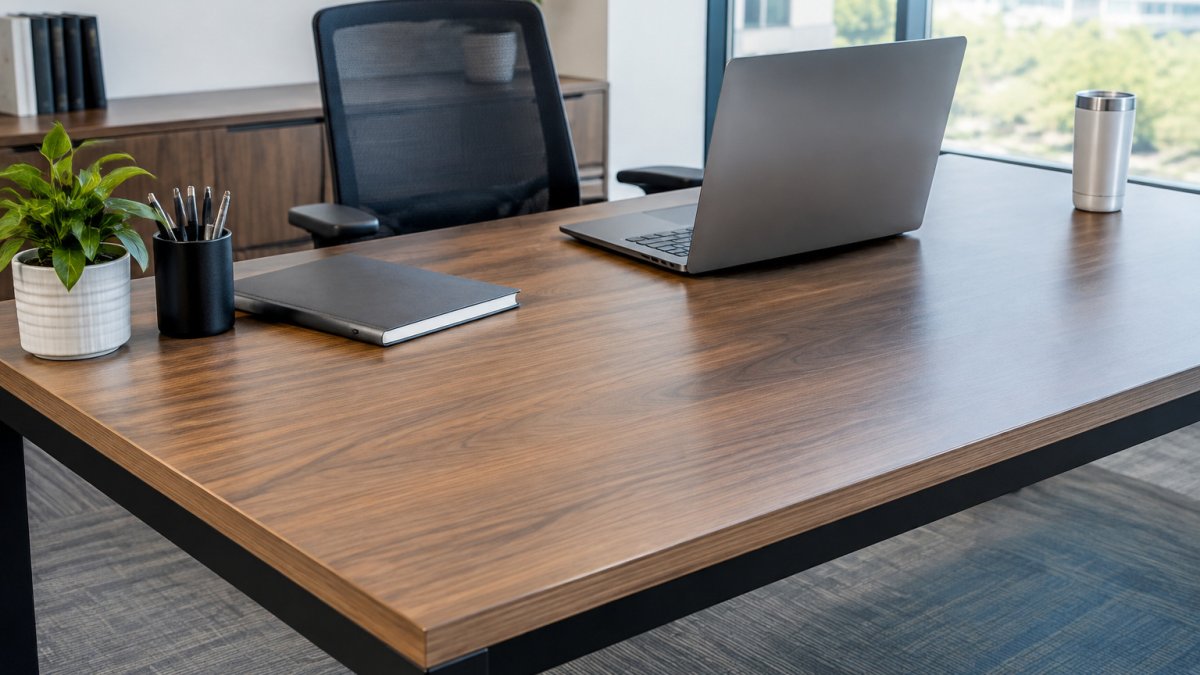
A solid wood desk top is a single thickness of real timber, and it remains the most repairable surface you can buy. Scratches and dents can be sanded out and refinished, which means a solid wood desktop can outlast the frame beneath it. That repairability is the quiet advantage most guides skip: a laminate top that chips is finished, but a hardwood top that chips can be fixed.
Hardwoods like maple and walnut hold up best under daily office use. Maple resists dents from heavy equipment, while walnut offers a deeper grain that hides minor wear. Both take a finish well and can be refinished multiple times over their life.
Solid wood needs occasional oiling or resealing to stay protected.
Hardwood vs. Softwood for Daily Office Use
Hardwood comes from slow-growing deciduous trees and holds screws, resists dents, and keeps its shape better than softwood. For an office desk, choose hardwood. Softwood dents easily under a monitor arm or a dropped mug and does not refinish as cleanly. If budget points you toward softwood, use it for a light-duty home desk, not a shared workspace.
Bamboo vs. Laminate Desk Top: Which Holds Up Better
Bamboo and high-pressure laminate each have different strengths in daily office use. Bamboo is a grass, not a wood, and it is pressed into a dense board that rivals hardwood for hardness. It resists scratches well and offers a warm, natural look that suits modern offices.
Laminate is a printed surface bonded over a core. Basic laminate can chip at the edges and delaminate if moisture gets underneath. High-pressure laminate, or HPL, is denser and far more resistant.
How Each Handles Scratches, Moisture, and Heat
Bamboo handles scratches and heat well but needs sealing to resist moisture at the seams. HPL shrugs off spills and hot mugs, which makes it the safer pick for break rooms and shared desks. Standard melamine laminate sits below both on every measure.
Engineered Options: Plywood, MDF, and High-Pressure Laminate
Engineered wood gives you stability and value, and plywood is the strongest of the engineered cores. Plywood is built from crossed layers of wood, so it resists warping and holds screws firmly, which matters for standing desks that get raised and lowered daily. MDF is denser and smoother but swells if water reaches the raw edges, so it needs a sealed finish. High-pressure laminate wraps these cores in a tough, cleanable surface, giving you the look of wood or stone without the upkeep.
If you are planning a larger fitout, our guide to choosing sustainable materials for office fitouts explains how these boards fit into a greener workspace.
Desk Surface Finishes That Add Years of Wear
The finish plays a major role in how long a desktop stays protected. A desktop finish is the protective coating applied to the surface, and it does the daily work of blocking moisture, stains, and scratches. Common options include catalyzed lacquer, polyurethane, UV-cured coatings, and oil finishes.
- Polyurethane: tough, water-resistant, good for busy desks
- Catalyzed lacquer: hard and clear, common on commercial furniture
- UV-cured coatings: fast-curing and durable, factory-applied
- Oil finishes: natural feel, easy to spot-repair, needs reapplication
Whatever the finish, care keeps it alive. Wipe spills promptly, use coasters, and avoid abrasive cleaners. Our article on caring for wood office furniture covers the daily habits that protect a finish.
Choosing a Durable Computer Desk Surface for Your Office
A durable computer desk surface is not one material; it is the material that matches the way the desk is actually used.
Shared or high-traffic workstations: Choose high-pressure laminate over a stable plywood or particleboard core. HPL resists coffee spills, cleaning chemicals, and constant keyboard and mouse movement, and it does not need refinishing.
Home office with light daily use: Solid hardwood or bamboo gives a warm surface that can be repaired rather than replaced.
Heavy equipment and monitor arms: Prioritize impact resistance and edge strength. Solid hardwood and dense bamboo hold clamps and resist denting better than thin laminate or MDF.
Budget fitouts: Standard laminate or MDF with veneer keeps costs down, but plan for shorter service life and avoid placing these desks near sinks, break rooms, or humid exterior walls.
High-humidity environments: HPL over a moisture-resistant core or toughened glass performs best.
Beyond durability, four practical factors affect everyday office use and are easy to overlook:
- Glare: Glossy laminate and glass reflect overhead lights and monitor glare. Matte finishes and satin-finished wood reduce eye strain in bright offices.
- Writing feel: Solid wood and dense bamboo feel stable under a pen; thin laminate over a hollow core can flex. If the desk doubles as a writing surface, test the feel before buying.
- Mouse tracking: Very glossy or glass surfaces can cause optical mice to track poorly. A matte finish or a desk pad solves this at low cost.
- Edge comfort and noise: Rounded or beveled edges are more comfortable for forearms during long sessions. Hollow-core desks can amplify keyboard noise; solid cores and dense materials dampen it.
Watch out: a surface that scores well on durability can still be the wrong pick if it creates glare, poor mouse tracking, or uncomfortable edges for eight-hour users.
For a wider look at desk options, see our comparison of the best office desks for productivity. If you are furnishing a full floor, read how to source matching office desks. Buying pre-owned executive desks is another smart route; our guide on what to look for when buying used executive office desks shows how to check a surface before you commit.
See Desk Surfaces in Person at Office Furniture Warehouse
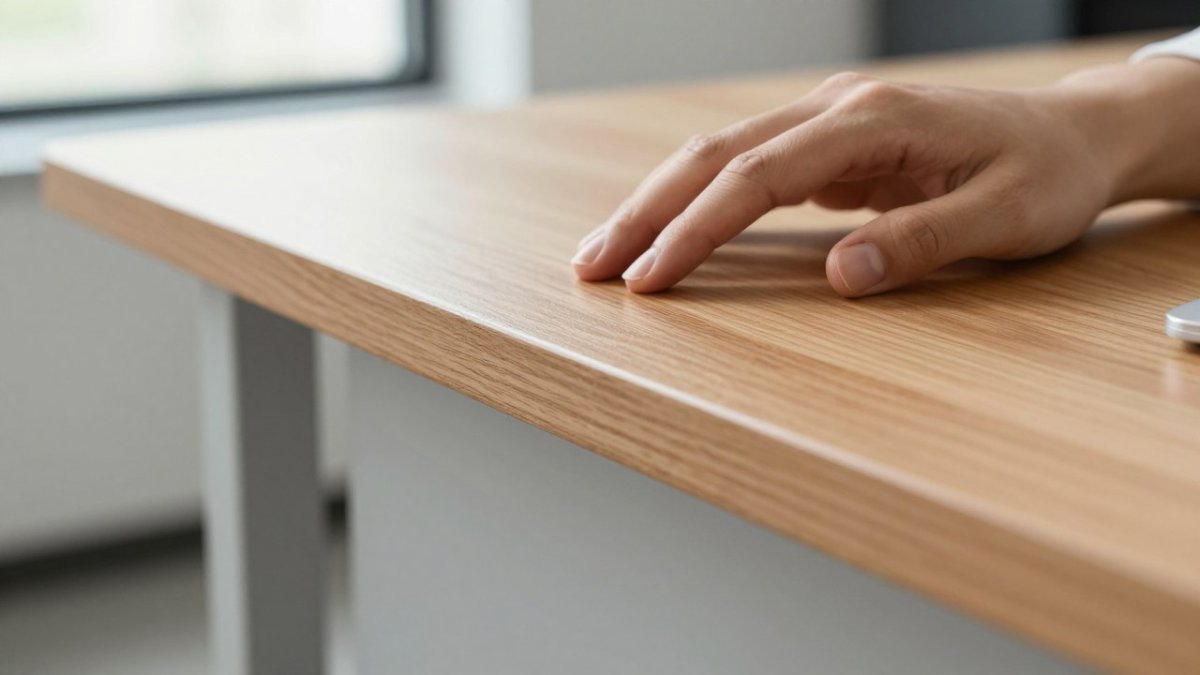
Reading about materials only goes so far. Running your hand across a solid wood top and pressing a thumbnail into a laminate edge tells you more than any spec sheet.
That is the advantage of shopping with Office Furniture Warehouse. We stock a 4-acre inventory of new and pre-owned furniture, including premium brands like Steelcase and Herman Miller, so you can compare real surfaces side by side. Our team offers expert design guidance to help match your space, with flexible pickup or delivery options. If you are outfitting a startup or refreshing a floor, we help you get a polished, durable result without overspending.
Frequently Asked Questions
What is the best material for a desk surface?
There is no single winner because the best choice depends on budget and use. Solid hardwood, such as maple, can be refinished, while high-pressure laminate is a common option for scratch and stain resistance. Bamboo is another material to consider. Match the material to how hard the desk will be used and whether you want the option to repair it later.
Which is better for a desk top, bamboo or laminate?
In a bamboo vs laminate desk top comparison, bamboo wins on appearance and repairability. It is a dense grass product that resists dents and can be sanded and refinished. Laminate wins on price, stain resistance, and low maintenance, since a printed HPL layer shrugs off coffee rings and ink. For a high-traffic shared desk, laminate is often the practical pick. For a single owner who wants a natural look and long service life, bamboo is the better fit.
Which desk surface material resists scratches and stains best?
Solid wood scratches more easily but can be sanded out. Toughened glass resists scratches but shows fingerprints. For shared workstations and hot-desking, specify HPL or a factory-applied finish, and add a desk pad under monitors and keyboards.
How do you protect an office desk surface from everyday wear?
Start with a finish suited to the material. Use a desk pad under keyboards, mice, and monitors, and felt pads under lamps and organizers. Wipe spills promptly, avoid placing hot mugs directly on the surface, and keep sharp objects off the desktop. For solid wood, plan to refinish every few years. For laminate, replace damaged sections rather than sanding.
Your office furniture should still look professional after years of daily use, not months. Visit Office Furniture Warehouse to see durable desk surfaces in person, compare materials with guidance from our team, and take advantage of our design planning and delivery options. Get started with Office Furniture Warehouse and furnish a workspace built to last.

