Last Updated: October 22, 2026
Quick Summary
The best office furniture sets for small home offices match the layout to your measured floor space: a corner L for rooms 7 by 7 feet and up, a single wall for 6 by 8 feet and up, and a closet conversion for rooms under 6 by 6 feet. Measure wall length, room depth, and door swing first, and confirm 36 inches of chair pull-out before ordering.
- A computer desk listed at 47 inches wide may need 50 inches of clear wall once assembled.
- A typical L-shaped desk runs 55 to 60 inches on the long leg with 24-inch depth.
- A 47- to 55-inch straight desk, printer stand, and wall shelf consume about 75 inches of wall.
- A wall-mounted desk 36 to 48 inches wide mounts at 29 to 30 inches high on a stud-backed wall.
- Bundles often land within 10 to 15 percent of buying the three core pieces separately.
Table of Contents
- How to Judge an Office Furniture Sets for a Small Room
- Small Home Office Layout Ideas That Actually Fit
- Compact Home Office Desk With Storage: What to Look For
- Small Office Desk and Chair Set: Matching Ergonomics to Space
- Budget Home Office Furniture Without the Flimsy Feel
- Set Costs, Assembly, Delivery, and Returns Compared
- Which Office Furniture Set Fits Your Work Style?
- Frequently Asked Questions
How to Judge an Office Furniture Sets for a Small Room
The best office furniture sets for small home offices fit your actual floor space, not a showroom photo. At Office Furniture Warehouse, we’ve spent over 35 years furnishing tight rooms, and the pattern is always the same: buyers measure the wall, order the set, then discover the chair won’t pull out.
A little measuring before you buy solves most of it. Below, we’ll show you how to size a set, which layouts work in small rooms, and where to save money without buying furniture that wobbles.
Measure the Footprint Before You Buy
Start with three numbers: wall length, room depth, and door swing. A footprint is the floor area a piece occupies once assembled, and it always runs larger than the desktop. A computer desk listed at 47 inches wide may need 50 inches of clear wall once you account for edge trim and cable gaps.
Write down your measurements in inches and keep the list with you while you shop. Most returns happen because a desk set fit the wall but not the walkway.
Clearance, Legroom, and Chair Pull-Out
Clearance is where small offices fail. A writing desk with a shallow apron can look tidy and still leave no legroom for a full-size ergonomic chair.
Measure from the wall to the nearest obstruction, then subtract the desk depth and the chair’s rolled-back position. If the result is negative, the set is too deep for the room, no matter how compact the listing claims to be.
Buying a set before checking chair pull-out is the most common small-office mistake. A desk that leaves under two feet behind the chair traps you at the keyboard and forces you to twist sideways to stand.
Small Home Office Layout Ideas That Actually Fit
Three layouts work reliably in tight rooms, but each only works inside a specific size band. Each is paired below with the room dimensions it needs, the clearance it consumes, and a coordinated set that fits, so you can match a layout to your floor plan instead of guessing from a photo.
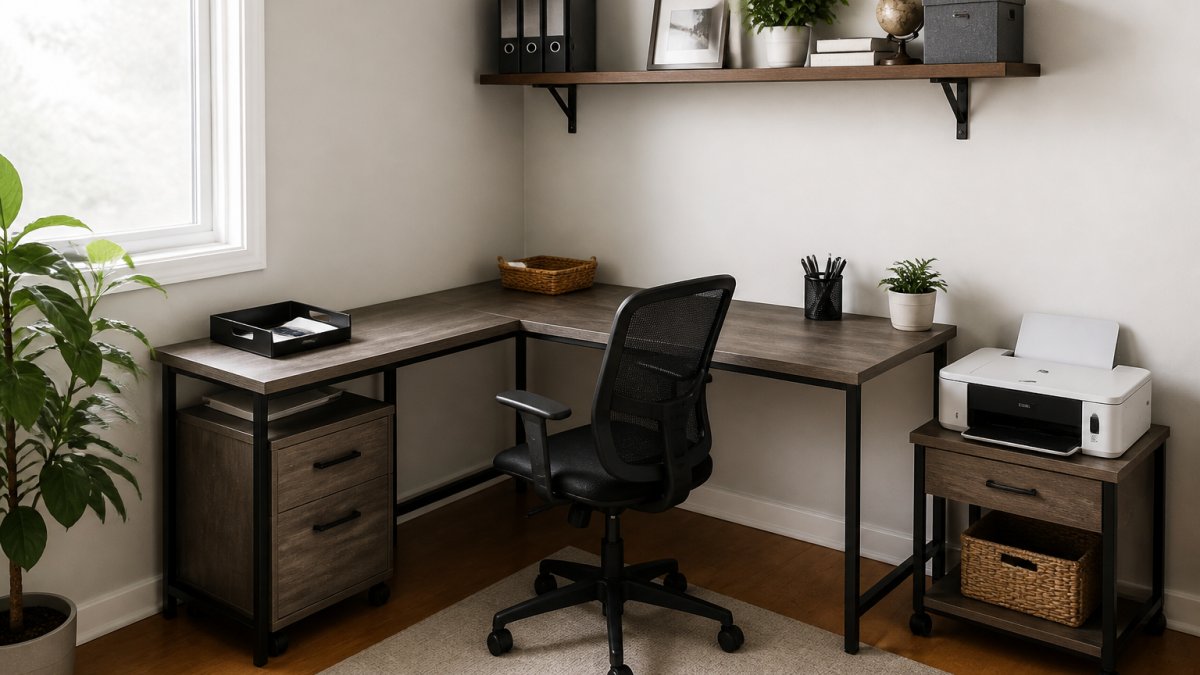
The corner L: best for rooms 7 by 7 feet and up
An L-shaped desk against two walls puts the work surface where the room is widest and leaves the center open. A typical L runs 55 to 60 inches along the long leg and 40 to 48 inches along the short leg, with a 24-inch depth on each side. That footprint needs a corner with at least 60 inches of clear wall on one side and 48 inches on the other.
Clearance math: allow 36 inches behind the chair for roll-back and stand-up, plus a 24-inch walkway to the door. In a 7-by-7 room, an L in the far corner leaves a usable center aisle of roughly 30 to 36 inches, tight but workable if the door swings outward or is a pocket door.
Set to look for: a two-piece L with a return, one under-desk filing cabinet, and a wall shelf above the short leg. Skip the hutch, it eats the corner light and makes the room feel smaller.
The single wall: best for rooms 6 by 8 feet and up
One straight desk with shelving above and a printer stand beside it. This suits narrow rooms and shared apartments because every piece sits on one plane, leaving the opposite wall free for a bed, sofa, or door swing.
A 47- to 55-inch straight desk at 24 inches deep, a 20-inch-wide printer stand, and a 12-inch-deep wall shelf above the desk consume about 75 inches of wall.
The closet conversion: best for rooms under 6 by 6 feet
A wall-mounted desk with a rolling chair that tucks away when the workday ends.
A wall-mounted desk 36 to 48 inches wide and 20 inches deep, mounted at 29 to 30 inches high, needs a stud-backed wall and a chair with a seat height that matches.
Set to look for: a floating desk with a rear cable tray, a wall-mounted shelf or two above, and a compact task chair with a low back so it fits under the desk when pushed in. Avoid filing cabinets here, they block the only floor space you have.
Whatever layout you pick, keep the walkway to the door clear. A compact workspace you have to squeeze into stops feeling like an office within a week.
Match the layout to the room, not the other way around. A corner L needs a 7-by-7 footprint, a single wall needs 6 by 8, and a closet conversion needs under 6 by 6. If your room falls between bands, size down to the next layout rather than forcing a set that leaves no chair pull-out.
Compact Home Office Desk With Storage: What to Look For
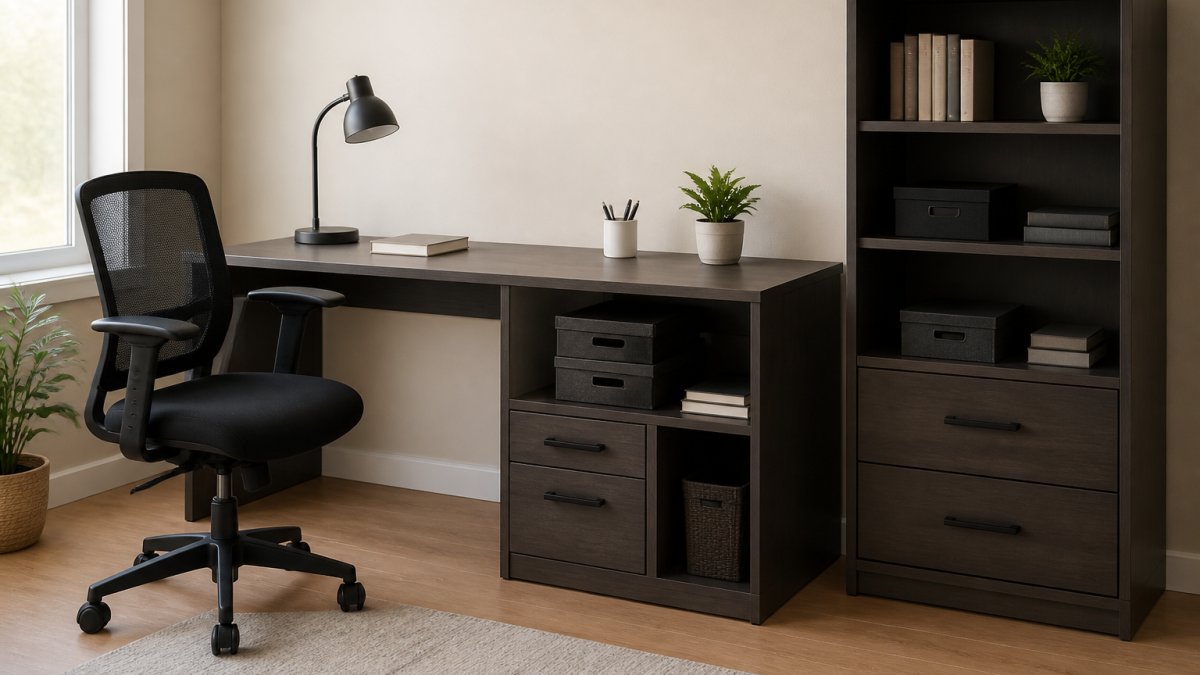
The best compact home office desk with storage hides its capacity rather than advertising it.
Two details separate good storage from bad. Metal ball-bearing drawer slides hold weight and stay smooth, while plastic runners bind once you fill them. And a desk with a grommet and rear tray keeps the work surface clear and stops cords from draping across your legroom.
If you share the room with a bed or a living area, choose a set with closed storage. Open shelves collect clutter fast in a multifunctional room.
Small Office Desk and Chair Set: Matching Ergonomics to Space
A small office desk and chair set works only when desk height and chair adjustability agree. A fixed-height desk paired with a chair that bottoms out leaves shorter users with dangling feet and taller users hunched.
Desk Height and Chair Adjustability
Standard desk height sits around 29 to 30 inches, which suits an average adult in a properly adjusted chair. If you’re outside that range, either the desk or the chair has to move.
Check the chair’s seat-height range against your own leg length before you commit. A set that fits the room but not the person is still the wrong set.
When space is tight, buy the chair first and the desk second. Chairs have narrower size ranges than desks, so matching a desk to a chair you already own is easier than the reverse.
Budget Home Office Furniture Without the Flimsy Feel
Budget home office furniture earns its price at the joints, not the finish. Pressed-wood panels with cam locks are fine for a bedroom desk. Particleboard with glued dowels and no bracing will sag under a monitor within a year.
Here is what we check on any budget set:
- Weight rating on the desktop and shelves, stated in pounds
- Bracing behind or beneath the desk, especially on wider spans
- Hardware quality on drawer slides and hinges
Pre-owned commercial furniture is the other route. Brands like Steelcase and Herman Miller are built for daily office use, and buying used puts that build quality inside a home budget.
Set Costs, Assembly, Delivery, and Returns Compared
Total cost is never the sticker alone. Assembly time, delivery fees, and return windows decide what a set really costs you.
| Consideration | What to Check | Why It Matters |
|---|---|---|
| Set price | Desktop, storage, and chair included? | Bundles often exclude the chair |
| Assembly | Time estimate and tools required | Flat-pack sets can run several hours |
| Delivery | Fee, scheduling window, room of choice | Stairs and tight doors add cost |
| Returns | Window length and who pays shipping | Large items are expensive to send back |
| Warranty | Coverage on frame vs. finish | Frames outlast surfaces |
Ask about delivery before you order. A set that arrives curbside in a building with no elevator costs more in effort than the discount saved. Confirm the return window in writing, since oversized furniture returns often carry shipping charges.
Which Office Furniture Set Fits Your Work Style?
Match the set to how you actually work, not how you’d like to. The four work styles below cover most small-home-office buyers, and each changes what the set must include, desk width, storage type, chair class, and bundle cost.
Laptop-only and occasional use
What the set needs: a writing desk 36 to 44 inches wide and 20 to 24 inches deep, one drawer, and a task chair with a seat-height range of about 16 to 21 inches.
What to skip: monitor arms, cable-heavy desks, and anything with a keyboard tray, a laptop sits on the desktop and a tray just steals legroom.
Typical bundle: desk plus chair plus one wall shelf.
Full-time remote work
What to skip: decorative hutches and open shelving that collect clutter in a room you sit in eight hours a day. Closed storage wins here.
Clearance: this is the work style that most often fails on chair pull-out. Budget 36 inches behind the chair and confirm the desk apron doesn’t hit your knees when the chair is at working height.
Two monitors or a desktop tower
What the set needs: a work surface at least 55 inches wide (two 24-inch monitors side by side need about 44 inches before you add speakers or a laptop), a printer stand, and a filing cabinet.
What to skip: corner Ls with a narrow short leg, the return often can’t hold a second monitor plus a printer.
Cable management matters more here: a grommet and a rear tray keep two monitor cables, a power strip, and a printer cable off the work surface and out of your legroom.
Mixed work and living space
What the set needs: a multifunctional set that closes up, a desk with a drop-leaf or a wall-mounted desk, closed storage, and a chair that tucks fully under the desk. Wall-mounted shelving above keeps the floor clear.
What to skip: open bookcases and printer stands on the floor. In a shared room, every floor-level piece is one more thing to move when guests arrive.
Comparing bundle cost against buying separately
A coordinated set is not automatically cheaper. Bundles often save on the desk and shelf but mark up the chair, landing within 10 to 15 percent of buying the pieces separately.
Also price the hidden costs: assembly time (flat-pack sets can run several hours), delivery fees (stairs and tight doors add cost), and return shipping on oversized items.
If you need help sizing a set to a specific room, our design and layout planning service maps a room layout before you buy.
Frequently Asked Questions
What furniture do you need for a small home office?
The core pieces are a desk sized to your room, an ergonomic chair, and one storage unit such as a filing cabinet or bookcase. A printer stand helps if you print regularly. Everything else is optional. Measure your footprint first: a desk 48 inches wide or less plus a chair that rolls out about 30 inches usually fits a spare-bedroom corner. Coordinated office furniture sets bundle these pieces so heights and finishes match, which saves time compared with buying each item separately.
Are home office furniture sets worth buying?
Sets usually cost less than buying the same pieces individually and guarantee matching finishes and heights. The trade-off is less flexibility: a set may include a bookcase you do not need or a desk that is a few inches too wide. Check the desk dimensions against your wall before ordering. If one piece does not fit, buy the desk and chair separately and add storage later. Sets make the most sense when the included pieces match your layout and equipment.
What size desk works best in a small room?
For most small home offices, a desk between 40 and 48 inches wide and 20 to 24 inches deep leaves room for a monitor, keyboard, and paperwork without crowding the space. Leave at least 30 inches behind the desk for chair pull-out. If you use two monitors, go closer to 48 inches. Measure the wall, subtract door swings and heating vents, then choose the largest desk that fits with clearance to spare.
How can you make a small home office feel bigger?
Choose furniture with visible legs or open bases so floor space shows through, and pick light finishes that reflect light. Mount shelving above the desk instead of adding a bookcase, and keep the work surface clear with drawers or a filing cabinet. A mirror opposite a window adds depth. Limiting your office furniture set to a desk, chair, and one storage piece prevents the room from feeling packed, and keeping cables managed makes the space read as tidy and larger.
Furnishing a small home office gets much easier once you stop guessing at dimensions. Office Furniture Warehouse offers over 35 years of experience, expert design and layout planning, and a 4-acre selection of new and pre-owned furniture, including premium brands at up to 80% off. Get started with Office Furniture Warehouse and build a workspace that fits your room, your body, and your budget.
