Table of Contents
- Why a Memory Foam Cushion for Office Chair Comfort Matters
- How to Choose the Best Seat Cushion for Office Chair Use
- Gel vs Memory Foam Seat Cushion: Heat, Pressure, and Durability Trade-Offs
- Memory Foam Seat Cushion for Tailbone Pain: What to Look For
- Office Chair Cushion for Long Hours: Pressure Relief and Breathability
- Side-by-Side Comparison: Memory Foam Cushion Options
- Durability, Care, and When to Replace Your Cushion
- Conclusion: Matching a Memory Foam Cushion to Your Chair and Workday
- Frequently Asked Questions
Last Updated: October 21, 2026
Why a Memory Foam Cushion for Office Chair Comfort Matters
A memory foam cushion for office chair use solves a simple problem: stock office chairs rarely fit every body. At Office Furniture Warehouse, we’ve spent 35+ years outfitting workspaces, and seating complaints are a common issue we hear from facility managers and remote workers alike. A cushion is the cheapest fix available.
The Occupational Safety and Health Administration’s guidance on computer workstations notes that prolonged sitting without proper support contributes to musculoskeletal discomfort. That’s the core argument of this guide: cushion choice is a fit problem, not a brand problem.
The best cushion is not the thickest or the softest. It is the one that keeps your hips level and your tailbone clear of the seat pan for the length of time you actually sit.
How to Choose the Best Seat Cushion for Office Chair Use
The best seat cushion for office chair use matches three things to your body and your chair: thickness, foam density, and footprint. Get those wrong and no amount of plush comfort will save you.
Start by measuring your chair’s seat pan. Then check your seated hip width. Most cushion returns come down to a mismatch in one of those two numbers.
Thickness, Density, and Firmness: What Actually Matters
Thickness determines how much you raise your seated height. A thick cushioning layer of 3 inches or more lifts you noticeably, which matters if your chair is already too tall for your desk. Foam density determines how long the cushion holds its shape. High-density foam resists compression; low-density foam feels great in week one and flattens by month three.
Firmness is personal, but firm beats plush for long sitting hours. Soft foam lets your sit bones sink until you’re effectively on the chair pan again.
Chair Compatibility and Sizing Guidance
Chair compatibility comes down to the seat pan, not the chair’s brand. Measure the pan’s width and depth, then pick a cushion that leaves a small margin on each side. An oversized cushion overhangs the pan and tips when you shift weight.
For task chairs with a pronounced waterfall edge, a thinner cushion (around 2 inches) preserves the edge’s leg circulation benefit. For flat, hard pans, a contoured shape of 3 inches works better.
Gel vs Memory Foam Seat Cushion: Heat, Pressure, and Durability Trade-Offs
The gel vs memory foam seat cushion decision comes down to heat. Memory foam responds to body heat, which is exactly why it conforms so well, and exactly why it retains warmth under a long sitter. Gel-infused foam and gel layers move heat away faster and stay cooler through an eight-hour day.
Pressure distribution is close between the two. Memory foam spreads load across a wider area; gel concentrates cooling at contact points. On durability, high-density memory foam generally holds its resilience longer than gel, which can compress or migrate over years of daily use.
A cheap gel layer bonded to low-density foam is the worst of both worlds: it runs warm once the gel warms through and loses support as the foam beneath compresses. Check foam density before you pay for the gel label.
Memory Foam Seat Cushion for Tailbone Pain: What to Look For
A memory foam seat cushion for tailbone pain needs one feature above all: a coccyx cutout.
Look for a cutout that runs the full depth of the rear edge, not a shallow notch. Pair it with a contoured shape that slopes the thighs slightly downward.
One honest caveat: cushions manage comfort, they don’t treat a medical condition. If pain persists, see a clinician. What a cushion can do is remove the daily pressure that makes long sitting worse.
Office Chair Cushion for Long Hours: Pressure Relief and Breathability
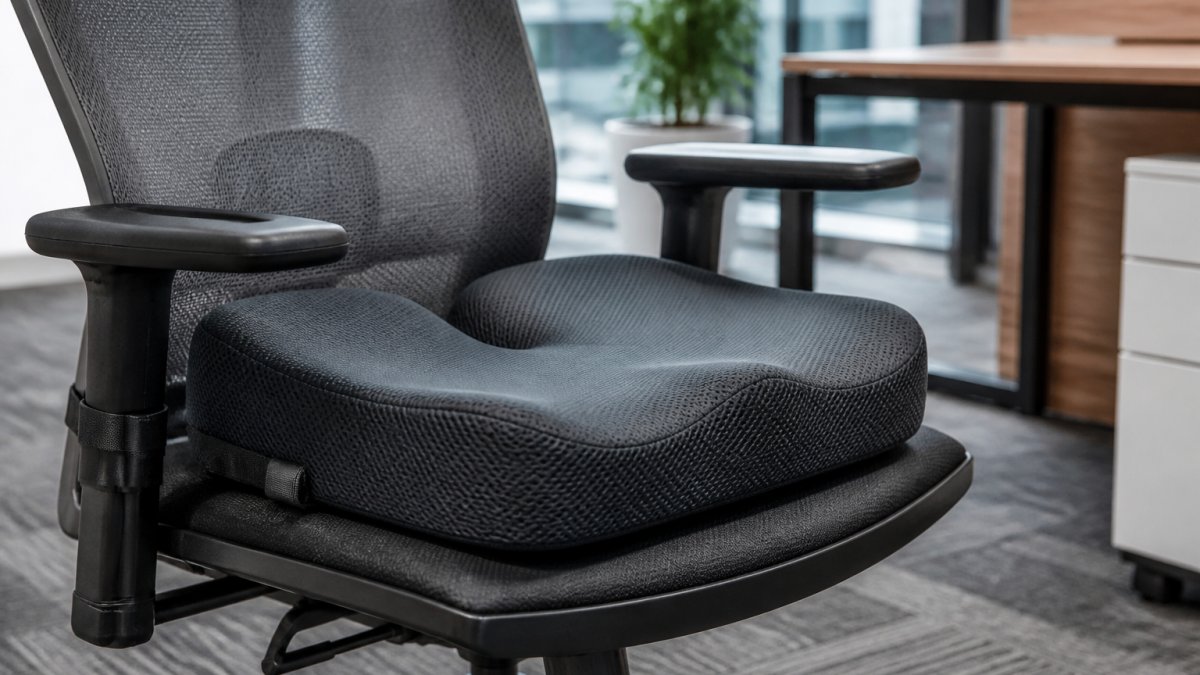
An office chair cushion for long hours has to do two jobs at once: hold pressure relief for eight hours and stay breathable enough that you do not overheat. Those goals pull against each other, because dense supportive foam traps heat.
The Heat and Pressure Trade-Off
Memory foam conforms by responding to body heat, which is exactly why it distributes pressure well and exactly why it retains warmth under a long sitter. Higher-density foam supports better but resists airflow; lower-density foam breathes better but bottoms out. Gel-infused layers and ventilation channels move heat away faster, but a thin gel layer bonded to low-density foam is the worst of both worlds: it warms through and loses support as the foam beneath compresses.
What Actually Keeps a Cushion Cool and Stable
The fix is in the cover, the base, and the foam structure:
- Breathable cover: a mesh or knit structure lets heat escape; a smooth synthetic cover traps it.
- Ventilation channels or gel layers: useful for moving heat, but only after density is adequate.
- Non-slip base and straps: keep the cushion from creeping forward as you shift, which otherwise forces you to re-settle and redistributes pressure unevenly.
- Removable, machine-washable cover: the difference between a cushion you keep for years and one you retire because it smells.
Comfort Features vs. Health Claims
A cushion manages comfort; it does not treat a medical condition. Features like a coccyx cutout, contoured thigh slope, and pressure-relieving foam reduce daily pressure and improve seated tolerance, but they are not a substitute for clinical care. If pain persists, worsens, or includes numbness or tingling, see a clinician. What a cushion can do is remove the daily pressure that makes long sitting worse, and that is a meaningful but limited benefit.
Rotate your cushion front-to-back once a week. It spreads compression across the foam and roughly doubles the time before the front edge flattens.
Side-by-Side Comparison: Memory Foam Cushion Options
Most cushion listings hide the two specs that decide whether a cushion works for you: foam density and exact dimensions. Rather than repeat marketing claims, we compare what is verifiable and flag what is not, so you can judge fit instead of guessing from comfort language.
What to Compare Before You Buy
Four numbers and two design details do most of the work:
- Seat pan footprint (width x depth): the cushion should sit inside the pan with a small margin, not overhang it.
- Cushion thickness: 2 inches preserves a waterfall edge; 3 inches or more suits flat, hard pans but raises seated height.
- Foam density: higher density resists compression; low density feels plush in week one and flattens by month three.
- Weight limit and warranty: the clearest proxy for expected durability and the seller’s confidence in the foam.
- Cover and base: removable, washable cover and a non-slip base with straps determine real-world longevity.
- Coccyx cutout depth: a full-depth U-channel suspends the tailbone; a shallow notch does not.
Comparison Table: Key Specs and Features
| Cushion | Foam Type | Listed Dimensions | Standout Feature | Watch Out For |
|---|---|---|---|---|
| Everlasting Comfort | Memory foam | Not listed | Multi-use for office, car, travel | Price and dimensions not shown |
| TushGuard | Extra-dense memory foam | Not listed | Soft-support feel, best-seller listing | No warranty or size details |
| Cushion Lab | Charcoal-infused memory foam | Not listed | Shape retention for all-day use | Price varies between listings |
| ErgoActive | Memory foam | 13-13/16″ H x 17-3/4″ W x 3″ D | Published dimensions | Pricing requires retailer login |
How to Read the Table
The table is deliberately honest about missing data. Where a listing does not publish dimensions or density, treat that as a fit risk, not a neutral blank. The ErgoActive is the only option here with published dimensions, which makes it the easiest to check against your chair pan before ordering. For the others, confirm dimensions and foam density with the seller or read the return policy before you buy.
Pros and Cons of Each Option
Everlasting Comfort suits buyers who want one cushion for the desk, the car, and travel.
TushGuard markets an extra-dense foam, which is the right direction for durability. The trade-off is that “soft support” and “extra-dense” are different promises, so read the return policy carefully.
Cushion Lab uses charcoal-infused foam, and the comparison source we reviewed credits it with holding shape longer than cheaper options.
ErgoActive is the only option here with published dimensions, which makes it the easiest to check against your chair pan.
Before ordering any cushion, measure your seat pan width and depth and write the numbers down. Then compare them to the cushion’s published footprint. If the seller will not provide dimensions, that is your answer.
Durability, Care, and When to Replace Your Cushion
Durability comes down to foam density and how you treat the cover. High-density foam holds its resilience through years of daily use; low-density foam compresses permanently within months. Wash the cover on a gentle cycle and air-dry it rather than machine-drying, since heat breaks down foam and elastic.
Replace the cushion when it stops springing back. Press your palm into the center: if the indentation lingers after a few seconds, the foam has lost compression resistance. That’s your signal.
Buyers who want to verify fit before ordering: choose a cushion with published dimensions, like the ErgoActive, and measure your chair pan first.
For offices furnishing multiple workstations, buying quality pre-owned seating from a source like Office Furniture Warehouse often beats adding cushions to worn-out chairs. We carry Steelcase and Herman Miller models at up to 80% off, and our design team can help you plan seating that fits your team and your budget.
Conclusion: Matching a Memory Foam Cushion to Your Chair and Workday
The right cushion is a measurement exercise, not a shopping spree. Match thickness to your desk height, density to your sitting hours, and footprint to your seat pan, and most comfort problems disappear.
If you’re furnishing a full office or replacing seating that no cushion can save, visit our showroom. Office Furniture Warehouse offers expert design and layout planning, a 4-acre inventory of new and pre-owned furniture, and flexible pickup or delivery. Get started with Office Furniture Warehouse and build a workspace your team can actually sit in.
Frequently Asked Questions
Are memory foam cushions good for office chairs?
Yes, a memory foam cushion can improve comfort on office chairs by adding pressure relief and contouring to the seat. Memory foam adapts to your body shape, which helps distribute weight more evenly during long sitting hours. Look for high-density foam (often 3 to 5 pounds per cubic foot) and a thickness of 2 to 3 inches for a balance of support and comfort. A non-slip base and breathable cover also help with daily use. Keep in mind that memory foam can retain heat, so if you run warm, consider a gel-infused or hybrid option.
How do I choose a memory foam cushion for an office chair?
Start by measuring your chair’s seat dimensions (width and depth) and match the cushion size to avoid overhang or sliding. Consider your primary need: tailbone relief calls for a coccyx cutout; sciatica or lower-back comfort may benefit from a contoured shape with a slight wedge. Thickness matters: 2 inches suits most users, while 3 inches adds more lift but may feel unstable. Check the cover for machine washability and the base for grip. Finally, compare foam density and read reviews about long-term compression before buying.
Can a memory foam seat cushion help with tailbone discomfort?
A memory foam seat cushion for tailbone pain often includes a U-shaped cutout at the rear to suspend the coccyx and reduce direct pressure. This design can ease discomfort during long sitting hours, especially on hard office chairs. Look for a cushion with a contoured shape and supportive foam that does not bottom out. Pair it with proper chair height and lumbar support for best results. If pain persists, consult a healthcare professional; a cushion is a comfort aid, not a medical treatment.
Do memory foam cushions get too hot for long sitting sessions?
Traditional memory foam can trap heat because it is dense and less breathable. For long sitting hours, choose a cushion with a breathable fabric cover, ventilation channels, or gel infusion to reduce heat retention. Gel vs memory foam seat cushion comparisons often highlight gel’s cooler feel, but gel can be heavier and may lose some contouring over time. A hybrid cushion that combines memory foam with a gel layer or airflow channels can balance support and temperature. Rotating or airing out the cushion also helps.
