Table of Contents
- What Sustainable Office Furniture Actually Means
- Sustainable Office Furniture Materials: What to Look For
- Office Furniture Sustainability Certifications and How to Verify Them
- Total Cost of Ownership: Lifecycle Costing for Buyers
- Used Office Furniture Buying Guide: Reuse and the Circular Economy
- How to Evaluate Used Office Furniture Before You Buy
- A Practical Buying Checklist and Decision Framework
- Frequently Asked Questions
Last Updated: October 19, 2026
What Sustainable Office Furniture Actually Means
Sustainable office furniture is furniture designed, manufactured, and delivered to minimize environmental impact across its full life, from material sourcing through disposal or reuse.
This buying guide from Office Furniture Warehouse covers how to answer that second question. With over 35 years of experience and a massive 4-acre inventory, we see a pattern where buyers often focus on recycled content but overlook the significant sustainability benefit of buying furniture that already exists.
Three things drive real environmental impact in office furniture: material choice, product lifespan, and what happens at end of life. Most purchasing decisions weigh only the first. The other two usually decide the outcome.
Sustainable Office Furniture Materials: What to Look For
Material selection is where most sustainability claims live, and where most of them are thinnest. A chair marketed as “eco-friendly” may contain a small percentage of recycled content in one component while the frame, foam, and finish are entirely conventional. The fix is to compare materials on three axes at once: recycled content, recyclability at end of life, and how the material affects product lifespan.
Prioritize materials that are genuinely circular or renewable:
- Recycled materials in steel frames, aluminum bases, and task chair components, which are highly recyclable at end of life
- Reclaimed wood for casegoods and tables, diverting material from landfill while adding character
- Responsibly sourced materials with documented chain of custody for any virgin timber
- Bamboo and other rapidly renewable resources for surfaces and accents
- Low-VOC materials in finishes, adhesives, and foam, which protect indoor air quality in enclosed workspaces
Recycled, Reclaimed, and Renewable Options
The practical distinction is recyclability versus recycled content. Steel and aluminum are among the most recycled materials on earth and hold resale value, which is why a used steel-frame task chair is often a better environmental choice than a new budget chair built from mixed plastics.
Reclaimed wood and bamboo reduce demand for virgin timber. Neither offsets a short product lifespan. A reclaimed table that fails in four years has a worse footprint than a conventional table that lasts twenty, because the manufacturing impact is repeated.
A simple comparison method for any two products:
| Question | Strong answer | Weak answer |
|---|---|---|
| Recycled content | Stated by weight, component by component | A single percentage with no breakdown |
| Recyclability | Metal frame, separable components | Bonded mixed materials |
| Repairability | Replaceable casters, cylinders, upholstery | Sealed or glued assemblies |
| Emissions | GREENGUARD or GREENGUARD Gold certificate | “Low-VOC” with no test |
| Sourcing | FSC code for wood content | “Responsibly sourced” with no documentation |
Score each product against the same five questions and the trade-offs become visible. A chair with high recycled content but a sealed mechanism may lose to one with slightly less recycled content that can be repaired for a decade.
Ask for the material breakdown by weight, not by marketing claim. A supplier who can tell you the steel content, foam density, and finish type of a chair knows their product. One who answers only with the word “green” does not.
The most common material mistake is optimizing one component. A recycled seat fabric on a chair with a non-replaceable gas cylinder is a cosmetic win. Weight the frame, mechanism, and foam, the parts that determine whether the product survives, before the visible surfaces.
Office Furniture Sustainability Certifications and How to Verify Them
Certifications are useful only when you know what each one tests and how to confirm the claim attaches to the specific product you are buying.
BIFMA LEVEL is a multi-attribute certification for furniture and seating.
GREENGUARD and GREENGUARD Gold are indoor air quality certifications administered by UL. They test for volatile organic compound (VOC) emissions from the finished product.
FSC certification applies to wood and wood-fiber products. It verifies that fiber comes from responsibly managed forests through a documented chain of custody.
Verification takes minutes and follows the same pattern for all three.
A practical documentation request to any supplier:
- The certificate number and the exact product model it covers
- The manufacturing facility named on the certificate
- The certificate’s expiration date
- Whether the claim is product-level or company-level
The U.S. Environmental Protection Agency’s indoor air quality guidance explains why low-emission materials matter in sealed commercial buildings. The U.S. Green Building Council’s LEED materials and resources criteria shows how furniture choices feed into broader building certification, which is often the real reason a facility manager needs documented proof.
Watch for self-declared claims with no third-party audit behind them. “Eco-friendly” and “sustainable” are not regulated terms in furniture, and a logo without a registry entry is marketing, not verification.
Build a one-page certificate log for every project: product model, certification body, certificate number, registry check date, and expiration. It takes minutes per item and gives you a defensible record if a building certification or internal audit asks for proof later.
Total Cost of Ownership: Lifecycle Costing for Buyers
Lifecycle costing is the practice of comparing furniture by total cost across its useful life rather than by purchase price alone. It is the single most useful habit in sustainable procurement, because the cheapest chair is rarely the least expensive one.
Build the comparison from four cost lines:
| Cost Line | What to Include | Why It Matters |
|---|---|---|
| Acquisition | Unit price, delivery, installation | The only line most buyers track |
| Maintenance | Replacement parts, reupholstery, repairs | Quality furniture is repairable; budget furniture is not |
| Churn | Expected replacement cycle in years | A 5-year chair costs twice a 10-year chair per year |
| Disposal | Removal, hauling, resale recovery | Responsible disposal has a cost; resale offsets it |
A pre-owned Herman Miller or Steelcase task chair typically carries a longer remaining service life than a new entry-level chair at a similar price, because the frame and mechanism were built to a higher standard. That is the arithmetic behind buying pre-owned, and it is why we recommend it to budget-conscious buyers who intend to keep furniture for years rather than months.
Pricing on any specific piece depends on quantity, condition, and delivery, so request a quote rather than working from list assumptions.
Used Office Furniture Buying Guide: Reuse and the Circular Economy
Reuse is the highest-impact decision in this entire guide. Every pre-owned desk that returns to service avoids new manufacturing, avoids packaging, and delays landfill waste by years.
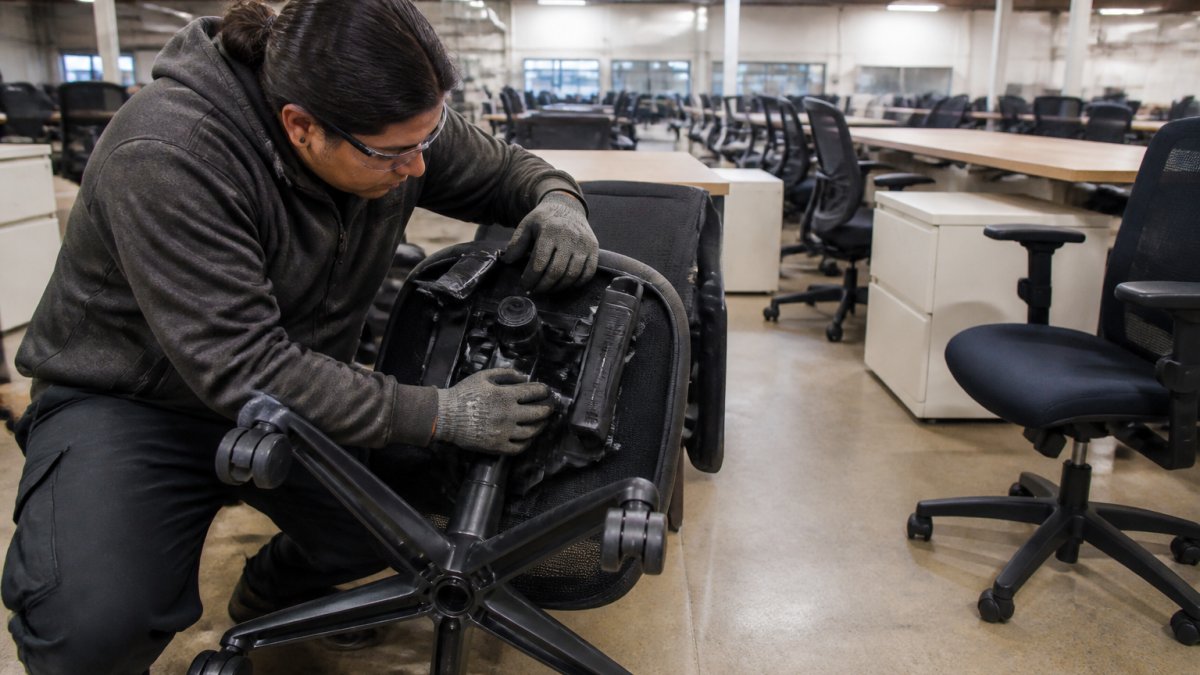
Refurbishment extends that further. Reupholstered seating, resurfaced worksurfaces, and replaced casters or gas cylinders return furniture to full commercial use at a fraction of new cost.
At Office Furniture Warehouse, pre-owned inventory moves through inspection and cleaning before it reaches the floor, and buyers can examine every piece in person rather than ordering from a photo. That matters for hygiene concerns and for fit.
The most common mistake in circular procurement is treating reuse as a one-time clearance purchase. Plan it as a standing process: as workstations come out of service, inspect and route them back into inventory rather than to a dumpster. Facilities that skip this step pay removal costs and then pay again for new furniture.
How to Evaluate Used Office Furniture Before You Buy
Evaluate used furniture on three axes: structural integrity, mechanical function, and cosmetic condition. Structural problems are disqualifying; mechanical and cosmetic issues are usually repairable and negotiable.
Run this sequence on any pre-owned piece:
- Frame and welds. Look for cracks, bends, or repaired joints on chair frames and desk bases. A bent frame rarely straightens correctly.
- Mechanisms. Test the gas cylinder through its full height range, cycle the tilt and tension controls, and check that the seat slider locks. Cylinders and casters are replaceable; a failed mechanism housing is not.
- Upholstery and foam. Press the seat cushion to check for collapsed foam. Surface wear is cosmetic; a compressed seat core means replacement.
- Surfaces. Check laminate for lifting at edges and veneer for water damage. Minor scratches refinish; swelling does not.
- Stability and hardware. Confirm all fasteners are present and the piece sits level.
Condition Checks and Supplier Due Diligence
Ask the supplier five questions before committing to volume: How is the furniture cleaned and prepared? What is the return or guarantee policy on pre-owned pieces? Can you inspect in person or only from photos? What is the delivery timeline and cost to your location? Do you handle removal of furniture being replaced?
A supplier who answers all five specifically is a supplier worth buying from. Vague answers on cleaning and guarantees are the warning sign.
Inspection beats description. Any pre-owned furniture purchase where you cannot examine the actual piece, or where the seller will not document condition, carries risk that no discount compensates for.
A Practical Buying Checklist and Decision Framework
Work through this before issuing a purchase order. It converts the sections above into a decision you can defend to a CFO or a sustainability officer.
Decision framework:
- If the need is immediate and the budget is fixed, buy pre-owned from inspected inventory
- If the space requires a specific finish or configuration, combine pre-owned core pieces with new accents
- If a certification is required for building compliance, verify the certificate registry before ordering
- If the project includes decommissioning, negotiate removal and resale credit as part of the same contract
Buying checklist:
- Confirm material content by weight, not by marketing language
- Verify every certification number in the issuing body’s registry
- Calculate lifecycle cost across acquisition, maintenance, churn, and disposal
- Inspect pre-owned pieces physically, or confirm a documented condition report
- Confirm cleaning and preparation process for used items
- Get delivery timeline and cost in writing
- Confirm removal and responsible disposal for furniture being replaced
- Check ergonomic adjustability against the people who will actually use the furniture
That last item deserves emphasis. Ergonomics and inclusive design are sustainability issues: furniture that hurts the people using it gets replaced early, and early replacement is the least sustainable outcome available.
Frequently Asked Questions
What makes office furniture sustainable?
Sustainable office furniture combines responsibly sourced or recycled materials, low-VOC finishes that protect indoor air quality, durable construction that extends product lifespan, and end-of-life options like refurbishment or recycling. A desk built from reclaimed wood with a low-emission finish and a 10-year service life counts as sustainable. So does a used Steelcase chair that stays out of landfill. Material selection, durability, and responsible disposal all matter more than any single green label.
Which certifications should I look for when buying sustainable office furniture?
Look for BIFMA LEVEL, GREENGUARD and GREENGUARD Gold for low chemical emissions, and FSC certification for wood sourcing. Verify each claim by checking the certification body’s public database rather than trusting a logo on a spec sheet. Ask suppliers for certificate numbers and confirm they are current. A certification that cannot be verified in a public registry is not worth much in a procurement file.
Is buying used office furniture more sustainable than buying new?
In most cases, yes. Reusing an existing chair or desk avoids the manufacturing energy, raw material extraction, and packaging of a new product, and it keeps functional furniture out of landfill waste. The environmental benefit grows with product lifespan: a quality used Steelcase or Herman Miller piece can serve another decade. Check condition and hygiene before purchase, and confirm the seller refurbishes and cleans items before resale.
How do I evaluate the condition of used office furniture?
Inspect five things: frame integrity and welds, gas cylinder and tilt function on chairs, upholstery wear and staining, drawer glides and locking mechanisms, and any wobble in desk legs or casters. Test adjustable parts through their full range. Ask how the seller cleaned and prepared the item, and what warranty or guarantee applies. Photos alone miss hidden structural issues, so buy from a supplier that lets you inspect in person or offers a return policy.
What should I consider when choosing sustainable office furniture for a business?
Weigh material sourcing, certification verification, durability and lifespan, ergonomics and accessibility, total cost of ownership, and end-of-life disposal. Match choices to how the space is used: task chairs need adjustability, shared desks need durable surfaces. Factor in delivery, installation, and removal of old furniture. Pricing depends on quantity, dates, and delivery, so request a quote rather than relying on list prices. A written checklist keeps procurement decisions consistent across a multi-room project.
Furnishing a space sustainably while staying inside a budget is a genuine tension, and most buyers feel it in the first week of planning. Office Furniture Warehouse addresses it directly, with more than 35 years of experience, a 4-acre inventory of new and pre-owned furniture including Steelcase and Herman Miller at up to 80% off, expert design and layout planning, and flexible pickup or delivery. Visit our showroom to inspect the furniture yourself and see how far a pre-owned budget stretches.
