Table of Contents
- Why Lower Back Pain When Standing Happens
- Standing Posture for Lower Back Pain: Body Mechanics That Help
- Lower Back Pain After Standing for Long Periods: A Timed Movement Routine
- Stretches for Lower Back Pain From Standing
- Self-Care and At-Home Pain Management
- Ergonomic Setup for Different Standing Environments
- When to See a Doctor for Lower Back Pain
- Conclusion
- Frequently Asked Questions
Last Updated: October 17, 2026
Why Lower Back Pain When Standing Happens
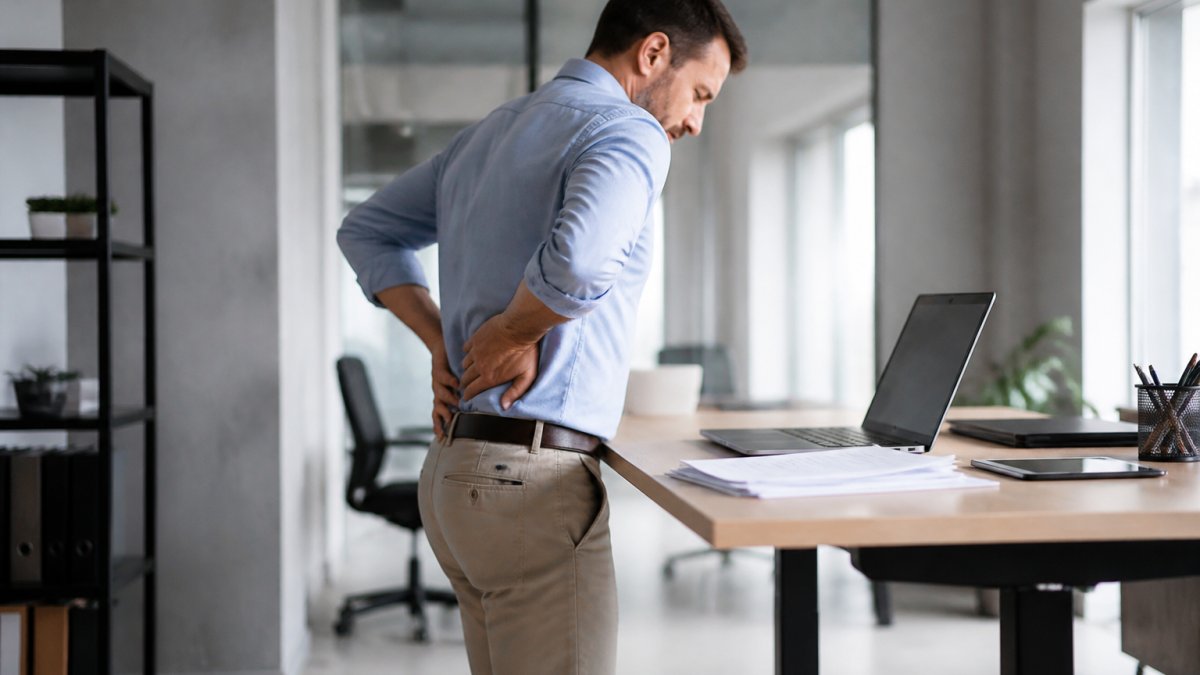
Lower back pain when standing is one of the most common complaints we hear from people setting up new workstations. Standing pain almost always comes down to two things: how long you stay still, and how your setup loads your spine.
Standing isn’t the enemy. Staying frozen in one position is.
Common Causes of Lower Back Pain
Most cases trace back to a short list of mechanical triggers:
- Muscle fatigue in the lower back and core from holding one posture
- A hard, flat floor with no give under your feet
- Uneven weight shift, where you lean on one hip for hours
- Weak core and glute muscles that can’t share the load
- Tight hip flexors pulling your pelvis out of line
- Poor footwear with thin soles and no arch support
A common mistake is blaming the spine itself. In practice, the muscles doing the holding are usually the ones complaining.
Why Pain May Worsen During Prolonged Standing
Standing still compresses the lumbar spine and keeps the same muscles switched on without a break. Blood flow slows, muscles tire, and stiffness builds. Many people find the ache peaks after 30 to 60 minutes of standing without moving.
The fix isn’t standing less. It’s moving more often.
Standing Posture for Lower Back Pain: Body Mechanics That Help
Good standing posture for lower back pain starts with three checkpoints: feet, pelvis, and ribs. Stack them and the spine carries far less load.
Run this quick checklist at your desk:
- Feet hip-width apart, weight even on both sides
- Knees soft, never locked straight
- Pelvis neutral, not tucked or arched
- Ribs stacked over the pelvis, not flared
- Shoulders relaxed, screen at eye level
- One foot propped on a small stool to shift load
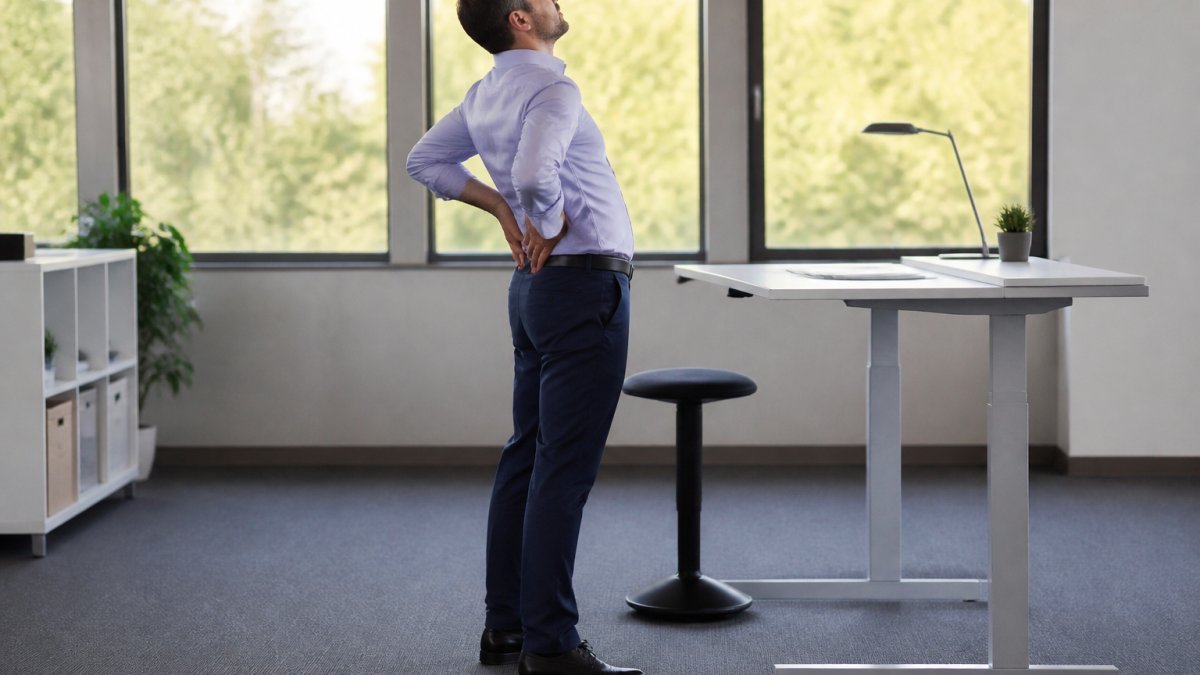
That last item matters more than most guides admit. A small stool under one foot rotates the pelvis slightly and takes pressure off the lumbar spine. It’s the cheapest ergonomic upgrade we know of.
Alternate which foot rests on the stool every 10 to 15 minutes. This keeps your hips from locking into one rotated position and spreads the load across both sides.
Lower Back Pain After Standing for Long Periods: A Timed Movement Routine
Lower back pain after standing for long periods responds best to a schedule, not willpower. Set a timer and follow this rotation.
| Time Block | Action | Purpose |
|---|---|---|
| Every 20-30 min | Shift weight, swap stool foot | Relieve static load |
| Every 45-60 min | 2-minute walk or sit break | Restore blood flow |
| Every 2 hours | 5-minute stretch session | Reset muscle tension |
| Midday | 10-minute walk | Loosen the lumbar spine |
| End of day | 5-minute lie-down with knees bent | Offload the spine |
Follow that rotation and you may notice the ache arrives later, then softer.
Stretches for Lower Back Pain From Standing
Stretches for lower back pain from standing should feel gentle, never sharp. Hold each for 20 to 30 seconds and breathe normally. But which stretch you choose matters less than whether it matches your symptoms. Use the decision guide below before you start.
Symptom-Based Guidance: Choosing the Right Movement
Not every stretch helps every back. Use this simple triage to pick movements that ease your symptoms and skip the ones that worsen them.
| Your symptom pattern | Try first | Avoid for now |
|---|---|---|
| Ache that builds after 30-60 minutes of standing, eases when you sit or walk | Standing lumbar extension, hip flexor stretch, cat-cow | Prolonged static stretching without movement breaks |
| Stiffness first thing in the morning that loosens with activity | Knees to chest, lower trunk rotation, gentle walking | Aggressive arching or bouncing |
| Sharp pain with backward bending or standing tall | Knees to chest, lower trunk rotation | Standing lumbar extension |
| Pain, numbness, or tingling that travels down one leg | Stop and seek assessment | Any stretch that reproduces the leg symptoms |
A common pattern is that people who feel better when they bend forward should favor flexion-based stretches, while those who feel better arching backward should favor extension. Use your own symptom response as the guide, not a generic list.
Gentle Exercises to Try
- Knees to chest: Lie on your back, pull one knee toward your chest, hold 20-30 seconds, switch sides. Repeat 2-3 times per side.
- Lower trunk rotation: Lie on your back, knees bent, let both knees fall slowly to one side. Hold 20-30 seconds, switch sides.
- Standing lumbar extension: Hands on hips, gently arch backward a few inches, return. Repeat 8-10 times, never forcing the range.
- Hip flexor stretch: Half-kneel, tuck your pelvis, lean forward slightly until you feel a stretch in the front of the hip. Hold 20-30 seconds per side.
- Cat-cow: On hands and knees, alternate rounding and arching your back through a comfortable range. Move slowly for 8-10 cycles.
Keep your back flat against the floor during the lying stretches. That contact tells you you’re not twisting.
A Simple Progression Plan
Start with the two or three movements that match your symptom pattern and feel easiest. Do them once daily for the first week. If symptoms are stable or improving, add one new movement every 3-5 days and increase holds to 30 seconds. If a movement consistently worsens symptoms, drop it and note which one triggered the flare so you can describe it to a clinician.
Tracking Your Progress
Recovery is easier to see when you measure it. Each week, note three things: how long you can stand before the ache starts, how intense the pain is on a 0-10 scale at its worst, and whether you can do one more daily activity (carrying groceries, cooking, walking to the mailbox) without stopping. Improvement in any one of those is a sign the plan is working, even if the others lag.
Pushing through sharp pain or leg tingling can turn a mild strain into a longer recovery. Stop the stretch and note which movement triggered it so you can describe it to a doctor.
Self-Care and At-Home Pain Management
Self-care can help with mechanical lower back pain, but not all remedies are equal. Here is what the evidence generally supports, what tends to provide only short-term relief, and when self-care stops being enough.
What the Evidence Generally Supports
- Keeping active: Gentle movement and normal daily routines are consistently associated with faster recovery than prolonged bed rest. Many people find that a short walk on a bad day beats lying flat.
- Heat for muscle tightness: A heating pad or warm shower can relax tense muscles and ease stiffness, especially in the first few days of a flare.
- Over-the-counter pain relievers and anti-inflammatory medication: These can take the edge off short-term pain so you can keep moving. Follow label directions and consult a healthcare professional if you take other medications.
- Sleep support: A pillow between the knees if you sleep on your side, or under the knees if you sleep on your back, helps keep the spine neutral overnight.
What May Provide Only Short-Term Relief
- Ice for a fresh flare-up: Cold can numb a sore area for a short period, but it does not speed healing. Use it for comfort, not as a cure.
- Rest breaks: A brief sit-down relieves static load, but long stretches of bed rest can stiffen the back and slow recovery. Keep breaks short and return to gentle movement.
- Massage and topical rubs: These can feel good and temporarily reduce muscle tension, but they do not correct the mechanical causes of standing pain.
When Self-Care Is Not Enough
Self-care is a reasonable first step for mild to moderate mechanical pain. It is not enough if:
- Pain persists or worsens after two to three weeks of consistent self-care
- Pain limits your ability to stand, walk, or perform daily activities
- You need pain relievers most days to function
- Symptoms include leg weakness, numbness, or bowel or bladder changes (see the warning signs section below)
In those cases, a physical therapy referral or medical assessment is the right next step. A clinician can assess your condition and build a plan matched to your symptoms.
Keep a simple symptom log for two weeks, what you did, how long you stood, and how your back felt afterward. That record makes a clinician visit far more productive and helps you see which self-care steps actually help.
Ergonomic Setup for Different Standing Environments
Ergonomic setup changes with where you stand. A warehouse floor, a kitchen counter, and a home office each load your back differently.
- Standing desk: top at elbow height, monitor at eye level, anti-fatigue mat underfoot
- Retail or warehouse floor: cushioned insoles, a stool for slow moments, rotating tasks
- Kitchen or lab bench: prop one foot on a low rail, keep work close to your body
- Home workspace: a mat, a footrest, and a chair nearby for real sit-stand switching
This is where the right furniture earns its keep. A height-adjustable desk and a supportive stool do more for standing pain than any single stretch. At Office Furniture Warehouse, we stock new and pre-owned standing desks, ergonomic chairs, and footrests from brands like Steelcase and Herman Miller, so you can build a setup that fits your body and your budget.
The best standing setup is one you can leave. A desk that switches to sitting, plus a stool for micro-breaks, can help prevent the static load that causes standing pain.
When to See a Doctor for Lower Back Pain
See a doctor promptly if you notice any of these:
- Loss of bowel control or bladder control
- Numbness in the groin or inner thighs
- Weakness in one or both legs
- Pain after a fall or injury
- Fever, chills, or unexplained weight loss
- Pain that worsens steadily despite rest and self-care
These signs can point to nerve or other medical causes that need urgent medical care, not stretching. For everyday mechanical pain, a physical therapy referral is a reasonable next step if two to three weeks of self-care brings no relief.
Conclusion
Standing pain rarely means you should stop standing. It usually means your setup and your movement habits need a reset. Build in timed breaks, check your posture, keep a stool handy, and stretch gently.
If your workspace is part of the problem, we can help. Office Furniture Warehouse offers height-adjustable desks, ergonomic seating, and expert design and layout planning, backed by over 35 years of experience and a 4-acre inventory of new and pre-owned furniture. Visit our showroom today and build a standing setup that works with your back, not against it.
Frequently Asked Questions
What can cause lower back pain when standing?
Lower back pain when standing often comes from muscle fatigue, poor posture, or underlying mechanical issues in the lumbar spine. Prolonged standing puts sustained pressure on the lower back, and weak core muscles or tight hip flexors can worsen it. A small stool or anti-fatigue mat may help reduce strain. If pain persists or radiates down your leg, consult a doctor if you have concerns about nerve involvement.
What stretches can help lower back pain from standing?
Gentle stretches like knees-to-chest, lower trunk rotation, and lying on your back with your back flat against the floor can ease tension. Standing lumbar extension (placing hands on hips and gently leaning back) also helps. Hold each stretch for 15-30 seconds and avoid bouncing. If a stretch increases pain, stop and try a different movement. A physical therapist can provide a tailored routine.
Can poor posture cause lower back pain while standing?
Yes, poor standing posture, such as slouching or locking your knees, can strain the lumbar spine and lead to pain. Good body mechanics include keeping your ears over your shoulders, engaging your core, and shifting weight occasionally. Using a small stool to prop one foot can reduce pressure. For prolonged standing, set a timer to remind yourself to adjust posture and take rest breaks.
Is walking or standing better for lower back pain?
Walking is often better than static standing because movement promotes circulation and reduces muscle stiffness. If you must stand for long periods, incorporate short walks every 30 minutes. A standing exercise routine with gentle mobility moves can help. Listen to your body: if standing worsens pain, alternate with sitting or walking. Over-the-counter pain relievers may offer temporary relief, but consult a healthcare professional first.
