Table of Contents
- What Office Furniture Decommissioning Actually Involves
- The Decommissioning Process: Step-by-Step
- Commercial Lease End Requirements Checklist
- Office Furniture Liquidation Services: Maximizing Asset Recovery
- Sustainable Disposal and Recycling Options
- Workspace Decommissioning Checklist for Project Success
- Common Mistakes to Avoid During Decommissioning
- Conclusion
Last Updated: August 27, 2026
What Office Furniture Decommissioning Actually Involves
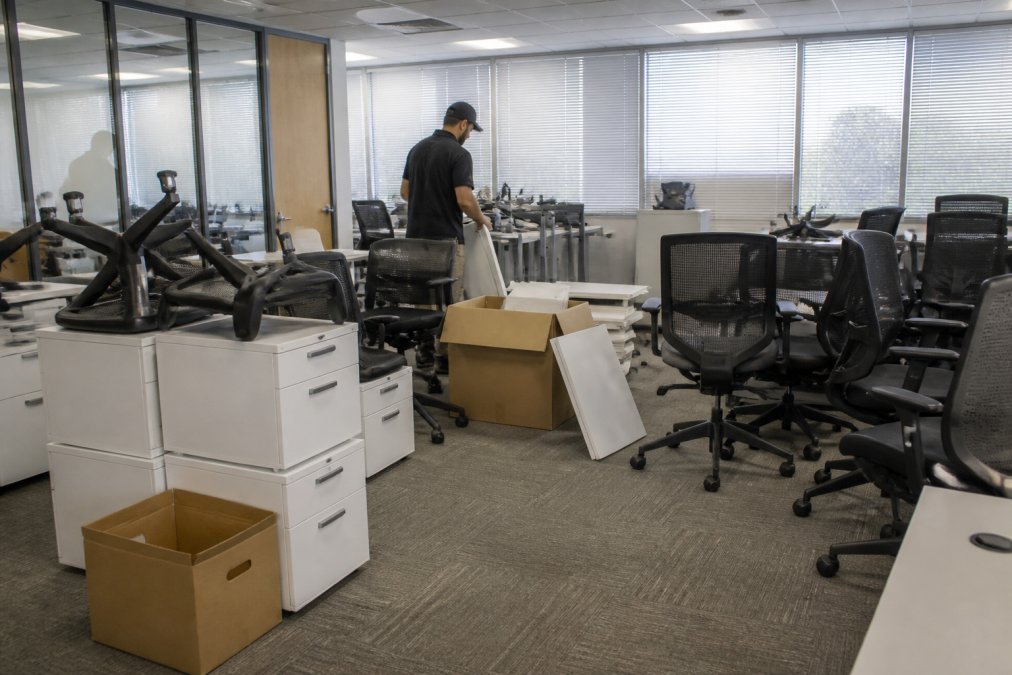
Office furniture decommissioning is the systematic process of removing, managing, and disposing of office furniture and equipment when a business relocates, downsizes, or renovates. It handles asset recovery, environmental responsibility, and lease compliance simultaneously.
When facing an office transition, decommissioning becomes critical. Your lease likely requires the space to be returned to its original condition. Furniture may have resale value. You want to minimize environmental impact. Professional office furniture decommissioning services manage all three while keeping operations running smoothly.
A poorly managed decommissioning project can cost thousands in unnecessary disposal fees, trigger lease violations with penalties, waste recoverable furniture, and create operational chaos. The right approach and partner makes all the difference.
The Decommissioning Process: Step-by-Step
A structured decommissioning process prevents costly mistakes and ensures nothing of value gets lost.
Step 1: Conduct a Site Assessment and Inventory
Before anything leaves your office, catalog every piece of furniture, identify its condition, and determine its disposition path. Walk your entire space systematically and document each workstation, conference table, storage unit, and accessory. For each item, record: brand, model, age, condition (excellent, good, fair, poor), and any damage or missing parts. Take photos.
Condition assessment determines value. A Herman Miller Aeron chair in excellent condition can be liquidated or donated. The same chair with a torn seat goes to recycling. Misrepresenting condition tanks resale value immediately.
Engage your facilities team and department heads. They know which pieces are functional versus which need replacement and can identify equipment integrated into IT infrastructure or bolted to the floor. Document findings in a spreadsheet or asset management system with location, description, condition, and preliminary disposition.
Step 2: Plan Your Removal and Logistics
Establish a timeline that works with your lease end date and move-in schedule for new furniture. Coordinate so old furniture exits before new furniture arrives.
Determine labor needs. Small office moves require 3-4 people for a day. Larger commercial decommissioning in 10,000+ square feet demands 6-8 people and multiple days. A typical workstation takes 45 minutes to an hour to fully deconstruct, tag, and stage (bls.gov).
Plan staging areas for sorting furniture by disposition: liquidation in one area, donations in another, recycling in a third. Coordinate with IT if furniture has integrated cable management or technology components. Ensure data destruction happens before equipment leaves your control.
Create a removal schedule that sequences work logically, removing items from the back of the office first and working toward exits.
Step 3: Execute Disassembly and Removal
Assign a project coordinator to oversee removal, confirm crews arrive on schedule, verify items match the inventory list, and handle documentation.
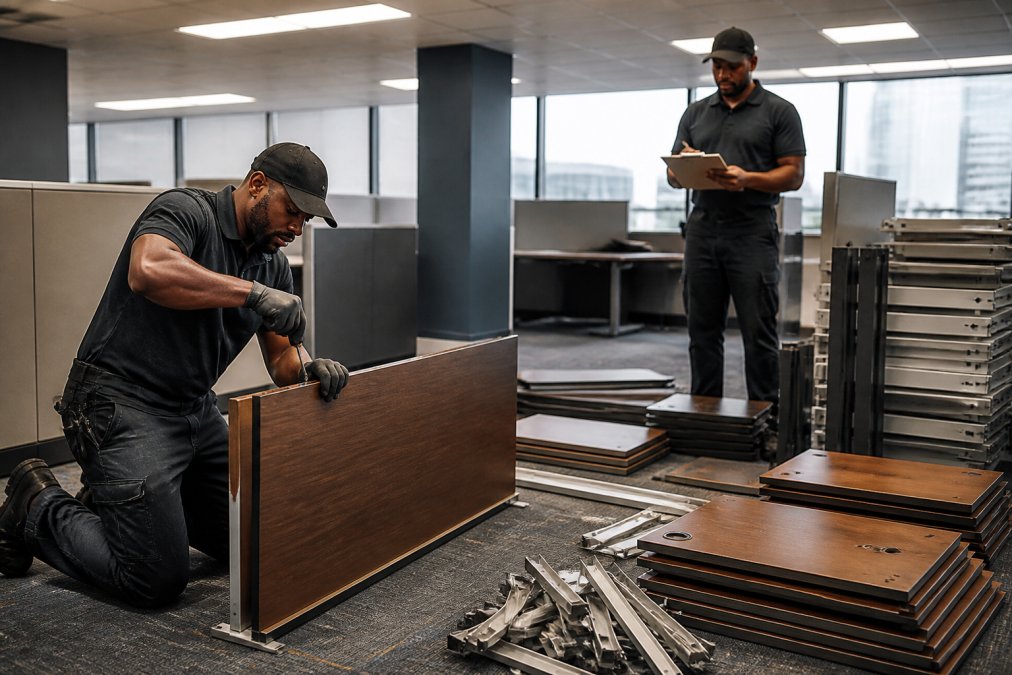
Disassembly should follow manufacturer guidelines. Remove drawers before moving filing cabinets. Detach shelving from uprights. Remove glass tops from tables. This reduces damage and simplifies reassembly.
Tag everything with colored stickers, barcodes, or labels to identify disposition: red for recycling, green for donation, blue for liquidation. Use proper equipment, furniture dollies, pads, and shrink wrap, to protect pieces during movement.
Document removal as it happens. Photograph each area after it’s cleared and confirm staging areas match your inventory.
Step 4: Manage Asset Disposition
Once furniture is removed and staged, it moves through disposition channels. This is where decommissioning becomes financially strategic.
Liquidation targets resalable items. Premium brands like Steelcase, Herman Miller, and Haworth retain value as used furniture. Working with a liquidation partner, you can recover 20-40% of original purchase price on quality pieces. The liquidation company handles pricing, marketing, sales, and logistics.
Donation works for functional furniture that doesn’t meet liquidation thresholds. Nonprofits, schools, and community organizations need office furniture. Donations are tax-deductible and you avoid disposal costs.
Recycling processes items that can’t be sold or donated. Metal components are separated and sent to metal recyclers. Wood goes to wood processors or biomass facilities. Upholstered pieces are dismantled, with foam and fabric separated from frames.
Maximize value while minimizing cost. A professional decommissioning partner knows the market for used office furniture and can route pieces to the channel that generates the best return or environmental outcome.
Commercial Lease End Requirements Checklist
Your lease agreement almost certainly contains clauses about returning the space. Missing these requirements costs money and damages your business reputation.
Review your lease document now. Look for language about "broom-swept condition," "original condition," "removal of tenant improvements," and "restoration of premises."
Broom-swept condition means the space is empty and clean. All furniture, fixtures, and equipment must be removed.
Original condition is stricter. The space must look like it did when you moved in. If you removed walls, they’re rebuilt. If you painted, walls are repainted to original colors.
Create a checklist based on your specific lease:
- All furniture and equipment removed from the space
- All personal property and files removed
- All signage and branding removed
- Walls cleaned and marked damage documented
- Carpet or flooring inspected for damage beyond normal wear
- Lighting fixtures and HVAC components verified as original or replaced
- Any custom installations removed
- IT infrastructure decommissioned
- Utilities disconnected
- Keys returned and access credentials revoked
- Final walk-through with landlord scheduled
- Photographic documentation of final condition completed
Schedule your final lease walk-through at least 48 hours before move-out. Bring the landlord (or their representative) through the space and document their sign-off. A signed final walk-through protects you against surprise charges later. Many leases include a security deposit that covers lease-end restoration costs if you don’t comply. A single violation can result in $5,000-$20,000 in landlord charges.
Office Furniture Liquidation Services: Maximizing Asset Recovery
Not all office furniture is worthless when you’re done with it. Strategic liquidation recovers money while avoiding disposal costs.
Office furniture liquidation is the process of selling used furniture to secondary markets, resellers, businesses, schools, and individuals who want quality pieces at reduced prices. A 5-year-old Steelcase desk might sell for 30-35% of its original price.
A liquidation partner assesses your inventory, identifies pieces with resale potential, and estimates market value. They handle pricing, marketing, sales, payment processing, and logistics. You don’t manage individual sales. The partner takes a commission (typically 20-40% of sale price) and you receive the remainder.
Timing matters. Liquidation works best when you have 4-8 weeks before move-out. Rush liquidation (2-3 weeks) reduces prices. Volume also affects pricing. A pallet of 20 matching chairs attracts bulk buyers willing to pay premium prices.
Expect to recover 15-40% of original purchase price for quality pieces. The real benefit is avoiding disposal costs while recovering something. Professional liquidation services ensure compliance with environmental regulations, proper documentation for tax purposes, and reliable payment.
Sustainable Disposal and Recycling Options
Environmental responsibility in decommissioning is now expected and often required by corporate sustainability commitments.
Sustainable disposal means diverting furniture from landfills through reuse, donation, and recycling. It reduces your organization’s carbon footprint and supports circular economy principles. Many companies now track waste diversion rates as part of their ESG reporting.
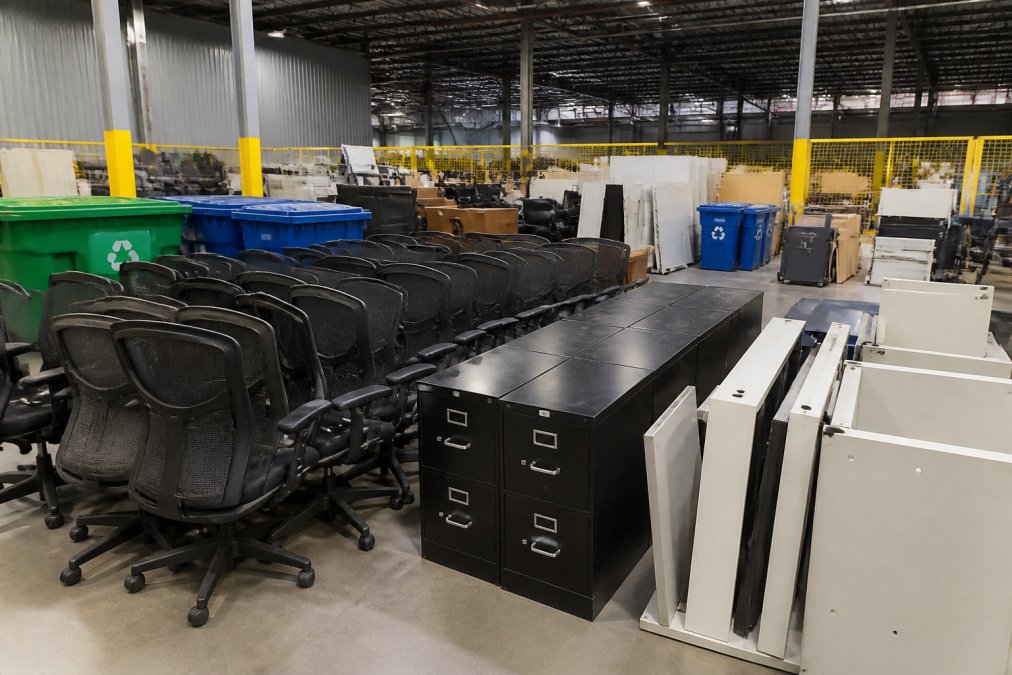
Reuse is the highest priority. Functional furniture gets donated or liquidated, extending the product lifecycle and keeping materials out of landfills.
Donation partners include nonprofits, schools, community centers, and disaster relief organizations. Donations are tax-deductible and create goodwill in your community. Many donation partners handle pickup.
Recycling processes furniture that can’t be reused. Professional recyclers disassemble pieces and separate materials: metals, wood, foam, and plastic. Each material stream goes to appropriate processors. A typical office workstation weighs 300-400 pounds, with recycling recovering 200+ pounds of material that would otherwise go to landfills (the EPA).
Donation is typically free or generates a tax deduction. Recycling costs $1-3 per piece (the CDC). Landfill disposal costs $5-10 per piece. Recycling is both environmentally superior and economically competitive.
Many decommissioning partners now track and report environmental impact, carbon footprint reduction, material recovery rates, and waste diversion percentages to support corporate sustainability reporting.
Workspace Decommissioning Checklist for Project Success
A structured checklist transforms decommissioning from chaotic to controlled.
Pre-Decommissioning Phase (4-6 weeks before move-out):
- Review lease agreement and identify all restoration requirements
- Schedule final lease walk-through with landlord
- Conduct comprehensive site inventory and assessment
- Identify decommissioning partner (liquidation, donation, recycling services)
- Develop detailed removal timeline and logistics plan
- Coordinate with IT department on data destruction and equipment decommissioning
- Notify all departments of decommissioning schedule
- Reserve staging areas or temporary storage space if needed
- Obtain necessary equipment (dollies, furniture pads, labels, safety gear)
- Assign project coordinator and define roles
Execution Phase (2-3 weeks before move-out):
- Conduct final inventory verification against initial assessment
- Begin staged removal according to planned sequence
- Tag all items with disposition labels (liquidation, donation, recycling, disposal)
- Document removal with photographs of cleared areas
- Verify staging areas match inventory and disposition plan
- Process any items requiring special handling (electronics, hazardous materials)
- Confirm liquidation partner has received inventory and begun marketing
- Confirm donation partner has scheduled pickups
- Monitor removal progress against timeline
Completion Phase (final week):
- Complete all furniture removal and staging
- Conduct final walkthrough of office space, verify empty and clean
- Obtain final disposition reports from liquidation, donation, and recycling partners
- Collect tax documentation for donations
- Collect payment from liquidation partner
- Receive environmental impact reports (waste diversion, material recovery)
- Prepare lease compliance documentation
- Schedule and conduct final lease walk-through with landlord
- Obtain landlord sign-off on condition
- Archive all decommissioning documentation
Assign responsibility for each item and track completion to prevent oversights that trigger lease violations or missed revenue opportunities.
Common Mistakes to Avoid During Decommissioning
Underestimating timeline. A typical office of 50+ workstations requires 2-3 weeks minimum. Start planning 8-10 weeks before move-out.
Ignoring lease requirements. Leases contain specific restoration language. Missing these requirements costs thousands. Read your lease now and build restoration into your decommissioning plan.
Mixing disposition streams. Putting items destined for recycling in the liquidation pile wastes time and reduces value. Keep clear physical separation with visible labels.
Delaying decision-making. Indecision creates bottlenecks. Make disposition decisions upfront and stick to them.
Failing to document condition. Take photos during inventory and removal. Undocumented damage claims reduce resale value.
Neglecting IT and security. Ensure IT has decommissioned integrated technology and cable management systems. Confirm data destruction on any equipment with storage and verify access credentials are revoked.
Underestimating disposal costs. Items that can’t be liquidated or donated go to disposal. Maximize liquidation and donation to minimize disposal.
Skipping professional help. DIY decommissioning seems cheaper but often costs more. Professional partners manage logistics, handle liability, know market value, and coordinate disposition efficiently. For offices with 20+ workstations, professional services pay for themselves.
Decommissioning doesn’t have to be chaotic. A structured approach, clear planning, and professional support transform it from a headache into a controlled process that recovers value, meets lease requirements, and minimizes environmental impact.
If you’re facing an office transition, Office Furniture Warehouse can help you navigate the entire process. We’ve supported businesses through dozens of decommissioning projects and understand the logistics, compliance requirements, and opportunity to recover value from your existing furniture. We offer expert guidance on space planning, asset recovery options, and sustainable disposition, all while helping you source the furniture you need for your next chapter. Visit our Cleveland showroom today to explore our wide range of seating, desks, and storage options with convenient delivery and pickup services.
== FAQ ANSWERS (audit these too, same rules) ===
[1] Q: What is included in office furniture decommissioning services?
A: Office furniture decommissioning services typically include site assessment, furniture inventory and tagging, disassembly of modular systems, removal and hauling, asset disposition (liquidation, donation, or recycling), and final space clearance to meet lease restoration requirements. Professional services handle logistics coordination, documentation, and compliance reporting. The scope depends on your project size, facility complexity, and whether you want asset recovery options like resale or remanufacturing.
[2] Q: How do I meet commercial lease end requirements when decommissioning?
A: Commercial leases typically require you to restore the space to its original condition or ‘broom-swept’ state. This means removing all furniture, equipment, and debris, repairing any damage caused by your occupancy, and often addressing flooring or wall marks. Review your lease agreement for specific restoration clauses, take before-and-after photos for documentation, and coordinate with your landlord before beginning work. Many businesses use professional decommissioning services to ensure compliance and avoid lease violation penalties.
[3] Q: What is the difference between office furniture liquidation and decommissioning?
A: Decommissioning is the complete process of removing furniture and restoring your space to meet lease requirements. Liquidation is one component of decommissioning focused specifically on recovering value from usable furniture through resale. You can decommission without liquidating (simply disposing of items), but liquidation is often part of a comprehensive decommissioning strategy. Liquidation services evaluate condition, handle resale logistics, and provide asset recovery revenue that can offset decommissioning costs.
[4] Q: How long does the office decommissioning process typically take?
A: Timeline depends on facility size, furniture quantity, and complexity. A small office might take 1-2 weeks, while a large corporate space could require 4-8 weeks or longer. Initial assessment and planning take 1-2 weeks, disassembly and removal span 2-4 weeks, and asset disposition adds 2-3 weeks. Professional project management can accelerate timelines by coordinating multiple vendors and maintaining schedule discipline. Plan ahead, most commercial leases require 30-60 days’ notice before vacating.
Frequently Asked Questions
Q: What is included in office furniture decommissioning services?
A: Office furniture decommissioning services typically include site assessment, furniture inventory and tagging, disassembly of modular systems, removal and hauling, asset disposition (liquidation, donation, or recycling), and final space clearance to meet lease restoration requirements. Professional services handle logistics coordination, documentation, and compliance reporting. The scope depends on your project size, facility complexity, and whether you want asset recovery options like resale or remanufacturing.
Q: How do I meet commercial lease end requirements when decommissioning?
A: Commercial leases typically require you to restore the space to its original condition or 'broom-swept' state. This means removing all furniture, equipment, and debris, repairing any damage caused by your occupancy, and often addressing flooring or wall marks. Review your lease agreement for specific restoration clauses, take before-and-after photos for documentation, and coordinate with your landlord before beginning work. Many businesses use professional decommissioning services to ensure compliance and avoid lease violation penalties.
Q: What is the difference between office furniture liquidation and decommissioning?
A: Decommissioning is the complete process of removing furniture and restoring your space to meet lease requirements. Liquidation is one component of decommissioning focused specifically on recovering value from usable furniture through resale. You can decommission without liquidating (simply disposing of items), but liquidation is often part of a comprehensive decommissioning strategy. Liquidation services evaluate condition, handle resale logistics, and provide asset recovery revenue that can offset decommissioning costs.
Q: How long does the office decommissioning process typically take?
A: Timeline depends on facility size, furniture quantity, and complexity. A small office might take 1-2 weeks, while a large corporate space could require 4-8 weeks or longer. Initial assessment and planning take 1-2 weeks, disassembly and removal span 2-4 weeks, and asset disposition adds 2-3 weeks. Professional project management can accelerate timelines by coordinating multiple vendors and maintaining schedule discipline. Plan ahead, most commercial leases require 30-60 days' notice before vacating.
This article was written using GrandRanker
