Last Updated: November 10, 2026
Quick Summary
Protect office carpet from chair wheels by placing a chair mat sized to the chair’s full working zone, with about 6 to 8 inches of margin on each side. Swap hard casters for soft-rubber or dual-wheel versions, and choose a mat suited to your pile height and traffic.
- Measure pile height first: under about 1/4 inch is thin, over about 1/2 inch is deep.
- Mark the desk front and furthest chair reach, then add 6 to 8 inches on each side.
- Replace hard plastic casters with soft-rubber or dual-wheel versions to spread weight.
- Vacuum the area before laying the mat so grit does not grind into the fiber.
- Check the mat every few weeks and reposition it if it shifts or curls at the edges.
Table of Contents
- Why Office Chair Wheels Damage Carpet
- Step 1: Measure Your Carpet and Choose the Right Protection
- Step 2: Set Up a Carpet-Friendly Chair Base
- Step 3: Consider Alternatives to Plastic Chair Mats
- Step 4: Install and Position Your Protection Correctly
- Common Mistakes to Avoid and How to Repair Crushed Carpet
- Booking a Furniture Consultation for Your Office Floor Plan
- Frequently Asked Questions
Why Office Chair Wheels Damage Carpet
Office chair wheels are small, hard, and carry a lot of weight in one spot, and that combination is what grinds carpet down over time. Every time someone rolls back from a desk or spins to reach a shelf, the caster presses into the same loops of fiber. On any office carpet, this wear usually shows up as flattened paths, fraying, and dark scuff lines near the desk.
Carpet fibers are built to bend back up after pressure, but repeated rolling pushes them past that point. The result is crushed pile that never fully recovers, plus a grit line that pulls more dirt into the carpet each day.
Step 1: Measure Your Carpet and Choose the Right Protection
Choosing a carpet protector for your office carpet starts with three measurements and two judgment calls: how thick the pile is, how far the chair travels, and how often the chair moves. Get these right before you compare products, because most fit problems come from skipping one of them.
Start with pile height. Lay a ruler flat on the carpet and measure from the backing to the top of the loops, then press the ruler down gently and measure again. Low-pile commercial carpet usually measures under about 1/4 inch, while plush residential carpet can exceed 1/2 inch. The difference matters because a mat or panel that is rigid enough for thin carpet can sit unevenly on deep pile, leaving one edge lifted and creating a trip point.
Next, map the chair’s working zone. Mark the desk’s front edge on the floor, then roll the chair back to the position you use most and to the furthest point you reach, such as a file cabinet or printer. Measure the rectangle that covers both positions, then add a margin of about 6 to 8 inches on each side so the casters stay on the protector during a normal roll. Desk clearance matters here too: if the chair must swing around a corner or past a return, add the arc of that turn to the length.
Count the chairs and the traffic. A single workstation with one occupant can use a smaller protector than a shared pod where two or three chairs rotate through the same floor area. Check whether the carpet is glued down or loose-laid, because loose carpet can shift under a mat and may need a backing that grips without adhesive.
With those numbers, the choice becomes a matching exercise:
- Thin commercial pile with one chair and a fixed desk: a compact rigid mat sized to the working zone is usually enough.
- Deep residential pile: choose a mat marketed for thick carpet, or a wider panel that spreads weight, and confirm the surface stays flat under load.
- Shared floor area or frequent chair travel: size the protector to the full combined path rather than the desk alone.
- Loose-laid carpet: prioritize a non-slip backing or a secured edge over a lighter, more portable mat.
If a product’s listed dimensions are smaller than your measured working zone, skip it. A protector that is too small is the most common cause of carpet wear at the mat’s edge, because the caster rides onto the fiber at the exact point where the mat ends.
The table below sums up the measurements and matching rules from this step so you can check them quickly.
| Carpet or situation | Recommended protection | Sizing rule |
|---|---|---|
| Thin commercial pile, under about 1/4 inch | Compact rigid mat | Cover the working zone |
| Deep residential pile, over about 1/2 inch | Mat for thick carpet or wide panel | Confirm surface stays flat under load |
| Shared floor area, two or three chairs | Protector sized to combined path | Cover the full combined path |
| Loose-laid carpet | Non-slip backing or secured edge | Prioritise grip over portability |
| Any setup | Margin around the working zone | Add about 6 to 8 inches each side |
Step 2: Set Up a Carpet-Friendly Chair Base
Next, check the wheels themselves. Hard plastic casters cut into carpet faster than soft rubber ones, so the base matters as much as the mat.
Swap out any cracked or worn casters before you lay the mat. Carpet-friendly casters use softer, wider wheels that spread weight across more fiber.
- Replace hard casters with soft-rubber or dual-wheel versions
- Clean hair and debris out of each caster before use
- Tighten loose wheel mounts so they do not wobble
- Test the chair on the mat before the whole team uses it
Step 3: Consider Alternatives to Plastic Chair Mats
Plastic chair mats are a common choice, but they are one of several ways to protect carpet. The right alternative depends on the surface material, the carpet’s pile and backing, and how often the chair moves. Comparing those trade-offs before buying usually saves money over the life of the floor.
Polycarbonate mats are rigid, clear, and inexpensive, which is why they dominate offices. Their weakness is that they can yellow, scratch, and crack under heavy use, and a hard edge can catch on low-pile carpet. Vinyl mats are more flexible and tend to grip better, but they can trap heat and may leave marks on some carpet backings over time. Tempered glass mats look high-end and resist scratching, yet they are heavy, can chip at the edges, and cost more; they suit fixed workstations where the chair rarely moves far.
Chair glides take a different approach. They replace the casters with low-friction pads, so the chair slides instead of rolling. This removes the concentrated pressure point that crushes fiber, and it often works without any mat at all on medium-pile carpet. The trade-off is mobility: a glided chair takes more effort to reposition, and glides can wear down and need replacing, usually sooner on dense or rough carpet. They fit best where people sit in one place for most of the day.
Wood or composite floor-protection panels spread the chair’s weight across a wider footprint. They are sturdier than most plastic mats and tolerate heavy chairs well, but they are bulkier, cost more upfront, and can create a step if the panel is thicker than the carpet pile. They suit busy spaces where a lasting, rigid surface justifies the higher initial price.
When comparing cost, look beyond the sticker price. A low-cost mat that needs replacing every year or two can cost more over five years than a durable panel or a set of quality casters. Casters and glides are often the cheapest lasting fix, because they treat the source of the damage rather than covering it. A simple test is to estimate how often each option will need replacing across the expected life of the carpet, then compare the totals.
Step 4: Install and Position Your Protection Correctly
Lay the mat or panel on a clean carpet surface, then smooth out any ripples. Vacuum the area first so grit does not get trapped under the protection.
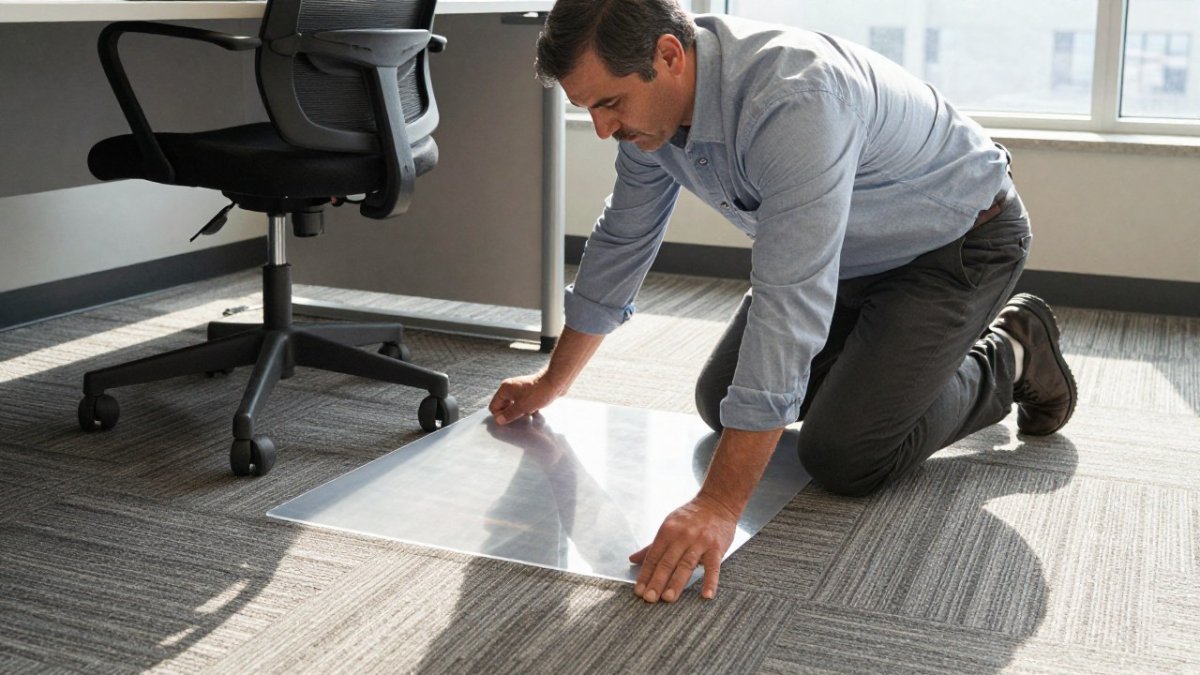
An office worker rolling an ergonomic chair onto a clear chair mat laid over a gray commercial carpet beside a desk is the setup most offices use. Place the mat so the chair’s resting position sits fully on it, not partly on the edge.
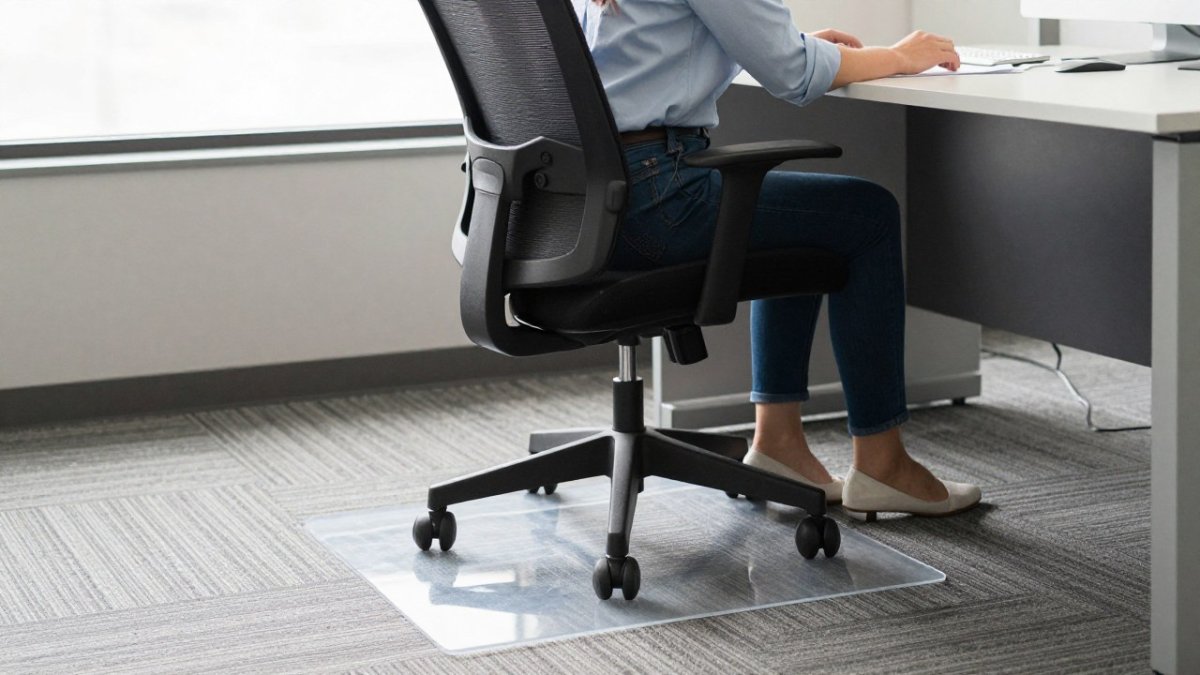
Check the mat every few weeks. If it shifts or curls at the edges, reposition it or use a light adhesive strip made for mats.
Common Mistakes to Avoid and How to Repair Crushed Carpet
Most carpet damage comes from a few repeat errors.
- Using a mat that is too small, so the wheels roll off the edge
- Leaving wheels locked or dragging the chair across the carpet
- Ignoring grit under the mat, which grinds into the fiber
- Skipping the vacuum before setting up protection
For crushed carpet that has already flattened, brush the pile in the direction of the nap, then steam the area lightly and let it dry fully. Deep dents may need a professional carpet repair.
Booking a Furniture Consultation for Your Office Floor Plan
If you are planning a full office layout, Office Furniture Warehouse can help you choose chairs, casters, and floor protection that fit your carpet and desk arrangement. You can book a consultation with our design team to talk through your floor plan and get practical recommendations for your space. Current pricing depends on the size of the project and the products chosen, so contact the team for a quote.
Frequently Asked Questions
Will office chair wheels ruin carpet?
Office chair wheels can ruin carpet over time, especially hard plastic casters carrying a lot of weight on a small contact point. Repeated rolling crushes carpet pile, flattens the fibers and can leave visible tracks or dark wear paths in high-traffic spots. Carpet that is already crushed often recovers partially with brushing and steam, but heavy, long-term damage usually requires replacing the affected section. A properly sized chair mat or carpet-friendly casters are the most reliable ways to prevent it.
What is the best office chair mat for thick carpet?
For thick or high-pile carpet, choose a mat with a rigid, flat surface and a lip or raised edge that keeps the chair from rolling off. Measure the carpet pile and the chair base before buying, and make sure the mat is large enough to cover the full area the chair reaches while rolling. Polycarbonate or similar rigid mats distribute weight well on thick carpet, while very thin mats can sink into the pile and wobble.
Are there alternatives to plastic chair mats for carpet?
Yes. Carpet-friendly casters with soft, wide rubber or polyurethane wheels distribute weight across more carpet fibers and reduce indentation. Chair glides, which replace the wheels entirely, work well for stationary chairs and avoid rolling damage altogether. Some people also use a sturdy rug or a piece of plywood as a barrier, though these do not give the same mobility and need to be checked for slipping.
Can I protect carpet from chair wheels without a mat?
You can, by switching to carpet-friendly casters or chair glides. Replacing the wheels is often the simplest fix because it works with any chair that accepts standard stems. Before buying replacements, check the stem size and fitting type on your current chair so the new casters or glides install properly. Rolling less often, such as pushing back only when needed, also reduces wear on the carpet.

