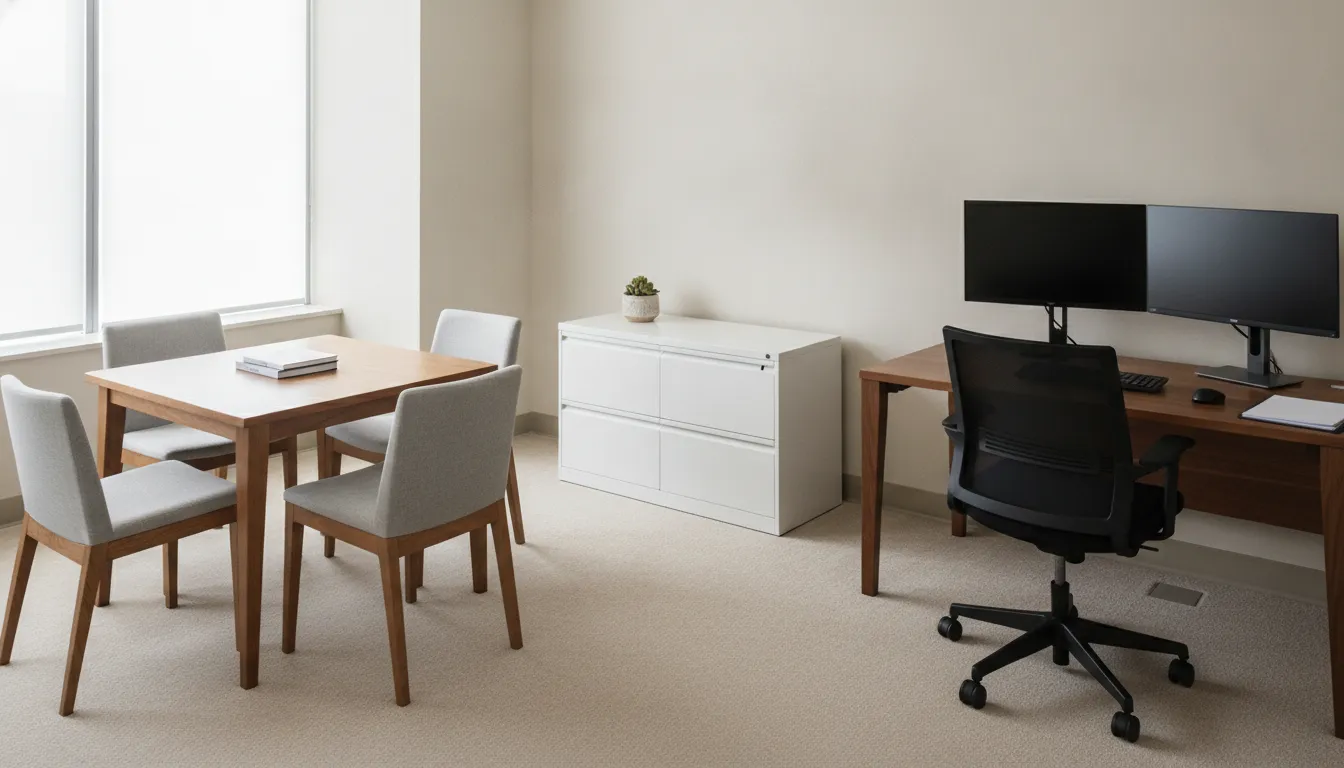
An office furniture finance office plan starts with the work, not a catalog. Client conversations need privacy. Advisors need a desk that holds screens and paperwork at the same time. The back office needs production space, and customer files need controlled storage. Office Furniture Warehouse in Cleveland carries new and pre-owned desks, seating, filing, tables, and cubicles, with planning, delivery, and setup across Northeast Ohio. Read the office furniture services in Cleveland overview before you lock a layout.
Call 216-431-2700 to plan a finance office
This guide covers furniture zones and buying checks. It is not a financing, loan, or lease article, and it does not replace your compliance program. If your team is an accounting practice rather than a finance or advisory office, use the separate accounting office furniture guide instead.
What office furniture a finance office needs
List the jobs before you list the products. A small branch, advisory office, or in-house finance team usually needs four zones. The client zone is for greetings and private conversations. The advisor zone is for daily screen and paper work. The back-office zone is for processing, shared printers, and team seating. The records zone is for files that should not sit in the open.
Write one line for each person or shared station. Note the screens, the paper that stays on the desk, and whether a visitor sits there. A station used for a client review needs a different surface and a different level of visual privacy than a station used only for data entry.
Mark each piece as individual, shared, or occasional. That split keeps a rare meeting from forcing every desk to be oversized. It also shows where one good conference table beats four extra guest chairs that never get used.
| Zone | Main furniture | What to check |
|---|---|---|
| Client greeting | Reception desk or counter. Add guest chairs. | Check sightlines. Check the path past open files. |
| Private meeting | Small table and chairs, or a desk return. | Check door or panel privacy. Leave room to exit. |
| Advisor desk | Desk, task chair, and pedestal. | Check monitor depth, writing space, and a lockable drawer. |
| Back office | Workstations or cubicles, plus task chairs. | Check shared equipment, panel height, and aisle width. |
| Records | Lateral or vertical file cabinets. | Check the lock, the drawer swing, and who holds the keys. |
Use the table as a shopping list, then delete rows the office does not have. A one-person advisory office may combine the meeting and desk zones. A processing team may skip the reception row and spend the budget on panels and filing. When the list is set, space planning and design can turn it into a layout before you buy.
Read each row as its own decision. A greeting area can be two guest chairs if nobody staffs a counter. A records row can be one locking pedestal if the office holds very little paper. Name the job before you buy a matching set that nobody needs.
How to set up client and advisor furniture
Client-facing furniture should look orderly and keep paperwork out of a visitor’s view. A reception counter or a modest desk works if the work surface behind it is not a pile of open files. Guest chairs should be sturdy and easy to move. Avoid soft lounge seating in a room where people review statements, because low seats make document review awkward.
For a private conversation, a four-person table is often easier than perching at the advisor’s desk. The table needs enough depth for two people to look at the same page. Leave clearance so a chair can push back without hitting a cabinet. If the room has no door, a tall panel or a bookcase can block the sightline from the waiting area. Test it by sitting in the guest chair and looking toward the hall.
Advisor desks fail when they are deep enough for monitors but too shallow for paper, or the reverse. Sketch the monitor footprint, then add space for a keyboard and an open folder. A return or a pedestal can hold the folder without widening the whole desk. Compare office desks in person when you need to see depth, knee space, and drawer travel.
Task chairs matter more than the finish. The person who sits there all day should test seat height, lumbar support, and whether the arms hit the desk. For pre-owned seating, sit in the chair, lean back, and work every lever. Shared chairs need controls that the next user can reset without tools. A chair that only one person can adjust is a poor fit for a desk that rotates between advisors.
Cubicle panels help when several advisors share a room and clients walk through it. Use panels to block sightlines to screens, not to build a maze. A lower panel can be enough beside a circulation path. A higher panel belongs where account details would otherwise face the door. Review office cubicles for panel height and workstation size before you commit to a run of them.
How to plan back-office work and filing
Back-office furniture is about throughput. Processors need a clear surface, a task chair, and a place for the files they touch that day. Shared printers and scanners belong on a stable table near the people who use them, not on someone’s primary desk. Leave a standing zone in front of the machine so a paper jam does not trap the neighboring chair.
Filing is a layout problem and an access problem. Measure the folders you already have instead of guessing cabinet count. Lateral files hold more in a shallow wall. Vertical files use less width but need more depth when a drawer is open. Stand in front of an open drawer and confirm the aisle still works. A cabinet that looks fine closed can block a doorway in use.
Decide which drawers lock, who holds the key, and which files stay at the desk. Active working files can live in a pedestal if the desk locks and the room’s routine supports that. Older or shared records usually belong in a cabinet away from the guest path. The Federal Trade Commission’s Safeguards Rule for customer information requires financial institutions to keep an information security program with physical safeguards. Furniture does not satisfy that rule by itself. It only supports the controls your institution already chose, such as locked storage and limited access.
Browse filing cabinets for lock style, size, and condition. On a used cabinet, pull every drawer, check the lock, and look for rails that sag. A sticking drawer becomes a daily tax in a file-heavy office. Bookcases and supply cabinets from office storage can hold binders and forms that do not belong in a locked file.
Meeting tables still earn a place in the back office when the team reviews work together. A small table with task or guest chairs is enough for a huddle. Save the larger conference tables for a room that is actually used for group reviews. Do not put the only table in a spot that doubles as the printer aisle.
How to choose new or pre-owned pieces
New furniture is the simpler path when you need a matched run, a specific size, or a finish the showroom can order. Lead times for new manufacturer orders are often measured in weeks, so do not plan a move around an unconfirmed date. Pre-owned furniture from brands such as Steelcase, Herman Miller, and Haworth is the practical path when the piece is in stock and the condition is acceptable. Office Furniture Warehouse offers premium pre-owned pieces at up to 80% off, and many in-stock items can be picked up the same day.
Mix the two. Use pre-owned task chairs and files where condition is easy to inspect. Use new laminate components or a new desk when the used options do not fit the measured opening. A mixed plan is normal. What matters is that each piece passes the same fit test.
Run this check before you buy:
- Tape the footprint on the floor, including the chair pulled out and the drawer open.
- Confirm the desk holds the real monitors, not a guess.
- Sit in the chair for several minutes and test every adjustment.
- Open every file drawer and test the lock.
- Walk the client path and see whether screens or files are visible.
- Note elevator, stair, and doorway limits before you choose a large table.
Condition notes belong on the shortlist. Look at edges, laminate chips, wobble, and stains on work surfaces. For panels, check that connectors are present. A missing bracket is a small part that can stall an install. If you are unsure, look at the piece at the Cleveland showroom at 4100 Payne Avenue rather than buying from photos alone.
Budget by zone, not by a single average price. A finance office can spend more on task chairs and locks and less on waiting-room finishes. Write a good, better, and best option for the advisor desks and the file run. Then drop the row that does not change the work. That keeps the project from growing into furniture nobody sits in.
How delivery and setup work in Northeast Ohio
Measure the path, not only the room. A conference table that fits the meeting room can still fail at the elevator, the stair turn, or a narrow suite door. Write down doorway widths and any steps before you pick the largest piece. Office Furniture Warehouse provides professional delivery, setup, and installation throughout Northeast Ohio. Confirm timing for your address when you order, because this guide does not quote a delivery fee or a promise date.
Ask for setup when the team cannot stop work for assembly. Placement matters in a finance office. A file cabinet on the wrong wall puts open drawers in the guest path. A desk turned the wrong way shows a screen to the door. Share the taped plan if you want the crew to match a layout you already approved. Planning help is a separate service from buying the furniture.
Sequence the work so the office is not empty. If old furniture is leaving, ask about liquidation so the pickup does not collide with the delivery. Rental furniture can cover a short gap, but only if you confirm that a rental piece is actually available. Do not assume a substitute desk is in stock.
On delivery day, clear the path and name one person who can approve placement. Have that person walk the client route and the back office before the crew leaves. It is easier to rotate a desk then than after the computers are plugged in. Keep packing material out of the file room so drawers can be tested the same day.
Contact the Cleveland showroom or call 216-431-2700 to check stock, planning, and delivery.
Frequently asked questions
What furniture does a small finance office need first?
Start with one work surface and a task chair per person, a lockable file for customer records, and a seat for a private conversation. Add a reception counter or a back-office workstation only if someone actually uses it every week.
How is a finance office different from an accounting office?
Accounting setups center on production desks and records storage. A finance or advisory office also needs a client path that hides screens and files, plus a place to review documents with a visitor. Use the accounting guide if that is the only job.
Can used furniture work in a client-facing finance office?
Yes, when the finish is clean and the size is right. Inspect chair controls, desk stability, and file locks in person. A worn guest chair in the meeting room is more visible than a worn pedestal in the back office.
Does office furniture meet financial privacy rules?
No. Locked cabinets, panel height, and desk placement can support a privacy program. They do not replace the safeguards a financial institution has to maintain. Confirm your own policy before you decide what may sit on a desk.
Where can I see finance office furniture in Cleveland?
Office Furniture Warehouse is at 4100 Payne Avenue, Cleveland, OH 44103. Hours are Monday through Friday, 8 am to 4:30 pm. Call 216-431-2700 before you visit if you want a specific desk, chair, or file pulled for review.
