Table of Contents
- Quick Comparison: Best Budget Office Furniture for Startups
- How We Evaluated These Budget Office Furniture Picks
- 1. Office Furniture Warehouse: Best Overall for Pre-Owned Value
- 2. Staples Essentials Task Chair: Best for High-Volume Seating
- 3. Uplift Standing Desk: Best for Long-Term Flexibility
- 4. CORT Furniture Outlet: Best for Fast Office Fit-Outs
- 5. New Life Office: Best for Design Guidance on a Budget
- 6. ROSI Office Systems Inc.: Best for Modular Workstations
- What Most Startups Get Wrong About Budget Office Furniture
- Frequently Asked Questions
Last Updated: September 10, 2026
Quick Comparison: Best Budget Office Furniture for Startups
Finding the best budget office furniture for startups means balancing ergonomic quality, upfront cost, and scalability. This guide from Office Furniture Warehouse breaks down six options that get the job done without draining your runway.
The picks below range from high-volume task seating to modular workstations, and each earns its place for a specific startup scenario.
| Pick | Best For | Starting Price | Standout Feature |
|---|---|---|---|
| Office Furniture Warehouse | Pre-owned value | Quote-based | Steelcase and Herman Miller at up to 80% off |
| Staples Essentials Task Chair | High-volume seating | $120 | Adjustable height, mesh back |
| Uplift Standing Desk | Long-term flexibility | $599 | Electric height adjustment |
| CORT Furniture Outlet | Fast fit-outs | Varies by item | Professional-grade clearance stock |
| New Life Office | Design guidance | Quote-based | Layout consultation included |
| ROSI Office Systems | Modular workstations | Quote-based | Customizable cubicle systems |
How We Evaluated These Budget Office Furniture Picks
Most “best budget” lists rank products by sticker price. That is the wrong metric for a startup, because the cheapest chair that fails in 14 months costs more than a mid-tier chair that lasts five years. We scored every pick on four weighted criteria, for a company that expects to double headcount within 24 months.
1. Ergonomic adjustability (30%). Seat-height range, seat-depth adjustment, lumbar support, armrest adjustability, and tilt tension. A chair with only height adjustment is a placeholder, not a workstation. The benchmark: thighs parallel to the floor, feet flat, and elbows at roughly 90 degrees without a cushion or footrest.
2. Warranty and expected service life (25%). We separate the warranty term from realistic service life. A 1-year warranty on a $120 task chair signals roughly 1-2 years of daily use; a 12-year warranty on a Steelcase or Herman Miller chair means the frame is rated for shift work. Pre-owned premium chairs often carry the balance of the original warranty, which is why they outperform new budget chairs here.
3. Scalability (25%). Can you buy 6 now and 14 more in eight months without a redesign? Modular panel systems, standardized desk footprints, and chairs that stay in production for a decade score well. One-off clearance finds score poorly, because you cannot match them later.
4. Total cost of ownership (20%). This is the criterion competitors skip. TCO = purchase price + delivery + assembly + repairs + replacement cycles − resale or trade-in value. A $120 chair replaced three times over five years is $360 plus three deliveries; a $300 pre-owned premium chair that lasts five years is $300 with one (gsa.gov). The pre-owned chair wins on cost and ergonomics.
A Simple TCO Worksheet You Can Run in 10 Minutes
For each candidate, write down five numbers:
- Unit price (including tax and freight)
- Assembly cost per unit (or your own hourly rate if you assemble it)
- Expected replacement interval in years
- Resale or trade-in value at end of life (pre-owned premium furniture typically holds 20-40% of its original retail; budget new furniture often holds near zero)
- Annual repair or parts cost
Then divide total five-year cost by 60 months. That monthly number is what you compare, not the invoice. A $599 standing desk at a 7-year service life is roughly $7.13 per month before resale; a $180 fixed desk replaced every three years is roughly $5.00, closer than the sticker prices suggest, and the standing desk carries the ergonomic and retention benefits.
Where the Money Should Go
A common pattern among founders who have furnished more than one office: spend on the chair, save on the desk, split the difference on storage.
- Chair: The single highest-return purchase. Employees sit 6-8 hours a day. Buy the best ergonomic chair your budget allows, new or pre-owned.
- Desk: Static desks are cheap and durable. Reserve sit-stand for roles that request it or for shared hot-desk stations.
- Storage and meeting furniture: Buy used. Filing cabinets, bookcases, and conference tables take almost no ergonomic wear and depreciate fast.
- Soft seating and decor: Buy used or skip until Series A. Nobody leaves a job over a lobby sofa.
Ask any vendor whether they handle delivery and assembly, and whether removal of old furniture is included. A cheap quote that excludes installation can cost more than a slightly higher one that bundles it. Get the install cost in writing per unit before you compare quotes.
Leasing vs. Buying: The Cash-Flow Question
Most budget furniture guides assume you are buying outright. If you are cash-flow sensitive, leasing deserves a look: it spreads cost across 12-36 months, preserves working capital, and can be structured as an operating expense rather than a capital purchase. The trade-off is a financing cost over the term, and you do not own the asset at the end unless the lease includes a buyout.
Run the comparison this way: add up total lease payments over the term, then compare that to (purchase price − resale value at end of term). If the lease premium is small and cash preservation matters more, leasing wins. If you plan to keep the furniture past the lease term, buying usually wins. For hybrid teams, a per-employee home-office stipend is often cheaper than either, because you are not paying for square footage you do not use.
For startups, the best budget office furniture isn’t the cheapest item on the shelf. It’s the piece that survives three years of daily use without a replacement, and the math that proves it.
1. Office Furniture Warehouse: Best Overall for Pre-Owned Value
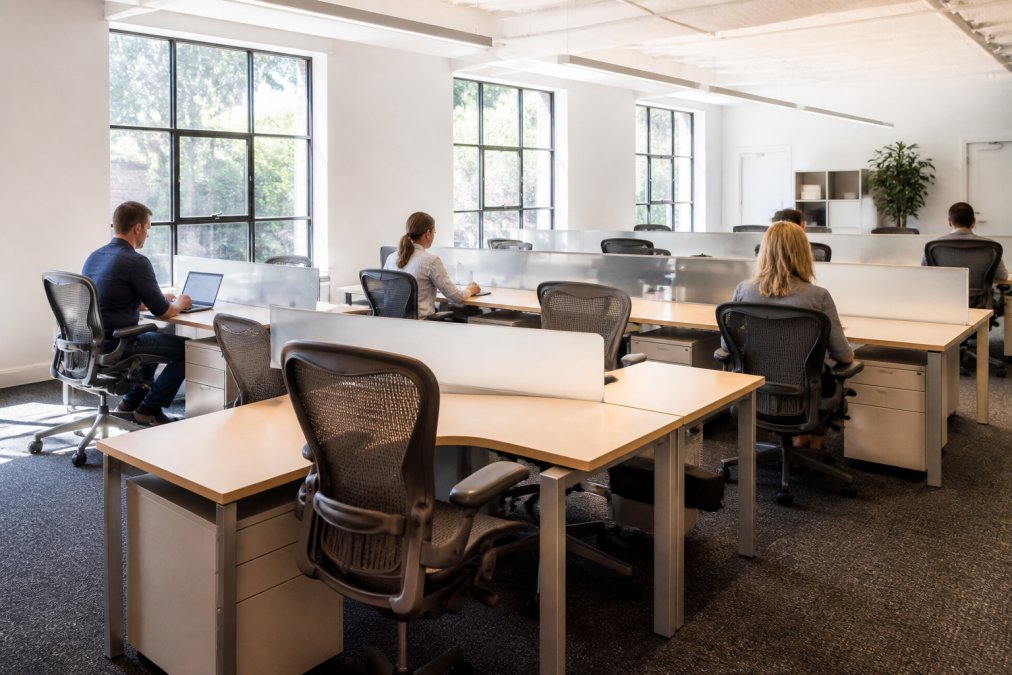
Office Furniture Warehouse is a strong pick for startups that want premium brands without premium pricing, thanks to over 35 years in business and a four-acre inventory of new and pre-owned furniture.
The Cleveland showroom stocks Steelcase and Herman Miller pieces at up to 80% off, and the team offers expert design and layout planning services. That matters when you’re furnishing 15 workstations and need matching pieces, not a patchwork of one-off finds.
Pros and Cons
What works: pre-owned pricing on top-tier brands, professional space planning, flexible pickup or delivery, and a wide selection of colors and styles.
What doesn’t: inventory turns over quickly, so specific models aren’t guaranteed to stay in stock.
For startups, the best budget office furniture isn’t the cheapest item on the shelf. It’s the piece that survives three years of daily use without a replacement.
2. Staples Essentials Task Chair: Best for High-Volume Seating
The Staples Essentials Task Chair is a practical choice when you need a dozen seats fast.
At roughly $120, it offers adjustable seat height, padded armrests, a breathable mesh backrest, and a swivel base with dual-wheel casters. Shipping is quick because it’s widely stocked.
The tradeoff is real: ergonomic adjustments are limited compared to premium models. For a call center or hot-desk setup, that’s fine. For someone sitting eight hours a day on the same chair, budget for an upgrade later.
3. Uplift Standing Desk: Best for Long-Term Flexibility
Uplift’s standing desk starts around $599.
The electric height adjustment, heavy-duty frame, and programmable memory keypad hold up under daily switching. The accessory ecosystem means you can add monitor arms and cable management without replacing the desk.
The higher upfront investment is the main drawback. If cash flow is tight this quarter, pair a few Uplift desks with static workstations for roles that don’t need sit-stand flexibility.
4. CORT Furniture Outlet: Best for Fast Office Fit-Outs
CORT Furniture Outlet sells pre-owned and overstock office furniture at discounted rates, an option when you need to furnish an entire floor quickly.
Inventory includes desks, chairs, and storage from professional-grade brands, with local pickup and delivery. Because stock rotates regularly, you can often find matching sets if you move fast.
Availability fluctuates, so treat CORT as a sourcing channel rather than a guaranteed catalog. Confirm lead time before you commit to a move-in date.
5. New Life Office: Best for Design Guidance on a Budget
New Life Office pairs a large selection of pre-owned inventory with layout consultation.
The service model reduces startup overhead because you’re buying used pieces and getting design help in the same transaction. Full-service delivery and installation round out the offer.
Pricing is quote-based, so you’ll need to contact the team directly. Expect a short discovery call before you get numbers.
6. ROSI Office Systems Inc.: Best for Modular Workstations
ROSI Office Systems supplies modular cubicle systems and workstations.
Configurations are customizable, turnaround times are fast, and ergonomic workstation options are available. The modular design means you can add bays as headcount grows instead of buying a whole new system.
Installation typically requires professional assistance, which adds to the project cost. Factor that into your budget before signing.
Skipping professional installation on modular systems to save money often voids the warranty and leaves panels misaligned. The rework usually costs more than the install.
What Most Startups Get Wrong About Budget Office Furniture
The biggest error is buying new when pre-owned inventory from corporate decommissions offers good build quality at a lower price. The second is treating furniture as a one-time purchase instead of a recurring cost with tax and cash-flow implications. The third is buying for today’s headcount.
Mistake 1: Comparing Sticker Prices Instead of Lifecycle Cost
A $120 task chair and a $300 pre-owned Steelcase chair are not competing products, they are competing five-year costs. The $120 chair typically needs replacing every 18-24 months under daily use: three purchases, three deliveries, and three assembly sessions over five years. The pre-owned premium chair is rated for shift work and often carries the balance of a 12-year warranty. Run the TCO worksheet above and the premium chair usually wins on cost and always wins on ergonomics.
Mistake 2: Ignoring the Tax Treatment
Office furniture is generally depreciable business property, but qualifying purchases may be deductible in the year they are placed in service under Section 179 of the Internal Revenue Code, subject to annual dollar limits and a taxable-income limitation. Bonus depreciation rules have also changed repeatedly in recent years, so the correct treatment depends on the tax year and the asset class. Confirm current thresholds and eligibility with the IRS Section 179 guidance or a CPA before you file. The practical point for a founder: a larger upfront purchase can be less painful after tax than the invoice suggests, and a lease may be treated differently. Do not make the buy-vs-lease call without running both through your accountant.
Mistake 3: Buying for Today’s Headcount
Fixed layouts do not absorb growth. If you sign a 10-person floor plan with built-in cubicles, adding six people means a construction project. Modular panel systems, standardized desk footprints, and stackable storage let you add bays as headcount grows. Space planners use 100-150 square feet per employee for a traditional office and 75-100 for a hybrid team with shared desks. Plan for the headcount you expect in 18 months, not today’s.
Mistake 4: Overlooking the Hybrid Reality
If part of your team works remotely, a dedicated desk for every employee is wasted square footage. Two models work well:
- Hot-desking with a smaller footprint. Provide fewer desks than employees, plus lockers. This cuts furniture spend and rent simultaneously.
- A home-office stipend. A one-time or recurring stipend lets remote employees buy their own chair, desk, and monitor. The cost per employee is typically far lower than a dedicated desk plus the square footage it occupies, and it supports retention without a lease commitment.
If you go the stipend route, put it in writing. Specify the amount, what it covers, whether it is taxable income to the employee, and what happens to the equipment if the employee leaves. A simple policy prevents disputes later. For ergonomic guidance on home setups, the OSHA computer workstation checklist is a useful reference for chair height, monitor placement, and lumbar support, share it with remote staff so the stipend actually improves their setup.
Mistake 5: Skipping the Resale and Disposal Plan
Furniture you cannot sell or remove is a liability. Pre-owned premium brands hold resale value; budget new furniture often does not. Before you buy, ask: what is this worth in three years, and who hauls it away when we outgrow it? Vendors that handle removal and trade-in save a real cost that never appears on the quote.
Skipping professional installation on modular systems to save money often voids the warranty and leaves panels misaligned. The rework usually costs more than the install.
Frequently Asked Questions
Is office furniture 100% tax deductible under Section 179?
Yes, Section 179 allows small businesses to deduct the full purchase price of qualifying office furniture and equipment in the year it is placed in service, up to the annual limit set by the IRS. This means startups can write off desks, chairs, and filing cabinets immediately instead of depreciating them over several years. Consult a tax professional to confirm your specific situation.
What are the best ergonomic chairs for startups on a budget?
Look for chairs with adjustable seat height, lumbar support, and a breathable mesh back. The Staples Essentials Task Chair starts around $120 and offers basic adjustability for high-volume seating. For long-term comfort, consider pre-owned Herman Miller or Steelcase chairs from a liquidator, which can cost up to 80% less than new while still providing premium ergonomics.
Should startups buy new or pre-owned office furniture?
Pre-owned office furniture often makes more financial sense for startups. You can get premium brands like Steelcase and Herman Miller at a fraction of the retail price, and many pieces are still under warranty or have years of life left. Pre-owned also supports sustainability and reduces lead times. However, if you need a specific color or configuration and cannot wait for inventory, buying new may be necessary. Evaluate your timeline and aesthetic needs before deciding.
What essential office furniture does a new startup actually need?
At minimum, each employee needs a desk, an ergonomic chair, and a computer. Shared essentials include a meeting table, storage cabinets, and task lighting. Start with adjustable desks and mesh-back chairs to support long work hours. Modular workstations from suppliers like ROSI Office Systems let you scale as you hire. Skip executive suites and heavy filing cabinets until your team stabilizes. Prioritize lumbar support and space optimization to keep your office functional and comfortable.
How can startups balance office aesthetics with budget constraints?
Focus on a cohesive color palette and consistent finishes rather than expensive statement pieces. Pre-owned furniture from a single liquidator often comes in matching sets, which makes a small office look polished. Add low-cost touches for a uniform look. Use modular workstations to create clean lines. A professional layout from a design service can also help you mix and match without looking mismatched, keeping your startup looking sharp on a tight budget.
