Table of Contents
- Quick Comparison: Best Office Desks for Small Startups
- How to Budget for Startup Office Furniture
- Top Standing Desks for Small Startup Teams
- Benefits of Sit-Stand Desks for Employees
- Best Fixed-Height and Compact Desks for Startups
- Best Office Chairs for Remote Workers
- How to Choose the Right Desk for Your Startup
- Conclusion: Outfitting Your Startup for Success
- Frequently Asked Questions
Last Updated: September 16, 2026
Quick Comparison: Best Office Desks for Small Startups
The best office desks for small startups balance footprint, adjustability, and price without looking like a card table. At Office Furniture Warehouse, we’ve spent 35 years outfitting growing teams, and the pattern is consistent: startups regret overspending on trendy desks before they regret buying too little desk. This guide compares seven options, from electric sit-stand models to compact fixed-height desks.
Here’s the short version before the details:
| Desk | Type | Starting Price | Best For | Standout Feature |
|---|---|---|---|---|
| Uplift V3 | Electric standing | $569 | Durability | Heavy-duty lift capacity |
| Branch Duo | Electric standing | $494 | Small spaces | Compact footprint |
| FlexiSpot EN1 | Electric standing | $250 | Budget teams | Value-to-cost ratio |
| Branch Daily | Fixed-height | $450 | Uniform layouts | Solid wood or laminate top |
| Fenlo Writing Desk | Fixed-height | $200 | Hot-desking | Slim profile |
| Everest Work Table | Manual adjustable | $300 | No-motor setups | Industrial steel frame |
| ErGear Adjustable | Electric standing | $180 | Remote staff | Memory presets |
The range is the point: a five-person startup doesn’t need the same desk as a twenty-person one, and mixing types across a floor plan often beats forcing uniformity.
How to Budget for Startup Office Furniture
Budgeting for startup office furniture starts with separating one-time capital costs from recurring ones. Desks, chairs, and storage are capital purchases; delivery, assembly, and future reconfiguration are operating costs that surprise people later.
Price the full workstation, not the desk alone: a desk without cable management, a monitor arm, or a chair that supports an eight-hour day is incomplete. Budget in tiers, core workstations first, shared and hot-desking areas second, aesthetic upgrades last.
Ask your accountant about Section 179 and bonus depreciation rules before you buy. Many small businesses can deduct qualifying furniture purchases in the year they’re placed in service, but the rules change, so confirm current limits with a tax professional rather than assuming last year’s numbers still apply.
Buying pre-owned is the biggest lever most startups have. Office Furniture Warehouse stocks over four acres of new and pre-owned furniture, including Steelcase and Herman Miller pieces at up to 80% off, letting a tight budget buy commercial-grade construction instead of entry-level particleboard.
Top Standing Desks for Small Startup Teams
Electric sit-stand desks are the default for teams that spend most of the day at a screen. The three below cover the durability, space, and budget ends of that market.
Uplift V3 Standing Desk: Best for Durability
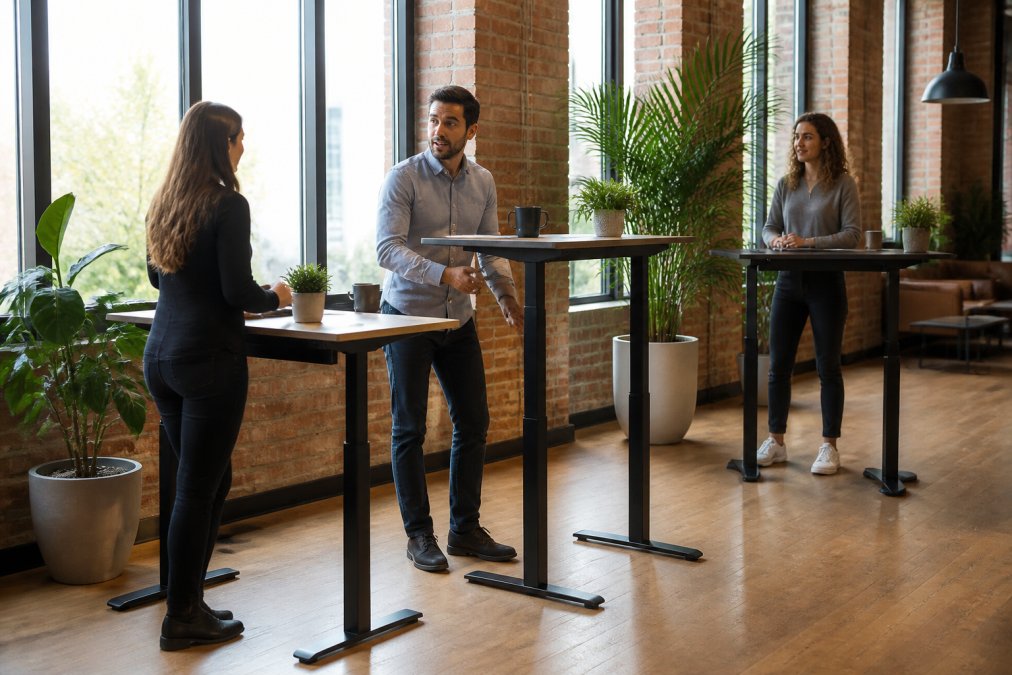
The Uplift V3 is the desk to buy if you expect it to survive a decade of daily use. Its advanced height-adjustment range and heavy-duty lifting capacity handle multi-monitor setups without the wobble that plagues cheaper frames at full extension. The tradeoff is price: starting around $569, it costs more than double some budget models. For a startup keeping furniture through several growth stages, that math works; for a team still figuring out headcount, it’s harder to justify.
Branch Duo Standing Desk: Best for Small Spaces
Branch built the Duo for exactly the problem small startups have: not enough square footage. Its compact dimensions and quiet dual-motor mechanism fit tight floor plans, and the simple keypad means nobody needs a manual. Assembly is straightforward, which matters when your “facilities team” is whoever isn’t in a meeting. The limitation: the desktop is small, and a dual-monitor setup will feel cramped.

FlexiSpot EN1 Electric Standing Desk: Best Budget Option
If you need to outfit eight workstations without blowing the furniture budget, the FlexiSpot EN1 is the pragmatic pick. At roughly $250, it delivers a 48×30 inch surface, programmable height presets, and a sturdy steel frame. The motor is reliable rather than refined, and you won’t find premium finishes, neither matters much when the alternative is a fixed-height desk nobody wants to sit at.
Benefits of Sit-Stand Desks for Employees
The benefits of sit-stand desks for employees come down to movement, not magic. Alternating between sitting and standing keeps blood flowing, reduces stiffness from long seated stretches, and gives people a physical reset between tasks. Most practitioners find the biggest focus gains land in the early afternoon, when a height change breaks the post-lunch slump better than another cup of coffee.
What most “best desk” guides skip is how those benefits translate into retention, recruiting, and the cost of getting the setup wrong. Here’s the operational version.
Comfort is a retention lever, not a perk. A workspace that supports the body reads as a company that respects the person in it.
Sit-stand benefits are real but conditional. The desk is the hardware; the monitor arm, cable management, and a simple standing rhythm are what make the hardware pay off. Budget for all three or expect the desk to become a very expensive fixed-height table.
Where this connects to scalability. A startup’s headcount and floor plan will change faster than its furniture budget. That’s the argument for buying adjustable desks in a modular system, same frame family, swappable tops, consistent dimensions, so a desk bought for a two-person pod can be redeployed to a four-person bench when the team grows, instead of being sold at a loss and replaced. For a startup, the resale and redeployment value of a standardized frame often outweighs the spec sheet difference between two similar models.
Don’t buy a standing desk and expect people to use it automatically. Without a monitor arm and proper cable management, the transition from sitting to standing leaves screens at the wrong height, and staff quietly stop adjusting the desk. Budget for the accessories that make height changes actually work.
Best Fixed-Height and Compact Desks for Startups
Not every workstation needs a motor. Fixed-height and compact desks cost less, fail less, and often look cleaner across an open floor plan. These three cover uniform layouts, hot-desking, and manual adjustability.
Branch Daily Desk: Best for Uniform Office Layouts
The Branch Daily Desk is what you buy when you want every workstation to match. Solid wood or laminate top options, sturdy metal legs, and integrated leveling glides give it a professional, consistent look that photographs well in client meetings. Starting around $450, it’s not cheap for a fixed-height desk, but the construction justifies it. The catch: no height adjustability, so pair it with an adjustable chair or desk riser if ergonomics matter.
Fenlo Writing Desk: Best for Hot-Desking Areas
For a shared desk that three people use on rotation, the Fenlo Writing Desk does the job at roughly $200. Its slim profile fits into corners and narrow runs where a full-size desk won’t, and the finish options keep it from looking institutional. Tool-free assembly means you can reconfigure the space yourself. Just don’t put heavy equipment on it. This is a light-duty desk for laptops and admin work, not a multi-monitor command center.
Everest Work Table: Best Manual Adjustable Desk
The Everest Work Table solves a specific problem: height adjustability without electronics that can fail. Its manual crank covers a 32 to 44.5 inch range, the industrial-grade steel frame is genuinely sturdy, and there’s no motor, control box, or power cable to route. Adjusting takes longer than pressing a button, but for startups burned by warranty headaches on electric desks, that tradeoff is often worth it.
Best Office Chairs for Remote Workers
The best office chairs for remote workers share three traits: adjustable lumbar support, a seat depth that fits the user’s body, and build quality that survives daily eight-hour use. A desk is half the ergonomic equation, and pairing a good desk with a bad chair defeats the purpose.
How to Choose the Right Desk for Your Startup
Choosing the right desk comes down to matching desk type to how your team actually works, and how it’s likely to change over the next 18 months. Most guides stop at the first half; for a startup, the second half is where the money is.
Conclusion: Outfitting Your Startup for Success
Furnishing a startup office is a series of tradeoffs between budget, durability, and how long you plan to stay in the space. The desks above cover every point on that spectrum without sacrificing a professional look to hit a number.
Frequently Asked Questions
What is the best desk for a small office?
The best desk for a small office depends on your space and budget. Compact standing desks or fixed-height options work well in tight footprints. Look for desks with a small surface area, integrated cable management, and a sturdy frame. For startups, modular desks that can be reconfigured as your team grows are a smart choice. Measure your space first, then prioritize adjustability and storage.
What are the benefits of standing desks for startup teams?
Standing desks offer several benefits for startup teams. They support ergonomic posture, which can reduce back pain and discomfort during long workdays. Height adjustability lets employees switch between sitting and standing, which may help maintain energy levels. For startups, standing desks also signal a modern, employee-focused culture. Many models include memory presets and cable management, keeping workspaces tidy. Investing in adjustable desks can improve user experience and productivity.
Is it better to buy new or pre-owned office furniture for a startup?
Buying pre-owned office furniture can stretch a startup budget significantly. High-quality brands like Steelcase and Herman Miller are often available at a fraction of their original cost. Pre-owned desks and chairs from reputable dealers are inspected and cleaned before resale. For startups furnishing multiple workstations, pre-owned is a practical way to get commercial-grade durability without paying full price. Just confirm the warranty and return policy before purchasing.
How do you choose the right desk size for a small startup office?
Start by measuring your available floor space and accounting for walkways and storage. A standard desk is 48 to 60 inches wide, but compact models at 40 to 48 inches work well in tight areas. Consider the number of monitors and equipment each employee uses. For collaborative spaces, modular desks with a smaller footprint allow flexibility. Also check weight capacity and cable management options. A professional space planner can help optimize your office layout.
