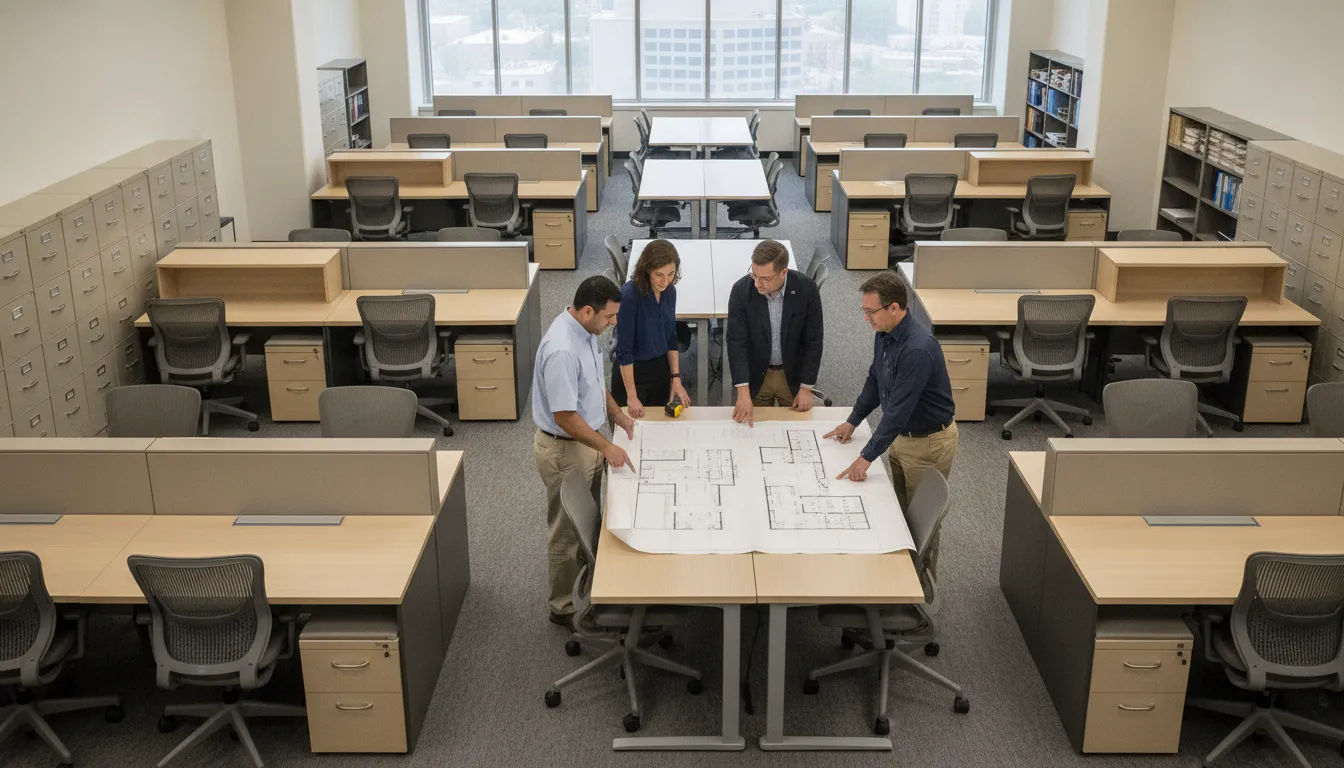
Furniture decisions are rarely limited to choosing desks. Nonprofits and schools must outfit offices, classrooms, meeting rooms, reception areas, libraries, and shared spaces while protecting limited budgets and planning for daily use.
Public agencies and eligible institutions should also review our guide to government office furniture procurement in Ohio before requesting quotes or comparing contract options.
Office furniture for nonprofits and schools northeast ohio should be selected around room function, condition, fit, quantity, and total project needs. A mix of new and pre-owned furniture can help organizations balance quality, budget, and flexibility, while local planning, delivery, and installation support the rollout.
Office Furniture Warehouse serves Cleveland, Akron, Canton, and surrounding Northeast Ohio communities from its showroom and warehouse at 4100 Payne Avenue in Cleveland. The company offers furniture and office furniture services across Northeast Ohio, including space planning, delivery, setup, and installation. The right starting point is understanding why pre-owned furniture may be a practical choice for institutional spaces, and what to evaluate before ordering.
Call Office Furniture Warehouse at 216-431-2700 to discuss your nonprofit or school furniture needs.
Why nonprofits and schools choose pre-owned office furniture
For a nonprofit or school, a furniture decision is also an operations decision. Pre-owned office furniture can preserve funds for programs, teaching, technology, and building needs while extending the useful life of furnishings that still perform well. The goal is not to choose used furniture automatically. The goal is to choose the right furniture for each room, user, and level of daily wear.
Office Furniture Warehouse explains that organizations can combine new and pre-owned furniture to balance quality, budget, and project requirements. Read more about choosing new or pre-owned office furniture before building a purchasing plan. A mixed approach may make sense when administrative offices, classrooms, reception areas, meeting rooms, or program spaces have different priorities.
Preserve the budget without lowering the standard
Pre-owned furniture can help control the cost of furnishing a room, particularly when an organization needs multiple workstations, desks, tables, or chairs. Ask whether each item is structurally sound, appropriate for its use, and likely to support the people using it. A durable pre-owned desk that fits an office may be more useful than a new desk that creates layout problems.
Start by separating essential requirements from preferences. List rooms, users, quantities, dimensions, storage needs, and daily activities. Then decide where new furniture adds value and where pre-owned furniture can meet the same functional need. These are planning choices, not promises about current inventory.
Condition, fit, and ergonomics matter
Inspect more than surface wear. Check whether desks are stable, drawers operate, doors align, chair adjustments work, and work surfaces suit the intended tasks. Look for damage that could affect safety, cleaning, comfort, or maintenance. Confirm that dimensions work with doorways, elevators, corridors, and the planned layout.
A systematic review indexed by PubMed found that compatibility between school furniture dimensions and students’ physical characteristics can affect physical responses. Buyers should evaluate dimensions against the people who will use the space, rather than selecting only by appearance or quantity.
The same principle applies to staff workstations. The University of Washington notes that workstations should support productivity and comfort while reducing susceptibility to pain or injury. Before a large order, have intended users assess seat height, back support, reach, work-surface height, and ease of adjustment when possible.
Reuse can support responsible purchasing
Choosing pre-owned furniture keeps useful furnishings in service instead of treating replacement as the only option. Oregon’s Department of Administrative Services describes repurposing, reuse, and responsible recycling as ways to keep furniture out of landfills. Its guidance also notes that responsible disposal can avoid landfill costs and reduce greenhouse gas emissions from landfilled waste.
Buyers in Cleveland, Akron, Canton, and surrounding Northeast Ohio communities can compare options at the Office Furniture Warehouse showroom and warehouse at 4100 Payne Avenue in Cleveland. Bring a room list, measurements, user requirements, and a clear idea of which spaces need new furniture versus pre-owned furniture.
What should institutional buyers compare before ordering?
Institutional furniture purchases affect more than one employee or classroom. A nonprofit may be furnishing staff offices, reception, meeting rooms, and program spaces. A school may be planning administrative offices, classrooms, student services, libraries, and shared areas. Use this checklist to compare fit, condition, comfort, and long-term usefulness before ordering.
- Use case: List who will use each item and what activity it must support. Separate private work, student services, group instruction, meetings, reception, storage, and flexible program use. A staff workstation has different needs from a classroom table or shared meeting chair. The customer service overview identifies these room types for nonprofit and school projects. See Office Furniture Warehouse services.
- Measurements: Record room dimensions, doorways, elevators, columns, outlets, windows, and other fixed features. Compare width, depth, height, clearances, and turning space against the actual room. Include space for people to move, open drawers, pull out chairs, and access equipment. A systematic review found that compatibility between school furniture dimensions and students’ physical characteristics can affect physical responses. Read the research at PubMed.
- Condition: For pre-owned furniture, inspect surfaces, edges, hardware, casters, locks, adjustment points, upholstery, and structural damage. Ask what can be repaired or refinished. New and pre-owned furniture can be combined to balance quality, budget, and project requirements. Review this new or pre-owned furniture guide. Confirm current availability before ordering.
- Cleanability: Consider how surfaces and textiles will be cleaned during normal operations. Compare accessible surfaces with hard-to-reach joints, damaged finishes, exposed edges, and upholstery that may need specialized care. Match the cleaning plan to the room’s traffic and use.
- Ergonomics: Compare adjustability, seat support, work-surface height, monitor position, reach range, and the needs of the people using the furniture. The University of Washington says office workstations should support productivity and comfort while reducing susceptibility to pain or injury. See its office furniture ergonomics guidance. When possible, have intended users try representative chairs or workstation components before a larger purchase.
- Quantity: Count seats, workstations, tables, and storage units by room. Separate immediate needs from optional additions. For volume purchases, prepare a room-by-room quantity schedule and request a project quote based on current inventory and requirements.
- Storage: Identify what must be secured, archived, shared, or accessed daily. Compare filing, shelving, personal storage, and supply storage based on capacity, location, access, and traffic flow. See the Northeast Ohio guide to filing cabinets and office storage.
- Future flexibility: Ask whether the furniture can support enrollment changes, program growth, staffing shifts, room reassignments, or hybrid use. Compare movable tables, adaptable seating, modular workstations, and pieces that can serve more than one room. Select only what fits the current plan, and document which items should match now and which can be added later.
Bring this checklist, room measurements, photos, and a quantity schedule when reviewing options. Office Furniture Warehouse lets customers browse online, visit its Cleveland showroom at 4100 Payne Avenue, and request guidance for volume purchases. A focused review helps institutional buyers compare practical choices before arranging delivery or installation.
Office furniture for nonprofits and schools in Northeast Ohio: room-by-room options
Room-by-room planning helps buyers match furniture to the work in each space. A reception desk has a different job from a staff workstation. A classroom needs flexibility that may not be necessary in a records room. Start with the people, activities, traffic, and storage. Then compare new, pre-owned, or mixed options against the budget and expected daily use.
For nonprofit organizations, the planning list may include staff offices, reception areas, meeting rooms, and program spaces. Schools may need furniture for administrative offices, classrooms, student services, libraries, and shared rooms. These are practical planning categories for organizations furnishing one room or coordinating a larger project across Cleveland, Akron, Canton, and surrounding Northeast Ohio communities.
| Room or use | Furniture types | Buying considerations |
| Nonprofit staff offices | Desks, workstations, task seating, storage | Fit the number of staff, privacy needs, daily computer work, records, and future flexibility. |
| Reception and intake | Reception desk, guest seating, side tables, storage | Prioritize a clear welcome point, accessible circulation, visitor seating, and secure files or supplies. |
| Meeting and program spaces | Conference or training tables, chairs, mobile or folding pieces | Choose layouts that support board meetings, classes, workshops, and room changes without blocking traffic. |
| School administrative offices | Desks, workstations, guest chairs, filing and storage | Balance confidential conversations, staff workflow, visitor access, records management, and available wall space. |
| Classrooms and libraries | Student tables, adaptable seating, shelving, study surfaces | Review clearances, supervision, cleaning, age-appropriate dimensions, and the need to change layouts. |
| Student services and shared rooms | Desks, consultation tables, chairs, storage, flexible tables | Support private conversations, scheduled group use, accessibility, traffic flow, and shared ownership of the room. |
Nonprofit offices, reception, and program rooms
In a nonprofit staff office, prioritize a workstation that supports focused work, meetings, and secure handling of client or organizational information. Buyers can review office desks for staff and administrators as one starting point, then compare dimensions, storage, surface condition, and the room’s circulation. If several employees share a larger room, office cubicles and workstations may help define work areas while preserving a workable path through the space. Do not assume a category page represents current stock. Confirm availability and fit for the specific project.
Reception areas should make the first interaction straightforward for visitors, clients, volunteers, and families. Consider the position of the welcome point, seating for short waits, access to files or supplies, and the route to offices or program rooms. Meeting and program spaces need a different kind of flexibility. Tables and chairs may support board meetings, staff training, workshops, counseling groups, or community programs. The conference, training, and breakroom tables category can help buyers compare relevant table groupings. For a deeper look at seating decisions, see the guide to training-room chairs for schools and meeting spaces.
School offices, classrooms, libraries, and student services
Administrative offices often combine private work, visitor meetings, phone calls, and records management. Plan the desk or workstation around the staff member’s tasks, then account for guest seating, filing, and clear access to the door. Student services offices may need a calm consultation arrangement, a small meeting surface, and storage for supplies. A room that serves multiple counselors or departments should be planned for shared use rather than one person’s workflow.
Classrooms and libraries benefit from furniture that can support instruction, independent work, group projects, and changing schedules. Check table dimensions, aisle clearances, supervision lines, cleanability, and how easily the arrangement can change. Fit matters for students as well as adults, so buyers should evaluate the dimensions and intended users instead of selecting solely by appearance. Libraries also need a deliberate balance between study surfaces, circulation, shelving, and quiet zones.
Storage is part of the room plan, not an afterthought. Filing and supply storage should match the records, materials, and access rules for the room. The guide to filing cabinets and office storage in Northeast Ohio offers a relevant reference for organizations managing records and supplies. For larger projects, a space plan can connect room requirements, traffic flow, ergonomic needs, and storage before furniture is selected. Buyers can also visit the Cleveland showroom and warehouse at 4100 Payne Avenue to discuss the project. Review available options, and coordinate next steps based on current inventory and requirements.
How volume purchasing, delivery, and installation work
For a school or nonprofit, furnishing several rooms is more than choosing a desk or chair. The project has to fit the number of people served, the way each room operates, the available space, and the organization’s budget. Office Furniture Warehouse can support that process with office furniture services across Northeast Ohio, including delivery, setup, and installation. The same process can be scaled for one replacement desk, a department refresh, or a complete office installation.
Start with an inventory and requirements review
First, define what the project requires. Make a room-by-room list for staff offices, reception areas, classrooms, student services, meeting rooms, libraries, storage areas, and shared spaces. Record users, existing furniture, replacement needs, and pieces that can remain in service. Photos, measurements, floor plans, and access notes can make the discussion more productive.
Next, review the quantity and mix. A nonprofit may need a combination of staff workstations, meeting tables, reception furniture, storage, and seating. A school may need administrative desks, work surfaces for student services, tables for shared rooms, and storage for records or supplies. The right mix is not always the largest possible order. It should reflect actual use, circulation space, accessibility needs, and the possibility that rooms will serve more than one purpose.
Build a quote around the project scope
Once the needs are clear, the buyer and furniture representative can review current product options. They can determine whether a new, pre-owned, or mixed plan makes sense. Check current inventory directly instead of relying on a website category or older list. For a volume purchase, the quote should identify quantities, furniture types, delivery and installation needs, and relevant site conditions. This gives the organization a clearer basis for comparison and approval.
Customers can browse products online, visit the Cleveland showroom, and request quotes for volume purchases. A visit to the Payne Avenue location at 4100 Payne Avenue can help decision-makers compare furniture in person and discuss how individual pieces will work together. It also gives the project team an opportunity to clarify which questions still need answers before an order is finalized.
Coordinate the site before delivery
Site coordination connects the order to the building. Confirm the delivery address, receiving contact, access instructions, parking or loading requirements, floor protection expectations, and the rooms that will be ready. Identify where furniture should go and whether existing items need to be moved before the crew arrives. For a larger project, a simple room map or labeled delivery plan can reduce confusion when several departments or floors are involved.
Delivery and installation can cover projects from a single desk to a complete office installation, with service coverage throughout Northeast Ohio. The work may include bringing furniture into the building, placing it in the designated rooms. Setting it up, and completing the installation required by the selected products and project scope. The organization should confirm the exact service scope during the quote process, including whether removal, relocation, or other supporting work is needed.
To discuss quantities, current inventory, delivery requirements, or installation for a Cleveland, Akron, Canton, or surrounding Northeast Ohio project, contact Office Furniture Warehouse and share the room list and site details.
How space planning helps schools and nonprofits use every room
Schools and nonprofits often need one facility to support several types of work. A school may have offices, classrooms, student services areas, libraries, and shared rooms. A nonprofit may need workstations, reception, meeting rooms, program spaces, and storage. Space planning connects those needs to the rooms, furniture, and circulation patterns already available.
The process starts with an assessment of the current workspace. That review should consider room dimensions, existing furniture, doors, windows, power access, lighting, accessibility needs, and the activities assigned to each room. Requirements gathering then adds the operational details: how many people use the space, whether the room changes functions. What equipment must be nearby, and where records, supplies, or personal items need to be stored. A clear room list helps an institution avoid ordering furniture that fits a catalog description but does not fit the actual building.
Layout development gives those requirements a practical arrangement. For example, a staff office may need a desk, visitor seating, storage, and enough clearance for normal movement. A classroom or training room may need a configuration that supports instruction, group work, or quick changes between activities. A reception area needs a clear arrival path and a sensible relationship between the front desk, waiting area, and nearby offices. Shared meeting rooms need layouts that support sightlines and participation without blocking doors or aisles.
Visualization provides a way to review the proposed arrangement before furniture is moved. A school or nonprofit team can discuss whether the plan supports its programs, whether staff can supervise shared spaces, and whether the layout leaves useful flexibility. Product selection should follow that review. The right choice may involve a mix of new and pre-owned furniture, depending on the room, budget, condition requirements, and current inventory. Office Furniture Warehouse provides office furniture services across Northeast Ohio, including planning and design support for institutional projects.
Traffic-flow optimization is especially important in busy schools and community-serving organizations. People should be able to enter, exit, queue, collaborate, and reach shared resources without crossing active work areas unnecessarily. Planning can also separate quiet work from high-traffic functions and reserve clear paths around desks, tables, storage, and seating. These decisions support safer, more predictable daily use, but they should still be reviewed against the building’s specific accessibility and safety requirements.
Ergonomic planning applies to both adult workstations and learning environments. Furniture dimensions should match the people using the room, and staff should be able to adjust their workstations when practical. Chairs and workstation components are worth evaluating in the context of the actual user and task rather than selecting by appearance alone. Storage planning completes the picture by assigning places for files, teaching materials, program supplies, and shared equipment. When storage is planned with the room, it can reduce clutter and protect the usable space needed for work, instruction, and service delivery.
For a project in Cleveland, Akron, Canton, or another Northeast Ohio community, bring room measurements, a furniture inventory, and a list of program requirements to the discussion. The Payne Avenue showroom and warehouse in Cleveland can help teams review options and coordinate the next stage of a project based on current needs and available products.
A practical buying process for a Northeast Ohio institution
Schools and nonprofits can manage an office furniture project more easily by treating it as a defined process. Start with rooms, users, measurements, and operational needs. Then review options, request a quote, coordinate the site, and confirm the installation plan.
-
1. Build a room list
List each office, classroom, library, reception space, meeting room, program room, and storage area. Record dimensions, door clearances, windows, power locations, and fixed features. Note how many people use each space and whether it needs workstations, tables, storage, seating, or flexibility.
-
2. Separate immediate and future needs
Mark which rooms must be furnished first. Identify worn furniture for replacement and pieces that can remain in service. This helps a school or nonprofit evaluate new, pre-owned, or mixed furniture according to function, budget, and project requirements.
-
3. Review options at the Cleveland showroom
Use online browsing to narrow the categories, then visit the Office Furniture Warehouse showroom at 4100 Payne Avenue in Cleveland. The facility includes more than four acres of showroom and warehouse space. Bring the room list, measurements, photos, and ergonomic requirements. Ask the team to confirm current availability.
-
4. Request a project quote
Provide room quantities, preferred options, delivery address, installation requirements, and site conditions. Ask the quote to distinguish furniture from services. A direct conversation can clarify whether new, pre-owned, or mixed furniture fits the scope. Confirm substitutions before approving the selection.
-
5. Coordinate the site
Review building access, loading areas, elevators, security procedures, room access, and floor-protection rules. Confirm which rooms will be ready and who will provide access. Delivery and installation can cover projects from a single desk to a complete office installation throughout Northeast Ohio. Establish the exact service scope during the quote process.
-
6. Complete a follow-up review
After placement, check that furniture is in the intended location, pathways remain usable, storage supports the room, and staff or students can use the furniture as planned. Record adjustments, missing components, or follow-up questions promptly. A final review also helps identify future phases.
This process gives a nonprofit or school a documented path from room measurements to completed installation. It creates a better basis for discussing current options, volume purchasing, delivery, and installation with a local furniture team.
How to request a nonprofit or school furniture quote
A useful furniture quote starts with a clear project brief. Gather the information your buyer, facilities team, or project coordinator already has. This helps the showroom team understand whether you are furnishing one office, several classrooms, a meeting area, or a larger project.
Bring the key project details
- Room list: Identify offices, classrooms, libraries, reception areas, student services rooms, conference rooms, training rooms, and program spaces.
- Measurements: Provide room dimensions, door widths, elevator information, columns, windows, outlets, and fixed equipment.
- Quantities: List desks, tables, chairs, workstations, and storage units by room. Separate immediate needs from later additions.
- Use cases: Explain how each room will function. A staff office, classroom, tutoring room, and community meeting room may need different layouts.
- Budget guardrails: Share an approved range, grant limit, donor restriction, or purchasing target if one exists. The team can discuss whether new, pre-owned, or mixed furniture fits the requirements.
- Site constraints: Note loading access, stairs, elevators, security procedures, construction activity, installation rules, and the person approving placement.
- Timing: Explain the decision date, move-in date, semester start, or renovation milestone. Timing supports planning, but it does not guarantee inventory or a specific delivery date.
Ask about stock and services
Ask which options fit the room list and whether relevant items are currently in stock. Availability changes, so request a current review instead of relying on an older list. You can also ask about volume purchasing, delivery, installation, setup, space planning, and layout coordination.
To discuss project details, current stock, a volume quote, or service needs, contact Office Furniture Warehouse. Sharing the room list and site constraints makes the next conversation more efficient.
Frequently asked questions
What does office furniture include for nonprofits and schools?
Office furniture can include desks, workstations, chairs, tables, filing and storage units, reception pieces, and furniture for meeting, training, classroom, library, or student-service areas. For a nonprofit or school, the right mix depends on who uses each room, how often it changes, and what must be stored. Start with a room list and use case, then compare dimensions, condition, cleanability, ergonomics, and flexibility before selecting new or pre-owned pieces.
What should a Northeast Ohio school or nonprofit do with old office furniture?
Start by sorting usable furniture from items that need repair or removal. A school or nonprofit may be able to reuse suitable desks, tables, chairs, or storage in another room, while damaged pieces may require responsible recycling or other disposition. For a larger move or closure, document quantities, access conditions, and deadlines, then ask about decommissioning, removal, liquidation, or recycling services. Availability of each service should be confirmed for the project.
Is office furniture considered office supplies?
Office furniture is generally treated as a separate category from office supplies. Supplies are usually consumable or frequently replaced items such as paper, toner, and writing materials. Furniture includes durable workplace equipment such as desks, chairs, tables, workstations, cabinets, and reception pieces. Keeping the categories separate helps schools and nonprofits build clearer project lists, assign budget responsibility, and request a more accurate furniture quote for each room or department.
What should organizations compare before choosing new or pre-owned furniture?
Compare function before appearance. Measure the room, note doorways and traffic paths, identify storage needs, and decide whether the furniture must support individual work, instruction, meetings, reception, or shared use. Check condition, cleanability, adjustability, and ergonomic fit. New and pre-owned options can be evaluated together, but current availability must be confirmed. For student spaces, dimensions should suit the people using the furniture, not just the room.
Can Office Furniture Warehouse help with a school or nonprofit furniture project?
Office Furniture Warehouse serves Cleveland, Akron, Canton, and surrounding Northeast Ohio communities, including schools and nonprofit organizations. Buyers can review options online or visit the Cleveland showroom and warehouse at 4100 Payne Avenue, then discuss volume purchasing, space planning, delivery, or installation. A project conversation can cover a single room or a broader rollout. Call 216-431-2700 or use the contact page to confirm current options and scope.
Talk with Office Furniture Warehouse about your project
Start with the rooms you need to furnish, the number of people each space must support, and any delivery, installation, or layout questions. Office Furniture Warehouse can help nonprofits and schools review practical new and pre-owned options based on current inventory and project requirements.
Visit the Cleveland showroom and warehouse at 4100 Payne Avenue to see available options and discuss your plan in person. The team serves organizations throughout Northeast Ohio, including Cleveland, Akron, Canton, and surrounding communities.
Call Office Furniture Warehouse at 216-431-2700 to discuss your project.
Contact Office Furniture Warehouse to plan your nonprofit or school furniture project.
