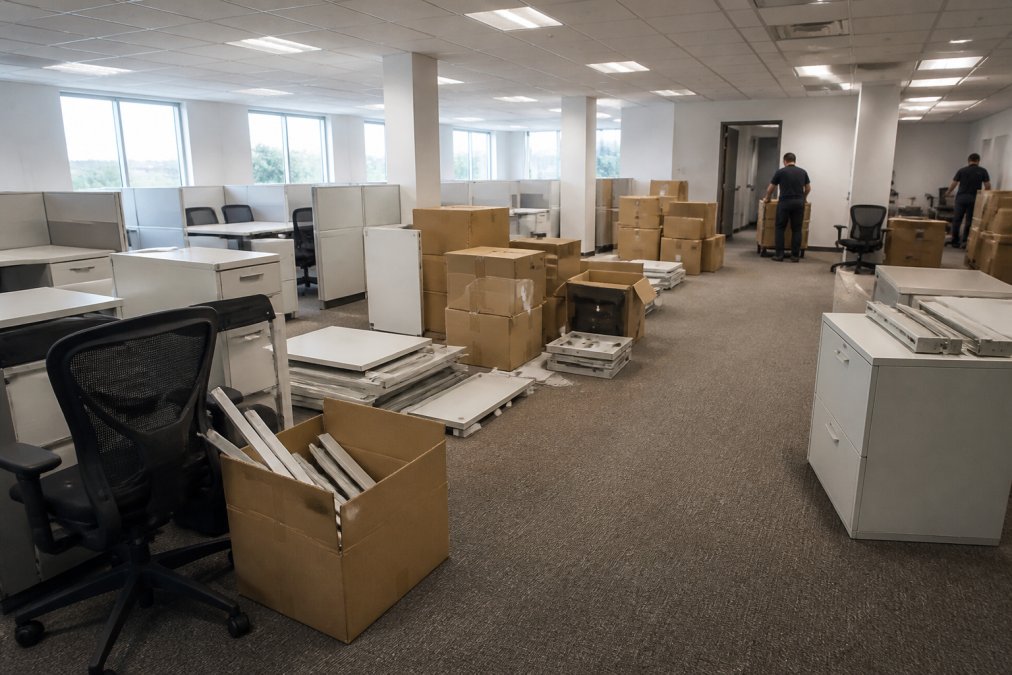
Table of Contents
- What Is Office Decommissioning?
- Office Decommissioning Checklist: Planning Your Project
- How Much Does Office Decommissioning Cost?
- Office Furniture Liquidation Services: Maximizing Asset Recovery
- Key Components of Professional Decommissioning
- Space Restoration and Lease-End Compliance
- Conclusion
- Frequently Asked Questions
Last Updated: August 31, 2026
What Is Office Decommissioning?
Office decommissioning services represent a comprehensive approach to dismantling, removing, and responsibly disposing of furniture, equipment, and assets when a business closes, relocates, downsizes, or transforms its workspace. This process goes far beyond hauling items to a landfill, it’s a strategic operation that protects your company’s interests, maximizes asset recovery, ensures environmental compliance, and meets lease obligations.
The scope typically includes furniture liquidation, workstation dismantling, data destruction, environmental compliance, space restoration, and logistics coordination. Some providers also offer asset valuation to help you understand which items have resale potential, which should be donated, and which require specialized recycling.
At Office Furniture Warehouse, we understand that closing or relocating an office is complex. Our team has spent over 35 years helping businesses navigate office transitions, transforming what could be chaotic and costly into a smooth operation that protects your budget and reputation.
The biggest mistake companies make during office decommissioning is waiting until the last minute to plan. Start conversations with decommissioning partners at least 60 days before your move-out date. This gives you time to properly inventory assets, arrange secure data destruction, and coordinate removal logistics without paying rush fees.
Office Decommissioning Checklist: Planning Your Project
A successful office decommissioning project follows a structured three-phase approach: assessment and inventory, asset disposition planning, and execution with removal.
Phase 1: Assessment and Inventory
Document every asset, from high-value items like server equipment and specialty furniture to chairs, desks, and storage units. Your inventory should include condition notes, brand information, and estimated value. Walk through each department and identify items that are still functional and potentially valuable for resale or donation. Flag anything damaged, outdated, or no longer useful. Photograph items of significant value for substantiating asset donations for tax purposes or for liquidation partners.
Pay special attention to technology infrastructure. Servers, networking equipment, computers, and printers contain sensitive company data. Identify which items need secure data destruction before leaving your facility. Also assess your space itself and take photos of any pre-existing damage to protect yourself if your landlord tries to charge you for wear that existed before decommissioning began.
Phase 2: Asset Disposition Planning
Once you understand what you have, decide what happens to each category of asset. You have several options: resale, donation, recycling, or disposal.
High-value furniture from established brands like Steelcase or Herman Miller often has strong resale markets. Gently used office chairs, desks, and filing cabinets can be sold to businesses upgrading their spaces or to institutions like schools and nonprofits. If you have significant quantities of usable furniture, resale can offset some of your decommissioning costs.
Functional items with limited resale appeal make excellent donation candidates. Many nonprofits, schools, and community organizations welcome office furniture donations, which are tax-deductible if your company itemizes deductions.
Electronics and equipment containing hazardous materials require specialized recycling. Servers, computers, monitors, fluorescent lighting, and batteries cannot go to standard landfills. Certified e-waste recyclers ensure safe processing and recovery of valuable materials like copper and precious metals.
Create a tracking document listing each asset category and its planned disposition. This becomes your action plan and ensures accountability as the project progresses.
Phase 3: Execution and Removal
Once disposition decisions are made, execution becomes a matter of logistics and coordination. Secure data destruction should happen first, followed by furniture and equipment removal, then space cleaning and restoration.
Coordinate timing carefully. If you’re still occupying the space, removal should happen in phases so operations can continue. If you’re vacating completely, you can move more aggressively. Establish clear timelines with your decommissioning partner so you know exactly when each phase will be completed. Ensure all removal crews have proper access, parking, and loading areas, and identify any items requiring special handling upfront to minimize surprises and delays.
The three-phase approach, assess, plan, execute, transforms office decommissioning from a chaotic scramble into a manageable project. Each phase builds on the previous one, and skipping or rushing any phase creates problems downstream.
How Much Does Office Decommissioning Cost?
Decommissioning expenses vary dramatically depending on your office size, the volume and type of assets being removed, your timeline, and your sustainability priorities.
Square footage determines labor hours required for removal and space restoration. A 5,000-square-foot office with modular cubicles costs significantly less than a 50,000-square-foot facility with built-in infrastructure. Asset composition matters too, removing basic office furniture is straightforward, while dismantling complex cubicle systems requires more skilled labor. Your timeline affects costs substantially; rush decommissioning requires accelerated labor and logistics, increasing expenses. Distance to recycling facilities and landfills also impacts transportation costs, particularly for heavy items.
Asset recovery can offset costs significantly. If your office contains valuable furniture or equipment with resale potential, a decommissioning partner with buyer networks can generate revenue that reduces your net expense. Some companies break even or come out ahead when asset recovery is factored in.
For accurate cost estimation, provide decommissioning partners with your office square footage, a preliminary inventory of assets, your desired move-out date, and your priorities regarding sustainability and asset recovery. Most providers offer free site assessments and quotes. When evaluating quotes, clarify what’s included, whether data destruction is included, how asset recovery revenue is handled, and what happens with items that don’t fit into resale or donation categories.
Avoid selecting a decommissioning partner based solely on the lowest bid. The cheapest option often means cutting corners on data security, environmental compliance, or space restoration quality. You could end up paying more later if your landlord withholds deposit money or if you face compliance issues from improper waste disposal.
Office Furniture Liquidation Services: Maximizing Asset Recovery
Office furniture liquidation converts surplus furniture and assets into cash or value through resale, donation, or recycling. When executed strategically, it can transform what seems like a disposal cost into a revenue opportunity.
The furniture liquidation market is strong. Businesses constantly need quality office furniture, startups furnishing new spaces, companies upgrading their environments, nonprofits outfitting facilities on tight budgets. Well-maintained furniture from established manufacturers has genuine demand. A used Steelcase task chair that cost $800 new might sell for $200-300 on the secondary market. Multiplied across dozens or hundreds of pieces, aggregate recovery can be substantial.
Professional liquidation partners understand these markets and have established networks of buyers, other businesses, office furniture retailers, online marketplaces, and institutional buyers. This network determines how quickly your inventory moves and what price it commands. The key to successful furniture liquidation is acting quickly. Furniture depreciates over time, and the longer items sit in storage, the less they’re worth. Start the liquidation process as soon as you know you’re decommissioning, and prioritize moving inventory within 30-60 days of removal.
Key Components of Professional Decommissioning
Professional office decommissioning services address several critical components that most businesses can’t handle effectively on their own.
Workstation and Cubicle Dismantling
Removing workstations and cubicle systems is far more complex than simply moving furniture. Modular cubicle systems involve interconnected panels, electrical systems, and cable management that must be carefully dismantled to preserve components for resale or reuse.
Professional dismantling requires trained crews who understand cubicle architecture and know how to safely disconnect electrical connections, remove power poles without damaging flooring, and disassemble panels in a sequence that prevents damage. They track and organize components, panels are stacked by size and color, power systems are carefully disconnected and labeled, and cable management systems are recovered. This organization makes it possible to resell components to other businesses or donate complete systems to nonprofits.
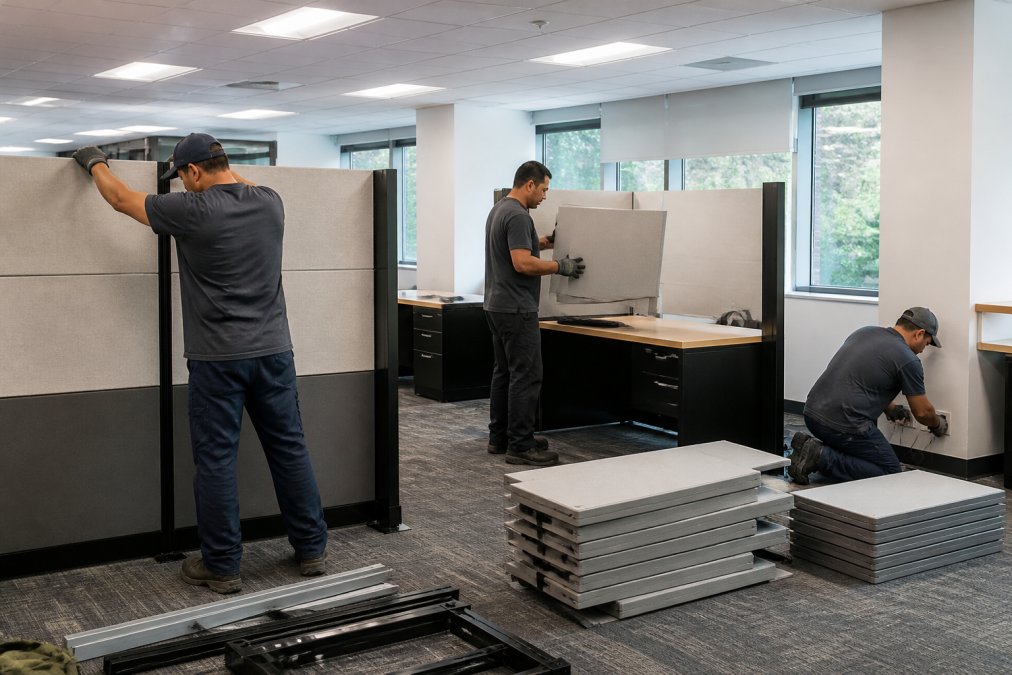
A typical crew can dismantle 8-12 workstations per day, though this varies based on system complexity and how tightly packed the space is.
Data Destruction and Confidential Document Shredding
Secure data destruction is non-negotiable during office decommissioning. Computers, servers, printers, and storage devices contain sensitive company information, customer data, financial records, and employee records. Improperly disposed of, this information becomes a liability and potential compliance violation.
Professional data destruction involves secure wiping of hard drives and storage devices using certified methods that meet NIST standards (nist.gov). This goes beyond simple deletion, it involves multiple overwrite passes that make data recovery impossible. For devices that can’t be securely wiped due to damage or age, physical destruction is performed through crushing, shredding, or incineration.
Confidential documents require similar treatment. Professional shredding services provide certification that documents were destroyed, protecting your company if questions arise later. Choose decommissioning partners who work with certified data destruction providers. Look for certifications like NAID (National Association for Information Destruction) or compliance with NIST guidelines, and request certificates of destruction for all data-bearing equipment and documents (naidonline.org).
Environmental Compliance and Recycling
Office decommissioning generates significant waste, much of which contains materials that can’t go to standard landfills. Electronics contain hazardous substances like lead, mercury, and cadmium (the EPA). Fluorescent lighting contains mercury. Batteries are hazardous. Proper handling is required by law and essential for environmental responsibility.
Professional decommissioning partners work with certified recyclers and waste management facilities that handle these materials safely. Electronics are processed through certified e-waste recyclers where components are separated, hazardous materials are safely contained, and valuable materials like copper, aluminum, and precious metals are recovered.
Many organizations track their environmental impact through landfill diversion rates, the percentage of waste diverted from landfills through recycling, reuse, and donation. ESG (Environmental, Social, and Governance) reporting increasingly requires documentation of waste management practices. Professional decommissioning services can provide detailed reporting on how your office assets were handled and the environmental impact of the project.
Space Restoration and Lease-End Compliance
When you vacate an office space, your lease typically requires that you return the space in acceptable condition, often described as “broom clean” or “in the condition it was when you took occupancy, normal wear and tear excepted.” This is where many decommissioning projects stumble.
Space restoration after office decommissioning typically includes floor cleaning, carpet cleaning, tile stripping and waxing, or hardwood restoration depending on flooring type. Walls need touch-up painting to address marks, holes, and scuffs. Ceiling tiles may need replacement if damaged or stained. HVAC systems should be inspected and cleaned. Light fixtures may need repair or replacement. Signage, shelving, and any built-in modifications need to be removed.

Work with your landlord early to understand their specific expectations for lease-end condition. Get clarity in writing so there’s no dispute when you vacate. Include these restoration requirements in your decommissioning plan and budget. Many disputes over security deposits arise because tenants underestimate restoration requirements. The cost of having the landlord’s contractors fix problems after you’ve vacated is always higher than doing the work properly before you leave.
Lease-end compliance protects your security deposit and your company’s reputation with the landlord. A properly restored space demonstrates professionalism and care, which matters if you ever need a reference for future leasing.
Conclusion
Office decommissioning services handle the complex, multifaceted work of closing or relocating office spaces responsibly and efficiently. From initial assessment through asset liquidation, data destruction, environmental compliance, and space restoration, professional decommissioning partners manage every detail so your company can focus on the business transition itself.
The stakes are high. Improper handling of data creates security and compliance risks. Neglecting environmental regulations results in legal exposure. Inadequate space restoration costs you money when landlords withhold deposits. Poor asset management leaves value on the table. Professional office decommissioning services address all of these risks systematically.
When you’re ready to decommission an office space, Office Furniture Warehouse can help. Our 35+ years of experience in the office furniture industry means we understand asset values, market conditions, and the logistics of managing large-scale furniture removal and liquidation. Whether you need guidance on planning your project, help valuing your existing furniture, or connections to professional decommissioning partners, we’re here to support your transition. Visit our Cleveland showroom or contact our team to discuss your decommissioning project and how we can help maximize your asset recovery while ensuring compliance and professional execution.
Frequently Asked Questions
What is included in professional office decommissioning services?
Professional office decommissioning services typically include site assessment, furniture and asset inventory, secure data destruction, workstation dismantling, furniture liquidation or donation, electronics recycling, space restoration, and documentation for compliance. Comprehensive providers manage project coordination, logistics, and environmental compliance to ensure all assets are handled responsibly and your space meets lease-end requirements.
How do I prepare my office space for a lease surrender using a decommissioning checklist?
Start by conducting a complete inventory of all furniture, equipment, and assets. Identify items for resale, donation, or recycling. Arrange for secure data destruction on computers and hard drives. Schedule workstation and cubicle dismantling. Coordinate logistics for furniture removal. Plan for space cleaning, repairs, and any required painting. Document the condition of the space before and after decommissioning to satisfy landlord requirements and avoid disputes.
What factors affect how much office decommissioning costs?
Costs depend on project scope, including the volume of furniture and equipment, complexity of cubicle systems, distance for transportation, whether items are liquidated versus donated, labor intensity, and any specialized services like data destruction or hazardous material handling. Geographic location and timeline also influence pricing. Request quotes from multiple providers based on your specific inventory and needs rather than assuming fixed rates.
What happens to old office furniture during decommissioning?
Decommissioned furniture typically follows multiple paths: high-quality pieces are resold through liquidation channels, usable items are donated to nonprofits and charities, and damaged or obsolete furniture is recycled or responsibly disposed of. Professional decommissioning services aim to maximize landfill diversion, often achieving 90-99% diversion rates by routing assets to the most appropriate destination based on condition and market value.
This article was written using GrandRanker
