Table of Contents
- Why Buy Used Ergonomic Office Desks
- Best Brands for Ergonomic Office Desks
- How to Inspect Used Office Furniture Before Buying
- Refurbished Standing Desks: What Sets Them Apart
- Ergonomic Features That Matter in Used Desks
- Workspace Planning: Desk Dimensions and Layout
- Shipping, Delivery, and Assembly Options
- Common Mistakes to Avoid When Buying Used
Last Updated: August 28, 2026
Why Buy Used Ergonomic Office Desks
Buying used ergonomic office desks offers premium brands at a fraction of new costs. Quality furniture from Steelcase, Herman Miller, and Haworth holds up well over time, and the secondary market is strong. At Office Furniture Warehouse, we’ve spent over 35 years sourcing pre-owned furniture, a well-maintained used ergonomic desk often performs identically to a new one while costing significantly less.
Commercial-grade furniture is built to last through multiple office cycles. New height-adjustable desks from premium brands often carry impractical price tags for growing teams. Used versions deliver identical ergonomic benefits: motorized height adjustment, stable frames, quality surfaces, and cable management, the only difference is cosmetic.
Beyond cost, there’s an environmental case. Extending furniture life reduces manufacturing waste and keeps usable products out of landfills. For companies serious about sustainability, buying refurbished standing desks aligns business needs with environmental responsibility.
The catch: you need to know what to look for. This guide walks you through evaluating used ergonomic office desks, understanding what separates quality refurbished pieces from problematic ones, and making a purchase that saves money without creating headaches.
Best Brands for Ergonomic Office Desks
When shopping for used ergonomic office desks, brand matters. Manufacturers that built reputation and longevity into their designs are the ones whose used pieces hold value and performance.
Steelcase Height Adjustable Sit-Stand Models
Steelcase desks dominate the used furniture market because they’re engineered for durability. Electric sit-stand models feature reliable motors that resist wear patterns that kill cheaper competitors. When evaluating a used Steelcase desk, focus on the motor, the part most likely to show wear. Adjustment should be quiet, smooth, and complete without hesitation or grinding sounds.
Used Steelcase sit-stand desks save substantially compared to new models, though inventory is volatile and specific configurations disappear quickly.
Herman Miller Renew Sit-to-Stand Desk
Herman Miller’s Renew line represents the premium end of the used market. These desks combine refined design with engineering that prioritizes long-term performance. Cable management is built in thoughtfully, and worksurface materials resist wear better than budget alternatives. A five-year-old Herman Miller Renew often looks and functions better than a three-year-old desk from a mid-tier brand.
Herman Miller pieces command higher prices even used, reflecting their reputation and durability. The electric height adjustment range typically spans 23"-49", accommodating many user heights.
Knoll Currents Desk (Refurbished)
Knoll’s Currents line bridges budget consciousness and design quality. Refurbished Currents desks combine modern aesthetics with genuine ergonomic adjustability and typically cost less than used Steelcase or Herman Miller, making them attractive for budget-conscious teams.
Haworth and Humanscale Options
Haworth produces reliable sit-stand desks that perform well on the used market. Their electric height-adjusting models offer flexibility for different workspace layouts.
Humanscale’s Quickstand Eco is a standing desk converter that sits on existing desks, allowing you to add sit-stand capability to furniture you already own. Used Humanscale converters are more affordable than full desks and work well for remote workers or small teams with limited budgets.
How to Inspect Used Office Furniture Before Buying
Inspecting a used ergonomic desk before purchase separates smart buyers from those who discover problems after delivery.
Visual Inspection Checklist
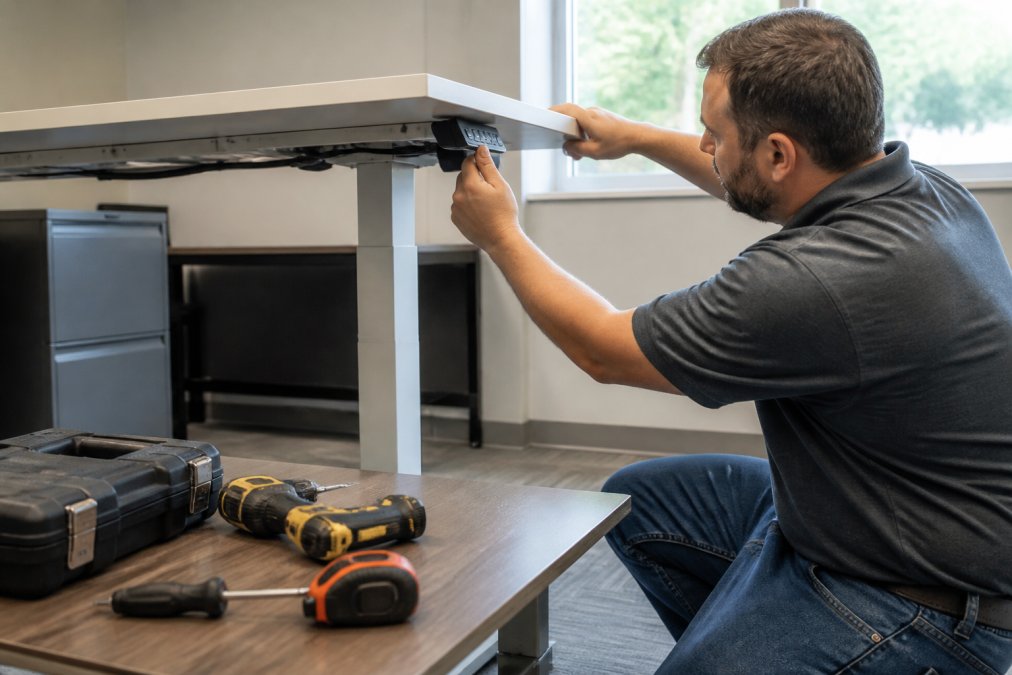
Examine the entire desk surface for damage affecting usability. Small cosmetic marks are normal; what matters is structural damage, deep gouges, water damage, or large cracks. Check the frame and legs carefully, feeling for cracks, bends, or separation.
Examine the finish. Laminate should be intact without peeling or bubbling. Paint or powder coating should be consistent without excessive chipping. Check all adjustable components; shelves, drawers, and cable trays should move smoothly without binding or excessive wobble.
Testing Height Adjustment and Stability
For height-adjustable desks, the motor is critical. Ask the seller to demonstrate the full range of motion. The desk should move smoothly from lowest to highest position without hesitation, grinding sounds, or stuttering.
Test stability at both lowest and highest positions. Place your hands on the desktop and apply downward pressure; the desk should feel rigid without wobble. Test the height range to ensure it reaches comfortable sitting height (typically 28"-30") and standing height (typically 40"-48") (osha.gov).
Verifying Condition Grade and Warranty
Reputable sellers classify condition into grades: "excellent" (minimal wear, fully functional), "good" (fully functional with minor cosmetic wear), "fair" (functional but more visible wear), or "refurbished" (professionally cleaned, inspected, and repaired).
Warranty coverage is your insurance policy. Quality sellers back used ergonomic office desks with warranties, typically 30 to 90 days covering motor function and structural defects. Ask about specifics: Does it cover the motor? The frame? Does it include labor for repairs?
Refurbished Standing Desks: What Sets Them Apart
A refurbished standing desk has been professionally inspected, cleaned, and repaired as needed. The key difference from simply "used" is professional intervention. A used desk is sold as-is; a refurbished desk has been through a quality process designed to restore it to reliable working order.
Refurbished inventory typically includes longer warranties, 90 days to one year is common. This reflects the seller’s confidence. The sustainability argument is stronger for refurbished pieces, representing intentional effort to extend product life.
Ergonomic Features That Matter in Used Desks
Not all ergonomic features are equally important. Understanding what to prioritize helps you evaluate desks effectively.
Height Adjustable Range and Motor Performance
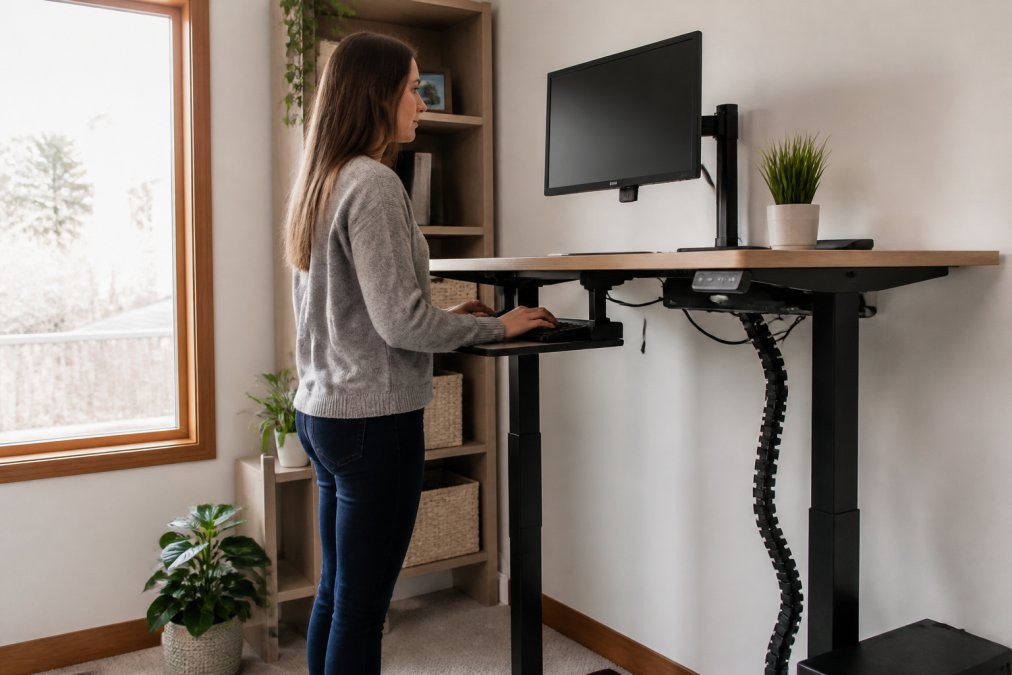
The height adjustable range determines whether the desk accommodates your team’s physical diversity. Sit-stand desks typically range from 22" to 48". Test the full range in person if possible. A motor working smoothly through the entire range is more reliable than one struggling at extremes.
The speed of adjustment matters for daily usability. Desks adjusting quickly encourage users to switch between sitting and standing throughout the day. Slow adjustment often signals a motor nearing the end of its lifespan.
Surface Material, Cable Management, and Weight Capacity
Laminate surfaces are most common and hold up well if not damaged. Inspect for water damage, which appears as swelling, discoloration, or soft spots.
Cable management built into the desk keeps cords organized and out of sight. Look for cable trays, grommets, or routing channels.
Weight capacity determines how much load the desk can safely support. Commercial-grade desks typically support 150-200 lbs (ansi.org).
Workspace Planning: Desk Dimensions and Layout
Choosing the right desk dimensions prevents the mistake of buying a piece that doesn’t fit your actual workspace.
Standard desk depths are 24" or 30". A 24" depth is tight; a 30" depth is more practical. Common widths are 48", 60", and 72". For a single user with one monitor, 48-60" is adequate; for multiple monitors or shared desks, 60-72" is more practical. Measure your actual space before shopping.
Consider the footprint in relation to your room layout. Confirm the desk will fit through doorways and in your intended location. For teams furnishing multiple workstations, consistency matters. When buying used, finding multiple units of the same model is challenging. A liquidator with substantial inventory often has multiple units available.
Shipping, Delivery, and Assembly Options
How the desk gets to you affects total cost and your experience.
Local pickup eliminates shipping costs and gets you the desk immediately. Delivery services vary in cost and reliability. Standard delivery (7-14 days) is cheaper than expedited (3-5 days). White-glove delivery (which includes assembly and placement) costs more but saves significant time and effort.
Assembly complexity depends on desk type. A simple straight desk might require 30 minutes; a height-adjustable desk typically takes 1-2 hours. Ask whether delivery includes assembly before finalizing your order.
Common Mistakes to Avoid When Buying Used
Skipping the in-person inspection. Buying sight-unseen creates risk. If possible, visit the showroom or arrange a video call where the seller demonstrates the desk’s full range of motion and stability.
Ignoring the motor. For height-adjustable desks, the motor is most likely to fail. Motors are expensive to replace, often costing $300-500 in parts and labor (peer-reviewed research).
Confusing "good condition" with "perfect condition." Used furniture shows wear. Small cosmetic marks are normal. What’s not acceptable is structural damage, water damage, or mechanical failure.
Underestimating delivery logistics. Confirm dimensions and access before ordering.
Buying without a warranty. A used desk without warranty protection is a risk. Reputable sellers back their inventory with warranties.
Choosing price over condition. A desk costing 30% less but requiring $200 in repairs isn’t a bargain. Compare total cost of ownership.
Overlooking cable management. A desk without built-in cable management is harder to keep organized.
Assuming all brands are equivalent. Steelcase, Herman Miller, Haworth, and Knoll desks hold up better and last longer than budget brands. On the used market, this difference is even more pronounced.
Buying used ergonomic office desks is a smart financial move when you know what to evaluate and where to shop. Office Furniture Warehouse’s 4-acre inventory of refurbished and pre-owned furniture gives you access to premium brands at significant discounts. Our team can help you assess condition, plan your workspace layout, and arrange delivery and assembly. Visit our Cleveland showroom to inspect desks in person, or contact us for a quote on the specific models and quantities you need.
| Feature | Priority | What to Check |
|---|---|---|
| Motor function | Critical | Smooth movement, full range, no grinding sounds |
| Frame stability | Critical | No wobble, rigid feel, no visible cracks |
| Surface condition | High | No water damage, no large gouges, finish intact |
| Height range | High | Accommodates your users’ sitting and standing heights |
| Cable management | Medium | Built-in routing, grommets, or trays present |
| Cosmetic wear | Low | Small marks acceptable; focus on structural integrity |
| Warranty coverage | High | 30+ days minimum; 90+ days preferred for peace of mind |
| Delivery options | Medium | Confirm feasibility and cost before purchase |
Common Questions About Buying Used Ergonomic Desks
How do I know a used desk will actually last? Commercial-grade desks from premium brands are built for durability across multiple office cycles. A Steelcase or Herman Miller desk that’s 5-7 years old with no mechanical problems will likely perform reliably for another 5-10 years. Test the motor and frame before purchase; if both work smoothly, the desk will last.
What’s the difference between "used," "refurbished," and "like-new"? Used means sold as-is. Refurbished means professionally inspected, cleaned, and repaired as needed. Like-new is marketing language, typically meaning refurbished with minimal visible wear. Refurbished is your safest bet because it includes professional quality control.
Will a used desk look cheap in my office? Not if you choose carefully. A used Steelcase or Herman Miller desk in good condition looks professional. What makes an office look cheap is broken furniture or visible damage. A well-maintained used desk from a premium brand looks better than a new desk from a budget manufacturer.
How much can I actually save by buying used? Savings typically range 40-70% off new pricing. A new height-adjustable desk from a premium brand might cost $1,200-1,800; a used version of the same model in good condition might cost $400-700.
What if the motor fails after I buy it? This is where warranty matters. A reputable seller backs their inventory with warranty coverage, typically 30-90 days. If the motor fails within the warranty period, the seller replaces it.
Do I need to hire someone to assemble it? It depends on the desk type and your comfort with assembly. A simple straight desk might take 30 minutes; a height-adjustable desk typically takes 1-2 hours. If you’re not comfortable with assembly, white-glove delivery is worth the cost.
Can you actually deliver to my location? Most liquidators serve a regional area. Office Furniture Warehouse serves the Midwest and beyond, with delivery and pickup options available. Confirm your location is serviceable before ordering.
Frequently Asked Questions
Is it worth buying a used ergonomic office desk?
Yes, if the desk is from a reputable brand like Steelcase, Herman Miller, or Knoll and has been properly inspected. Used ergonomic office desks typically save 40-80% compared to new models while maintaining the same durability and ergonomic features. Premium brands are built to last decades, so a well-maintained used desk performs as well as a new one. The key is verifying condition, testing the height adjustment mechanism, and confirming the warranty coverage.
What should I look for when buying a used ergonomic desk?
Check the height adjustable range (typically 22-48 inches for sit-stand models), test the motor or manual crank for smooth operation, inspect the surface for deep damage or stains, verify cable management functionality, and confirm weight capacity matches your needs. Look for minor cosmetic wear as normal for used furniture, but avoid desks with wobbly bases, non-responsive controls, or visible structural damage. Always ask about the condition grade (gently used, liquidated, or refurbished) and what warranty or guarantee applies.
Do used ergonomic desks come with warranties?
Many refurbished standing desks and used ergonomic office desks from reputable liquidators include limited warranties covering the motor, frame, and structural components. Warranty terms vary by seller and condition grade, gently used items often carry longer coverage than liquidated pieces. Always confirm warranty details in writing before purchase, including what parts are covered and how long the coverage lasts. Office Furniture Warehouse and similar retailers typically back their inspected inventory with a guarantee.
How do I know if a used ergonomic desk is in good condition?
Request the condition grade and inspection report from the seller. Gently used desks show minimal wear, while liquidated pieces may have cosmetic marks. Test the height adjustment by raising and lowering the desk, it should move smoothly without grinding sounds or jerking. Check the surface for stains, deep scratches, or damage that affects usability. Inspect the base and frame for cracks or bending, and verify all cables and controls function. If buying in person, sit at the desk and test it yourself before committing.
Where can I find high-quality pre-owned office furniture?
Liquidators and furniture retailers with large inventories, like Office Furniture Warehouse, offer inspected used desks from premium brands. Many have showrooms where you can examine pieces in person or browse online inventory with photos and condition details. Check for retailers that specialize in refurbished standing desks and offer delivery services. Reading customer reviews and confirming warranty coverage helps ensure you're buying from a trustworthy source.
ANSI/BIFMA standards for office furniture durability
Occupational Safety and Health Administration ergonomic guidelines for office workstations
Environmental Protection Agency guidance on furniture reuse and recycling
This article was written using GrandRanker
