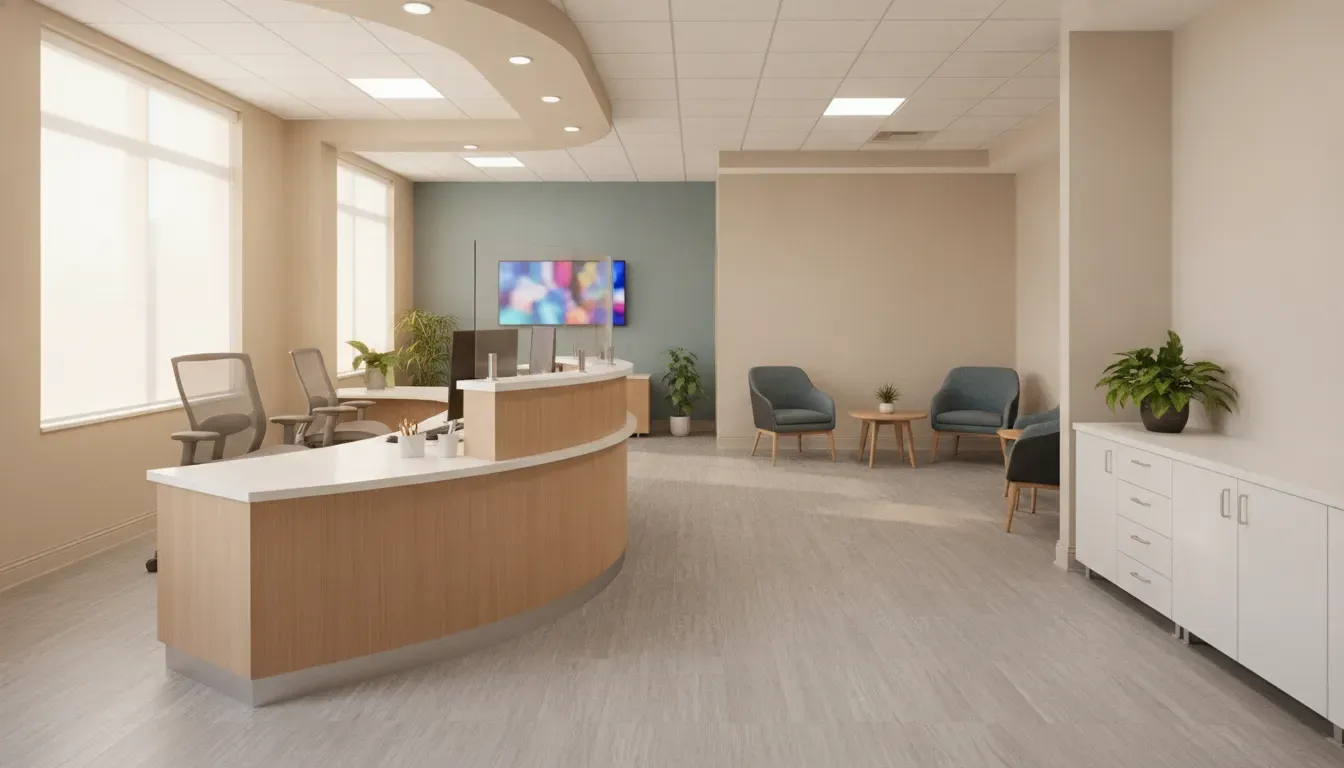
Healthcare office furniture in Cleveland, Ohio has to do more than fill a room. It needs to hold up to daily use, support staff workflow, create a calm experience for patients, and fit the practical requirements of a medical office. Office Furniture Warehouse helps Cleveland-area practices compare new and pre-owned seating, desks, workstations, reception pieces, and storage in one local showroom. For the broader project, start with the Office Furniture Services in Cleveland guide, then use this healthcare-specific checklist to plan your purchase.
Call 216-431-2700 to check current healthcare furniture availability in Cleveland.
What makes healthcare office furniture different?
A medical office may include a reception area, waiting room, exam-room support spaces, private offices, billing workstations, nurse or care-team stations, conference rooms, and break areas. Each zone has a different job. A waiting room needs comfortable, stable guest seating. An administrative workstation needs a durable work surface, organized storage, and a chair that can be adjusted for regular computer work. A reception desk needs a professional appearance while supporting check-in, phones, paperwork, and equipment.
The right selection process starts with use and traffic, not with a brand name. Ask how many people will use each piece, how often it will be cleaned, whether it must be moved, what equipment it must support, and how long the practice expects to keep it. Buying furniture that fits the actual workflow can be more valuable than buying the most expensive item in a catalog.
Healthcare furniture buying checklist for Cleveland practices
- Map each zone. List reception, waiting, administrative, clinical support, private office, conference, and storage needs separately.
- Measure before shopping. Record room dimensions, door widths, elevator constraints, power locations, and the intended circulation paths.
- Prioritize cleanability. Ask about surfaces, seams, upholstery, finish care, and the manufacturer’s cleaning instructions.
- Plan for repeated use. Choose stable frames, durable work surfaces, replaceable components when available, and seating appropriate to the traffic level.
- Check accessibility with the project team. Furniture placement affects routes, clear floor space, counter use, and approach to doors and equipment. The facility’s architect, contractor, or accessibility professional should confirm the final layout.
- Confirm delivery details. A complete quote should address delivery, assembly, installation, packaging removal, staging, and any site restrictions.
- Verify current inventory. Pre-owned inventory changes frequently. Ask the showroom to confirm the exact model, condition, quantity, and availability before making a room plan around it.
Durable seating for medical office waiting rooms and staff areas
Waiting-room seating is one of the most visible choices in a healthcare office. Look for chairs that feel stable when patients sit down or stand up, are sized appropriately for the space, and can be maintained using the practice’s cleaning process. A mix of single chairs, guest chairs, and small lounge pieces may work better than one large configuration when the room needs to accommodate different visit patterns.
Staff seating has a different requirement. Administrative teams may spend most of the day at a computer, so adjustable task chairs and properly sized work surfaces matter. Use the OSHA computer workstation guidance as a useful ergonomic reference. OSHA explains that computer workstation concerns are primarily ergonomic and that there is no single OSHA standard specifically for computer workstations. That distinction matters: furniture can support a sound setup, but it cannot replace a workplace assessment or a practice’s safety process.
For a Cleveland practice comparing pre-owned seating, inspect the chair in person. Check the base, casters, arms, controls, seat and back condition, upholstery, and overall stability. A reputable local showroom lets the buyer test fit and condition instead of relying only on a product photograph. Browse the current office seating category for examples, then call before visiting if a specific quantity or model is important.
Reception desks and workstations for medical offices
Reception furniture has to balance public-facing appearance with practical work. Consider the height of the transaction surface, privacy at the desk, placement of phones and monitors, storage for active files, and the amount of space needed for staff movement. A curved or modular reception configuration may make sense in a larger lobby, while a compact desk and separate storage may be easier to fit in a smaller neighborhood practice.
Administrative workstations should support the actual tasks performed there. A billing team may need generous work surfaces and organized storage. A scheduling area may need multiple monitors and cable management. A practice manager’s office may require a desk, guest chairs, and a small meeting area. Do not assume that a workstation built for a corporate office automatically fits a healthcare workflow. Measure equipment and plan the room before choosing the furniture.
Office Furniture Warehouse’s desk inventory includes new and pre-owned desks in multiple sizes and configurations. Product examples in the current customer catalog include compact table desks, laminate desks, electric standing desks, and larger executive or L-shaped configurations. Product prices and inventory can change, so use catalog examples as starting points rather than a promise of current stock.
How much does healthcare office furniture cost?
Healthcare office furniture pricing depends on the piece, size, brand, condition, quantity, finish, and whether delivery or installation is included. A useful budget separates individual furniture costs from project costs such as space planning, delivery, assembly, electrical work, construction, and accessibility modifications.
Current Office Furniture Warehouse catalog examples show how wide the range can be. Seating examples include a Steelcase Cobi chair listed at $169, a Steelcase Amia chair at $349, and a Haworth Fern chair at $599. Desk examples include a 48-inch by 24-inch table desk listed at $199, a new 30-inch by 60-inch laminate desk at $695, and a new electric standing desk at $999. These are customer-supplied catalog examples, not a quote for a healthcare project, and used or clearance inventory can change without notice.
For a multi-room project, compare the cost of a complete usable setup rather than focusing on the lowest unit price. A lower-priced chair that does not fit the user or withstand the expected traffic may cost more to replace. Conversely, a sound pre-owned commercial chair or desk may provide a practical way to furnish a new office while preserving budget for installation, technology, or clinical equipment.
New versus pre-owned furniture for a Cleveland medical office
| Option | Best fit | What to verify |
|---|---|---|
| New furniture | Projects needing consistent finishes, larger quantities, or a specific configuration | Lead time, specifications, finish, warranty terms, delivery, and installation scope |
| Pre-owned commercial furniture | Practices furnishing quickly, adding workstations, or controlling project cost | Exact condition, quantity, dimensions, cleaning process, components, and current availability |
| Mixed plan | Projects that need a polished reception area plus practical staff workstations | Color and finish coordination, room measurements, and a unified delivery schedule |
Brand comparison should also be practical. Herman Miller, Steelcase, Haworth, HON, and other commercial manufacturers may appear in new and pre-owned inventory, but the best choice depends on the exact model, fit, condition, quantity, and use case. Ask to compare specific pieces side by side. A local showroom is especially useful when several staff members need to test chairs or when a buyer wants to coordinate desks, guest seating, and storage in the same visit.
What does compliant healthcare furniture planning involve?
Furniture alone does not make a medical office HIPAA-compliant, ADA-compliant, or compliant with an infection-control program. Those requirements depend on the facility, services, construction, policies, equipment, and applicable laws. Treat furniture selection as one part of a larger project and ask the practice’s architect, contractor, facilities lead, and compliance or infection-control professionals to approve the final plan.
For accessibility planning, review the U.S. Department of Justice 2010 ADA Standards and have the project team apply the requirements to the facility. Furniture placement should not narrow an accessible route, block required clear floor space, or create an avoidable barrier at a counter or workstation. The exact dimensions and scoping requirements depend on the project, so do not use a furniture article as a substitute for professional design review.
For cleaning, ask whether the proposed material and finish can be maintained using the practice’s approved products and procedures. The CDC environmental cleaning guidance emphasizes risk-based cleaning procedures and attention to high-touch surfaces. The practice’s infection-control team should decide what is appropriate for each area. Follow the furniture manufacturer’s instructions and avoid assuming that a material is suitable for every clinical setting.
Delivery and installation across Northeast Ohio
A medical-office furniture project does not end when the order is placed. Delivery may need to be coordinated around patient hours, building access, elevators, loading zones, construction schedules, and equipment installation. Before scheduling, share the site address, floor, access limitations, receiving rules, and any requirement for staging or packaging removal.
Office Furniture Warehouse provides delivery, setup, and installation services across Northeast Ohio, including Cleveland, Akron, Canton, and surrounding counties. Its local facility at 4100 Payne Avenue gives buyers a place to inspect furniture and discuss a project before scheduling the next step. For a broader overview of planning, delivery, rental, refinishing, and liquidation, review the Office Furniture Services page and the Cleveland office furniture services guide.
Talk with the Cleveland showroom about your healthcare furniture project and current availability.
For a multi-room clinic or administrative office, ask for a written scope that separates furniture, delivery, assembly, installation, and any work that must be completed by another contractor. Confirm quantities and room assignments before delivery. This makes it easier to catch a measurement issue before furniture arrives and gives the installation team a clear sequence.
Why shop locally for healthcare office furniture in Cleveland?
Online shopping can be useful for researching styles, but local inspection is valuable when condition, fit, quantity, and timing matter. Office Furniture Warehouse has served Northeast Ohio for more than 35 years and operates a large Cleveland showroom and warehouse. Buyers can compare new and pre-owned options, test seating, inspect finishes, ask about current inventory, and discuss delivery instead of guessing from a listing.
The showroom is located at 4100 Payne Avenue in Cleveland. If you are furnishing a new practice, renovating a waiting room, adding administrative staff, or replacing worn workstations, bring room measurements and a list of required quantities. The team can help narrow the options and identify what needs confirmation from your facility or compliance professionals.
Healthcare office furniture FAQ
What furniture does a medical office usually need?
Most projects consider reception furniture, waiting-room seating, administrative desks or workstations, task chairs, guest chairs, storage, filing, conference furniture, and break-room pieces. The exact list depends on the practice’s services, staff, patient flow, equipment, and rooms.
Is pre-owned office furniture appropriate for a healthcare office?
Pre-owned commercial furniture may be appropriate when its condition, materials, cleanability, dimensions, quantity, and intended use fit the practice’s requirements. Inspect each piece, confirm the cleaning process with the facility team, and verify current availability before planning around it.
Does healthcare furniture need to be HIPAA-compliant?
Furniture is not, by itself, HIPAA-compliant. HIPAA obligations involve how a covered entity protects health information and operates its facility and systems. Work with the practice’s privacy, compliance, facilities, and design professionals to address privacy and workflow requirements.
Can Office Furniture Warehouse deliver healthcare furniture in Northeast Ohio?
Office Furniture Warehouse provides delivery, setup, and installation services across Northeast Ohio, including Cleveland, Akron, Canton, and surrounding counties. Confirm the scope, timing, access requirements, and current availability with the team before ordering.
How should a Cleveland medical office start a furniture project?
Start with a room list, measurements, required quantities, workflow notes, and a target move or opening date. Then visit the Cleveland showroom or call to compare new and pre-owned options and discuss delivery. Have the project architect, contractor, accessibility professional, and infection-control team review any requirements that go beyond furniture selection.
