
Table of Contents
- What a Used Office Furniture Warranty Actually Covers
- Office Furniture Warranty Duration: What to Expect
- Original Purchaser Rules and Non-Transferable Clauses
- As-Is vs Refurbished Office Furniture: How Coverage Differs
- How to Inspect Used Office Chairs Before You Buy
- Filing a Claim: Documentation, Third-Party Providers, and Success Rates
- Frequently Asked Questions
Last Updated: September 12, 2026
What a Used Office Furniture Warranty Actually Covers
A used office furniture warranty is a written guarantee covering defects in materials and workmanship present at purchase, not normal wear from daily use. This guide breaks down what those policies protect, what they exclude, and how to spot marketing language before you sign.
Most buyers assume a warranty on pre-owned furniture works like a new-car warranty. It doesn’t, the typical policy is narrower, shorter, and more conditional than the paperwork suggests.
Defects in Materials and Workmanship
Coverage generally applies to manufacturing defects, failures tracing back to how the piece was built, not how it was treated. A gas cylinder that loses height adjustment after two months or a desk surface that delaminates without spill or impact points to a defect. Those claims get approved.
Workmanship covers assembly and finishing errors: a separating weld, stitching pulling apart at a seam, a misaligned drawer glide. It does not cover anything that happened after the item left the factory floor, including everything the previous owner did to it.
What Standard Policies Exclude
Exclusions are where most disputes start. Nearly every used furniture warranty excludes:
- Wear and tear from normal use, including compressed foam and scuffed arms
- Upholstery damage such as stains, tears, fading, or pilling
- Shipping damage once the item has been accepted
- Labor costs for removal, repair, or reinstallation
- Modifications made by the buyer, including aftermarket casters or arms
- Improper use beyond the manufacturer’s rated weight or commercial grade
The single most common claim mistake is filing for upholstery damage. Stains, tears, and fading are almost universally excluded because they result from use, not from a defect. Filing that claim wastes your window and puts your documentation under scrutiny for no reason.
Office Furniture Warranty Duration: What to Expect
The standard warranty period on used office furniture runs 30 to 90 days from purchase, though terms vary by seller and whether the piece was refurbished (consumer.ftc.gov). A limited lifetime warranty on a specific component, usually the frame or structural base, is common on premium brands, and is not a full lifetime guarantee.
That distinction trips up buyers: a chair advertised with a lifetime warranty may carry that term only on the frame, while the gas cylinder, casters, and upholstery fall under a shorter window or no coverage.
Limited Lifetime vs. Standard Terms
Here’s how the two compare in practice:
| Warranty Type | Typical Duration | What It Covers | Best For |
|---|---|---|---|
| Standard used-furniture warranty | 30-90 days | Defects in materials and workmanship | Budget buyers, single pieces |
| Limited lifetime | Frame or base only, original purchaser | Structural integrity, welds | High-use seating, premium brands |
| Extended coverage | 1-3 years, purchased separately | Broader component coverage | Fleets of 10+ workstations |
| As-is | None | Nothing | Buyers who inspect in person |
Read the component list, not the headline. A “lifetime” claim on a chair frame tells you nothing about the parts that actually fail.
Original Purchaser Rules and Non-Transferable Clauses
Most warranties are non-transferable: coverage applies only to the original purchaser and expires the moment the item changes hands. This clause makes buying used furniture genuinely risky, and sellers mention it least.
When you buy from a dealer rather than a private seller, the dealer often becomes the original purchaser and passes along its own warranty, which is why dealer-backed coverage is usually stronger. Ask directly: is this the manufacturer’s warranty, or yours?
The manufacturer’s warranty almost never survives a resale. What you’re actually buying is the dealer’s own guarantee, so evaluate the dealer’s terms, not the brand on the chair.
As-Is vs Refurbished Office Furniture: How Coverage Differs
As-is and refurbished furniture sit at opposite ends of the coverage spectrum, and the price gap reflects that. The difference isn’t just whether a seller promises anything, it’s which default legal protections apply when they don’t.
As-is means the seller makes no promises about condition. Under the Uniform Commercial Code, adopted in some form by every state except Louisiana, a seller can disclaim the implied warranty of merchantability only if the disclaimer is conspicuous and in writing, typically “as is” or “with all faults” in the contract or invoice. A verbal “you’re buying it as-is” at the loading dock does not do it. Without a written disclaimer, the implied warranty of merchantability may still apply, meaning goods must be fit for their ordinary purpose, your fallback when no express warranty exists.
Refurbished means the seller replaced worn components, reupholstered seating, and tested control mechanisms. Because the seller touched the product, refurbished pieces typically carry an express warranty, often 90 days to one year, and the seller cannot easily disclaim the implied warranty on parts it replaced.
Most buyers land in the middle: a piece sold as “pre-owned, inspected” may include a short guarantee on function only, gas cylinder and tilt mechanism, nothing cosmetic. That’s reasonable if the price reflects it, but ask whether the inspection was documented and whether the seller will share the report.
Federal law backs you here. The FTC’s Used Merchandise and Warranty Guidance requires that warranty terms be disclosed before purchase, so a seller who won’t put the terms in writing is telling you something. The FTC’s Used Merchandise rule also requires that used goods be clearly marked as used, and that any warranty terms be available for review before sale.
An as-is sale is only as-is if the disclaimer is in writing and conspicuous. If the invoice doesn’t say it, the implied warranty of merchantability may still protect you, and that warranty covers fitness for ordinary use, not just manufacturing defects.
How to Tell If a Seller’s Warranty Is Real or Marketing
A warranty is only as good as the seller’s willingness to honor it. Before you buy, check:
- Is it in writing? A warranty that exists only in a sales conversation is not a warranty. Ask for the terms on paper or in the invoice.
- Who is the warrantor? The manufacturer, the dealer, or a third party? Each has different incentives and different ability to source parts.
- What is the remedy? Repair, replacement, or refund? A warranty that promises only “repair” on a discontinued model is worth little.
- What voids it? Many dealer warranties void if you move the furniture yourself, use a non-approved technician, or fail to report a defect within a set window.
- Is there a claims deadline? Some policies require written notice within 10 days of discovering a defect. Miss it and the claim is denied regardless of merit.
A legitimate warranty names the warrantor, states the duration and remedy, lists exclusions, and explains how to file. If any of those are missing, treat the coverage as marketing language.
How to Inspect Used Office Chairs Before You Buy
Inspection is your real warranty. A chair that passes a hands-on check today beats a 90-day guarantee on a piece you never examined. Bring this checklist to any showroom or pickup.
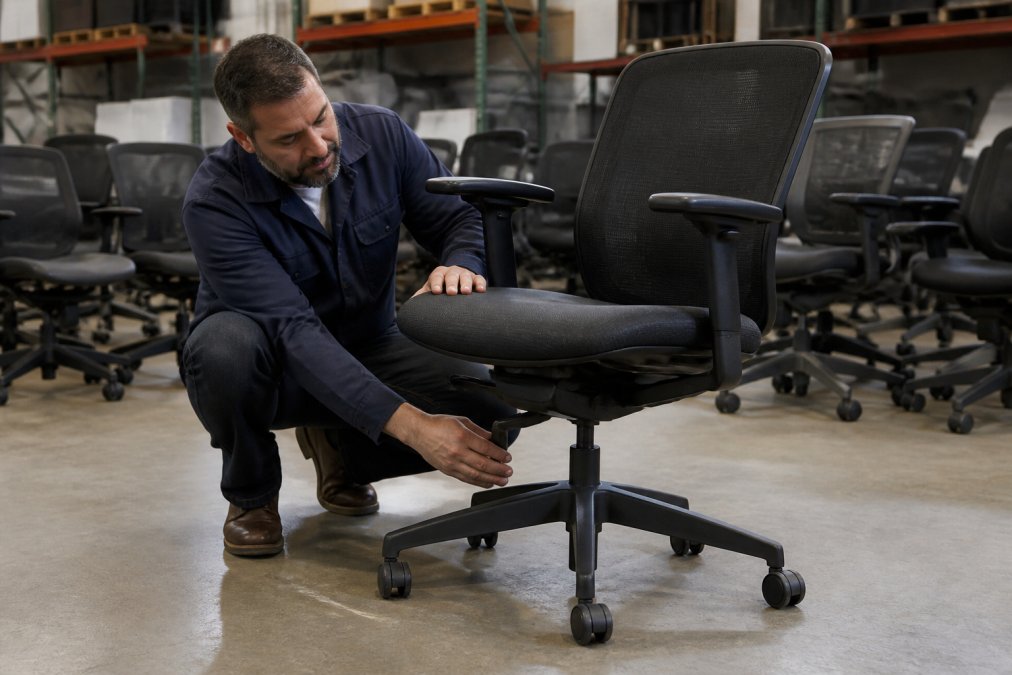
A 10-Point Inspection Checklist
- Sit and adjust height through the full range; listen for grinding
- Test the tilt tension and lock mechanism at every setting
- Rock the chair side to side to check base and caster play
- Spin each caster; replace any that wobble or drag
- Press the seat cushion edges for collapsed or uneven foam
- Run a hand along the seat and back seams for separation
- Check armrests for cracks at the mounting point
- Inspect the frame welds under the seat for cracks or rust
- Confirm the cylinder holds height under your full weight for a minute
- Ask for the date of purchase and any product registration on file
Do the cylinder test last, after you’ve been sitting for a few minutes. A failing gas cylinder often holds height when cold and sinks once the chair warms up, so a quick test misses it.
Filing a Claim: Documentation, Third-Party Providers, and Success Rates
A claim succeeds or fails on paperwork. Sellers consistently require proof of purchase, a date of purchase, photos of the defect, and often the original product registration or order number. Without those, even a legitimate defect gets denied.
Proof of purchase is the single biggest reason used-furniture claims fail. Unlike a new-goods buyer with a retailer receipt, a used buyer often has only a handwritten invoice, a text confirmation, or nothing. Buying from a dealer? Ask for a formal invoice listing the item, serial number if available, purchase date, and warranty terms. Buying from a private seller? Write a simple bill of sale and have both parties sign it, that document is your proof of purchase.
The sequence matters:
- Photograph the defect from multiple angles, including the full piece
- Locate your invoice or order confirmation
- Contact the seller in writing, not by phone
- State the defect and the date it appeared
- Request a specific remedy: replacement part, repair, or refund
Keep it in writing. Verbal promises about replacement parts or labor costs are worth nothing when the seller changes staff, dealers often honor claims verbally until the original salesperson leaves, then deny everything undocumented.
Working With Third-Party Warranty Providers
Third-party warranty companies sell extended coverage on furniture like they do on appliances. These plans can make sense for a fleet of 15 or more workstations where one failed cylinder means real disruption, but they carry their own exclusions, waiting periods, and claim submission requirements, often stricter than the dealer’s.
Before buying one, check five things:
- Who authorizes the repair? Some plans require pre-authorization before any work is done. If you call a technician first, the claim is denied.
- Must you use their technician? If so, you are limited to their network and their scheduling.
- What happens if the part is discontinued? A plan that requires an out-of-production part is a plan that will deny your claim.
- Is there a waiting period? Many plans exclude claims filed within the first 30 or 60 days, which is exactly when a hidden defect surfaces.
- What is the claims success rate? Ask the provider for their denial rate and their average time to resolution. A provider that won’t share those numbers is telling you something.
A plan that costs more than 15 percent of the furniture’s purchase price is usually a poor value for used goods, because the furniture’s replacement cost is already low.
Legal Rights for Used Goods
On legal rights, the FTC’s guidance on warranties and guarantees confirms that implied warranties, including merchantability, apply to used goods in most states unless the seller explicitly sells “as is” in writing. That is your fallback when a written warranty falls short.
The Magnuson-Moss Warranty Act also matters. It doesn’t require a seller to offer a warranty, but if one is offered on a consumer product, the Act requires it be labeled full or limited and the terms be available before purchase.
Do not assume a manufacturer’s warranty survives the resale. In most cases it does not. What you are enforcing is the dealer’s warranty or your state’s implied warranty, not the brand’s original policy.
How to Improve Your Claim Success Rate
Claims succeed when the buyer documents the defect with dated photos, reports it in writing within the warranty window, and requests a specific remedy rather than a vague “fix it.” They fail when the buyer reports verbally, waits until the last week of coverage, or asks for a refund when the warranty only promises repair.
If a claim is denied, ask for the denial in writing and cite the specific warranty clause the seller relies on. A seller who can’t point to a clause is often willing to negotiate. If they still refuse, your state attorney general’s consumer protection division may be a resource for a written warranty that was not honored.
Frequently Asked Questions
Does a warranty on used office furniture mean free replacement?
Not usually. Most used office furniture warranty policies cover repair or replacement of defective components, and manufacturers decide which option applies. Labor costs, shipping, and wear-and-tear damage are commonly excluded, so a failed gas cylinder might be replaced with a part while you pay for installation. Ask the dealer to put in writing whether replacement parts, labor, and return shipping are covered before you buy.
What are the common limitations of used office furniture warranties?
Typical limitations include non-transferable clauses that void coverage when furniture changes hands, proof of purchase and product registration requirements, exclusions for wear and tear and as-is condition items, and shipping exclusions on replacement parts. Commercial grade furniture used in high-traffic settings may also fall outside standard coverage. Read the warranty limitations section carefully and confirm the date of purchase will be documented on your invoice.
Are warranties on refurbished furniture different from as-is furniture?
Yes, and the difference matters. Refurbished pieces are usually stripped down, with worn components replaced and control mechanisms, upholstery, and structural integrity checked before resale, so dealers can offer a limited warranty on them. As-is furniture sells in its current condition with no coverage, which is why the price is lower. If long-term reliability matters, refurbished with a written warranty is usually the safer purchase.
What should I look for in a dealer’s warranty policy?
Check five things: the standard warranty period, whether it is a limited lifetime warranty or a fixed term, who qualifies as the original purchaser, what counts as a manufacturing defect versus wear and tear, and how claim submission works. Also confirm whether the dealer is an authorized dealer for brands like Steelcase or Herman Miller, since that affects access to replacement parts and service over the product lifecycle.
